
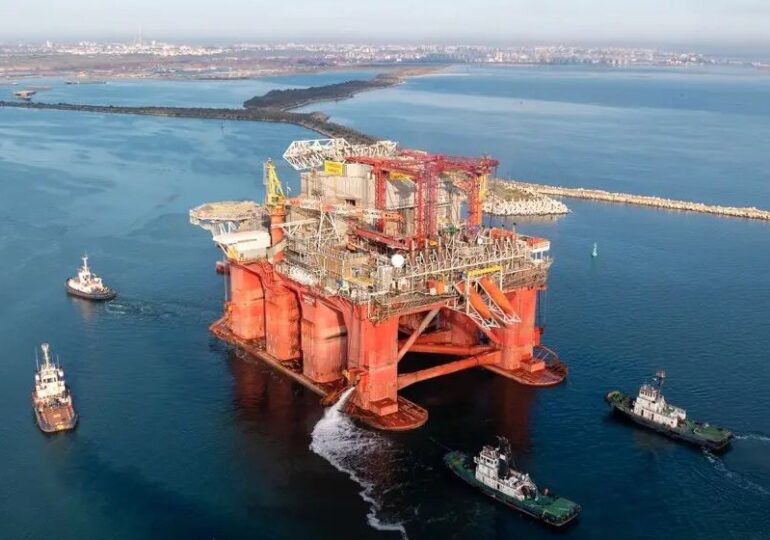
The development of the Neptun Deep project, the most significant energy investment currently in preparation in Romania, brings to the forefront an uncomfortable question: who would defend the energy platforms and infrastructures in the Black Sea in case of an attack, sabotage, or major incident?
The President of the Smart Energy Association (AEI), Dumitru Chisăliță, warns that Romania currently lacks a single structure responsible for the protection of offshore energy infrastructures and for coordinating the response in crisis situations.
His analysis comes at a sensitive time, just one day after the explosion of a maritime drone in the Port of Constanța, an incident that has reignited discussions about the security vulnerabilities in the Black Sea.
Many institutions involved, but no single responsible entity
According to Dumitru Chisăliță, the security of offshore platforms is theoretically ensured by a set of institutions and structures with partial responsibilities.
These include the operator of the facilities - in the case of Neptun Deep, OMV Petrom - private security firms, the Naval Forces and the Romanian Air Forces, intelligence services, the Ministry of Internal Affairs, the Border Police, and the Romanian Naval Authority.
However, the issue is that none of these institutions have as their main and exclusive mission the protection of energy infrastructures.
"There is no institution whose main and/or exclusive mission is the defense of offshore and/or onshore energy infrastructures and the coordination of ensuring Romania's energy security," said the AEI president.
Why Neptun Deep is a special case
Chisăliță points out that the future Neptun Deep field raises additional security issues because it is not located in Romania's territorial waters.
The platforms and installations will be located approximately 170 kilometers from the shore, in Romania's Exclusive Economic Zone (EEZ).
"Neptun Deep is not in Romania's territorial waters, but in Romania's Exclusive Economic Zone. In territorial waters (12 nautical miles from the coast), Romania exercises full sovereignty, similar to national territory. In the Exclusive Economic Zone, Romania does not have territorial sovereignty but sovereign rights over resources and economic infrastructures, including hydrocarbon exploitation and offshore installations," explains the specialist.
For this reason, he says, defending such infrastructure is much more complicated both legally and militarily than protecting an objective located on national territory.
The scenario that could hinder the state's response
The expert describes a scenario in which a threat to energy infrastructure would require the simultaneous intervention of multiple institutions.
The risks listed include maritime drone attacks, sabotage of submarine pipelines, direct attacks on production platforms, hybrid operations against critical infrastructure, or even large-scale power outages.
"If tomorrow were to happen: a maritime drone attack; sabotage of submarine pipelines; an attack on production platforms; a hybrid operation against critical infrastructure; a blackout, the theoretical response would involve simultaneously the Naval Forces, the Air Forces, intelligence services, the Ministry of Energy, economic operators, and other state structures," says Chisăliță.
However, his conclusion is a pessimistic one. "In reality, we would probably have a collective stumble. There is no single command dedicated to energy security that permanently coordinates these capabilities," he warns.
Norway and the UK's model
In the specialist's opinion, the start of production at Neptun Deep will compel Romania to change its approach regarding energy security. He believes that the current concept of general maritime space surveillance is no longer sufficient to protect strategic investments worth billions of euros.
"Romania will probably have to move from the current general concept of 'general maritime space surveillance' to a pragmatic concept of permanent protection of energy infrastructures, similar to the models used by Norway or the United Kingdom for platforms in the North Sea," says Chisăliță.
A ten-year-old proposal
The AEI President recalls that the organization he leads proposed back in 2016 the establishment of a dedicated structure for coordinating energy security.
"In fact, the question 'Who defends the gas platforms in the Black Sea?' highlights Romania's significant vulnerability, which can be eliminated by the proposal put forward by the Smart Energy Association to the Romanian Government in 2016, to establish the National Energy Security Dispatch, an independent institution under government coordination," said Dumitru Chisăliță.
The Neptun Deep project, developed by OMV Petrom and Romgaz, is considered the key to transforming Romania into the main natural gas producer in the European Union in the coming years. Therefore, the expert says, the discussion on who and how these infrastructures are defended becomes a matter of national security.