
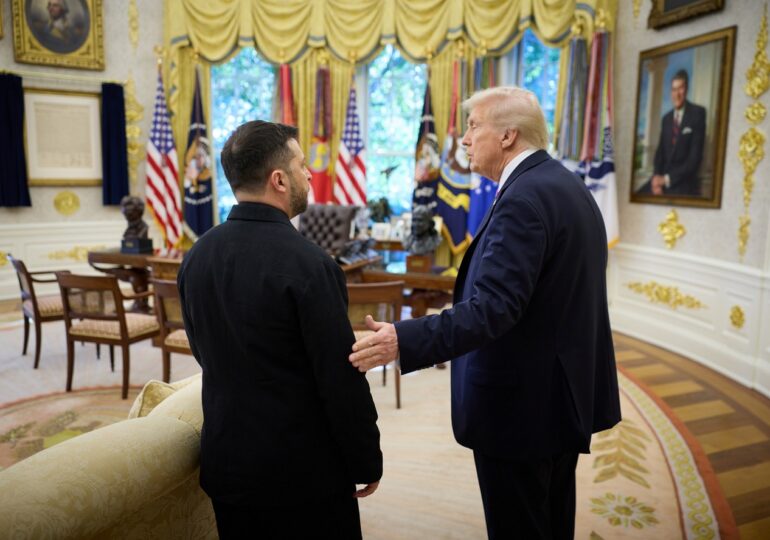
A week ago, President Volodymyr Zelensky returned to Washington for a considerably more cordial meeting with American President Donald Trump than the one in the Oval Office in February 2025, when Trump and Vice President JD Vance publicly confronted the Ukrainian leader.
The visit was initially presented as a success, reflecting a significant improvement in the relationship between Zelensky and Trump. However, conflicting signals have since emerged.
Most importantly, Trump stated that he had not definitively agreed to allow Ukraine to produce Patriot interceptors, although he had previously seemed to have made this commitment. At the same time, he rejected Zelensky's request for an emergency package with 300 Patriot missiles.
The issue is becoming increasingly pressing. Russia continues to attack Ukraine almost daily, and Kyiv is bearing a particularly heavy price.
On July 31, Russia launched 35 missiles at Ukraine – including 27 ballistic missiles – and 185 drones. However, only one ballistic missile was intercepted, and 10 people were killed in Kyiv.
Kyiv Post analyzes the outcomes of the visit to Washington and the unresolved issues.
A Different Meeting at the White House
Zelensky traveled to Washington primarily to attend the funeral of Republican Senator Lindsey Graham, who unexpectedly passed away on July 11.
Graham had been one of the most influential supporters of Ukraine in Congress and one of Trump's closest allies in foreign policy. He had visited Ukraine numerous times after the onset of the large-scale Russian invasion, including a final visit to Kyiv one day before his death.
The funeral provided Zelensky with an opportunity to return to Washington at a time when his relationship with Trump was already improving.
This change was also felt within the MAGA movement. Influential conservative commentator Laura Loomer visited Kyiv shortly before Zelensky's visit, interviewed him, and publicly retracted much of her previous criticism of Ukraine.
Unlike the previous public confrontations between the two leaders, the meeting on July 28 took place in private and ended without reproach. According to the Ukrainian Presidential Office, discussions focused on anti-aircraft defense, sanctions, and efforts to restart diplomacy with Russia.
Lockheed Martin and Ukraine's New Strategy
During the visit, Zelensky also met with representatives of Lockheed Martin, the company that produces PAC-3 Patriot interceptors, ATACMS missiles, HIMARS systems, and F-16 aircraft.
According to the Presidential Office, the two parties discussed joint production, technology transfer, Patriot capabilities, and other defense systems. Their teams are working on concrete proposals to start co-production as soon as possible.
However, no contracts, funding methods, production locations, or implementation schedules have been announced.
The meeting nevertheless reflected a significant shift in Ukraine's approach to Washington. Kyiv is increasingly trying to present itself not only as a recipient of American weaponry but also as a potential partner in the defense industry.
Ukraine has extensive experience in drone warfare and electronic warfare, as well as in adapting Western systems to a constantly evolving conflict. It has also agreed to export drones to the US for participation in the Pentagon's Drone Dominance program, as part of the extended defense cooperation between the two countries.
The Pentagon has acknowledged that the US is still years behind Ukraine's drone production capacity in wartime conditions. It is estimated that Ukraine will produce between 6 and 7 million small FPV drones in 2026, while the US will have ordered less than 200,000 by February.
Congress Sends the Strongest Signal
The most concrete political result of the visit came from the Senate. Zelensky met with over 60 senators before attending the vote in which the Senate, with 86 votes in favor and 12 against, decided to advance the Lindsey O. Graham Sanctioning Russia and Iran Act bill.
The law would authorize sanctions against Russian officials and allow Trump to impose tariffs of up to 100% on major purchasers of Russian energy. It would also target states that help Moscow evade existing sanctions and extend sanctions against Iran.
The vote represented one of the strongest bipartisan demonstrations of support for Ukraine since Trump's return to the White House.
However, it was just a procedural vote. The bill must go through other stages in the Senate before reaching the House of Representatives, which is not expected to consider it before resuming activities in September.
The prospects of the law have also become more uncertain after Zelensky's visit. Democrats and some Republicans have expressed concerns that the tariff provisions would give Trump excessive powers and could affect US allies.
As of August 4, the Senate had not yet finalized the legislative procedure, and Reuters reported that the dispute could block the bill in Congress.
Diplomacy Returns, Without Decisive Progress
Trump and Zelensky also discussed resuming negotiations with Russia. American envoys Steve Witkoff and Jared Kushner are expected to make their first visit to Ukraine later this month, after numerous trips to Moscow and meetings with Russian President Vladimir Putin.
A final date has not been announced, but reports suggest that the visit could take place in the second half of August, possibly around Ukraine's Independence Day. If realized, this would give the two envoys their first direct contact with war-torn Ukraine after months of dialogue with Moscow.
Ukraine has once again proposed a ceasefire along the current front line and using the armistice as a starting point for negotiations.
However, there are no indications that Russia has accepted this proposal or abandoned its broader territorial and political claims.
There are also reports that the Trump administration is working on new proposals to relaunch peace efforts this fall. Trump is considering using the UN General Assembly session in September for multilateral meetings if there are concrete diplomatic progress in the coming weeks, making the planned visit to Kyiv particularly important.
Secretary of State Marco Rubio confirmed that Trump has instructed his foreign policy team to seek ways to resume negotiations.
"The President told his team: if you see an opportunity to boost peace negotiations, let's take advantage of it," Rubio told Fox News.
Was the Visit a Success, Then?
A week later, Zelensky's visit seems to have been neither a complete success nor a failure.
The Trump administration has largely moved away from announcing direct arms packages for Kyiv. Instead, European allies and other partners are acquiring American weapons for Ukraine through the NATO Prioritized Ukraine Requirements List (PURL).
This mechanism has become essential for Ukraine's anti-aircraft defense.
In this context, the main question is what will happen with the proposed agreement on producing Patriot interceptors, presented as the main outcome of the defense sector visit.
After the meeting at the White House, the Ukrainian Presidential Office stated that the leaders discussed implementing Trump's decision to grant Ukraine licenses for manufacturing Patriot interceptors – an idea Trump first proposed at the NATO summit in Ankara.
Zelensky expressed even more confidence in an interview later with Fox News, stating that Trump "agreed to grant us the licenses."
However, three days later, Trump disputed this version. The American President said that Washington had not approved production in Ukraine and described the transfer of Patriot technology as an important and potentially risky step.
"It's hard to offer that kind of technology," Trump stated.
Even if Washington eventually approves the license, production will not immediately address Ukraine's interceptor shortfall for anti-aircraft defense.
Olha Stefanishyna, Ukraine's recently resigned ambassador to the US, stated that producing PAC-3 interceptors could take between 12 months and five years.
Therefore, Kyiv is also discussing a long-term procurement agreement and the possibility of swapping its place in the production queue with another customer.
The failure to obtain the requested 300 interceptors represented the most immediate disappointment of the visit. Washington's reluctance comes amid serious concerns about American stocks after months of conflict with Iran.
Reuters reported on August 4 that the US had used approximately 65% of Patriot interceptors during that conflict. However, a potentially encouraging development subsequently emerged.
On August 3, the Pentagon announced contracts worth over $3 billion with Lockheed Martin and Northrop Grumman to increase production of components for Patriot and THAAD interceptors. The plan aims to triple the production of essential Patriot components, but it will not immediately resolve Ukraine's shortfall.
Poland could assist Ukraine in advancing in the production queue, but even this would not eliminate short-term shortages.
Another unresolved issue concerns the previously approved American aid. The Pentagon informed Congress that it intends to spend only 600 million dollars out of the approved billion through the Ukraine Security Assistance Initiative by September 2027, postponing the remaining 400 million until fiscal year 2029. The delay has drawn criticism from both Democrats and Republicans.
Therefore, the ultimate importance of the visit will depend on three developments.
Firstly, if Trump will finally approve the license for the production of Patriot interceptors, thereby strengthening Ukraine's long-term air defense.
Secondly, if the sanctions bill initiated by Graham will be adopted by both chambers of Congress. Sources from Kyiv Post in Washington state that there is a favorable momentum towards a final vote, but caution that "we should not take this for granted."
Thirdly, if the planned diplomatic efforts by Witkoff and Kushner - both in Moscow and Kiev - will yield more concrete results than previous negotiation rounds, especially considering Zelensky's commitment for Ukraine to make every effort to end the war initiated by Russia before winter sets in.
For now, the visit has confirmed a real reset in the political relationship between Zelensky and Trump and has shown that Ukraine still has strong supporters in Congress.
However, it did not bring the immediate military assistance that Ukraine most urgently needs.