

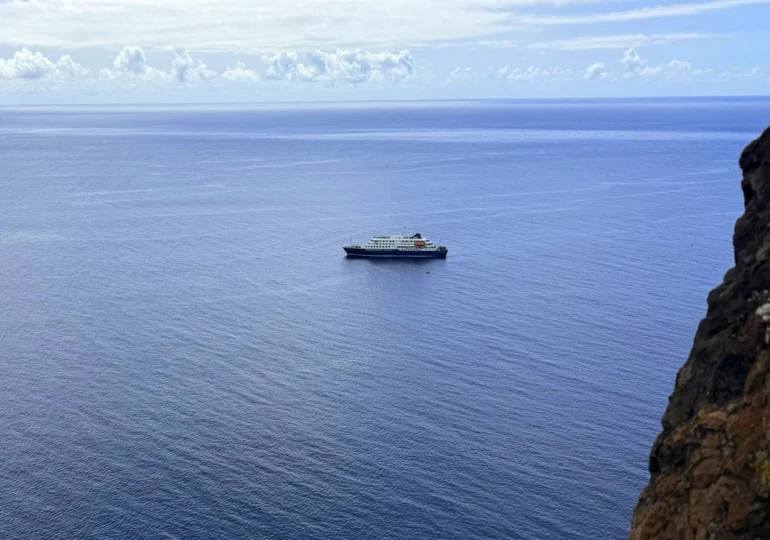
Five countries will send planes to evacuate passengers from the MV Hondius cruise ship, affected by hantavirus, and the WHO director will personally oversee the evacuations. However, all individuals on board are considered „high-risk contacts” who need to be monitored for 42 days, the World Health Organization (WHO) announced on Saturday.
Germany, France, Belgium, Ireland, and the Netherlands have confirmed they will send planes to evacuate their citizens on board the cruise ship affected by a hantavirus outbreak, currently heading towards Spanish territory, Spanish Interior Minister stated in Madrid on Saturday, as reported by Reuters and cited by News.ro.
The European Union is sending two more planes for the rest of the European citizens, added Fernando Grande-Marlaska.
The United States and the United Kingdom have also confirmed that they are preparing planes and emergency plans for citizens from non-EU countries whose countries could not send air transport, he specified.
How the disembarkation will be carried out
Passengers will be allowed to take their essential personal belongings with them, but the rest of the luggage, as well as the body of the deceased passenger on board, will remain on the ship and will be transported to the Netherlands, where they will be disinfected, Garcia stated.
Spanish citizens will disembark first, with the order of evacuation of the other groups of citizens to be determined by health authorities.
Citizens will not be able to disembark until their evacuation plane is ready to depart, Grande-Marlaska added.
The cruise ship affected by a hantavirus outbreak is expected to arrive in the Canary Islands on Sunday "between 04:00 and 06:00" local time (06:00 and 08:00 Romania time), Spanish Health Minister Mónica García Gómez announced on Saturday.
"Neither the luggage nor the body of the deceased person (on board) will be disembarked in the Canary Islands; they will remain on board along with some of the ship's crew, who will then continue their journey to the Netherlands," she confirmed at a press conference, mentioning "an unprecedented operation."
WHO Director Arrives in Spain
The Director-General of the World Health Organization (WHO) announced on X that he has arrived in Spain and is on his way to the Canary Islands, where he will oversee the evacuation of the cruise ship affected by hantavirus.
"I have arrived in Spain, where I will join senior government officials for a mission to Tenerife to oversee the safe disembarkation of passengers, crew members, and health experts from the MV Hondius cruise ship," Tedros Adhanom Ghebreyesus stated on X.
He added, "At this moment, there are no other individuals on board showing symptoms of hantavirus."
What Comes Next
All individuals on board the MV Hondius cruise ship are considered "high-risk contacts" who need to be monitored for 42 days, the World Health Organization (WHO) announced on Saturday.
"We classify all individuals on board as what we call high-risk contacts," explained Maria Van Kerkhove, the director of the WHO's Department for Epidemic and Pandemic Preparedness, in a live broadcast on social media.
She added that "active surveillance and monitoring of all passengers and crew members who will disembark for a period of 42 days is recommended."
It's Not a New Covid
On the other hand, the Director-General of the World Health Organization assured the residents of Tenerife on Saturday that the risk associated with the arrival of a ship where a hantavirus outbreak has been detected is "low," thanking them for their "solidarity" at the same time.
"I want you to understand clearly: this is not about a new Covid. The current public health risk related to hantavirus remains low," wrote Tedros Adhanom Ghebreyesus in an open letter to the population of the Spanish island of Tenerife, where the MV Hondius is due to arrive.
There are 53 types of hantavirus recorded globally, with only the Andes strain being responsible for human-to-human transmission, so far in rare cases localized in Argentina and Chile.
However, this very strain was detected after sequencing the virus on Wednesday in one of the ill passengers on the MV Hondius cruise ship. Departing from Ushuaia, the Dutch-flagged ship was supposed to return to Cape Verde when the deaths of three passengers and the increase in suspected cases triggered an international alert last weekend.
After several days of uncertainty off Praia (Cape Verde), the ship, where passengers must remain isolated in their cabins, is now heading towards the Canary Islands.
Six cases of hantavirus have been confirmed out of the eight suspected cases reported following an outbreak on a cruise ship in the Atlantic Ocean, the World Health Organization (WHO) announced on Friday.