

For the exhibition „Dacia! The Kingdom of Gold and Silver,” the Drents Museum in Assen was chosen because it is extremely modern and dynamic, with the most modern equipment to ensure the security of the pieces, explained the director of the National Museum of Romanian History, Ernest Oberländer-Târnoveanu, in a press conference on Sunday. He also said that only four artifacts, the most important ones, were stolen, and that the museum had to ensure 24/7 security, according to the contract. The entire exhibition is insured for 30 million euros, Târnoveanu added, without indicating the amount for which the stolen artifacts were insured.
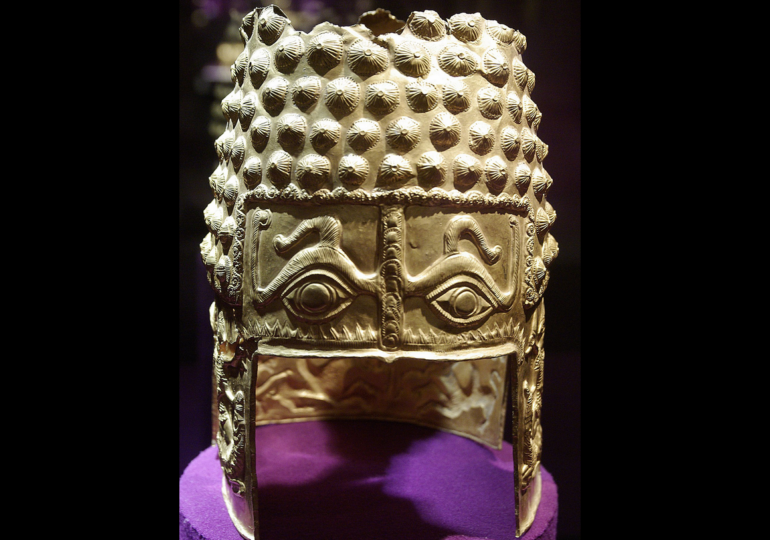
The statements come in the context where four of the most valuable artifacts from Romania’s Dacian Treasure were stolen on Saturday from the Drents Museum in the Netherlands, where they were on display. The stolen items include the Golden Helmet from Coțofenești and three Dacian bracelets. In total, 673 precious metal objects from the Dacian Treasure were on display there.
- The most important pieces from the Dacian Treasure were stolen from a museum in the Netherlands
- Theft from the Dacian Treasure: Police released video recordings of the thieves (Video)
Here are the main statements made by the director of the National Museum of Romanian History:
- Why a provincial museum in the Netherlands? Assen is a city of 70,000 inhabitants, located in an extremely rich and industrialized province. In the Netherlands, there are dozens of important museums in smaller cities. This is an extremely modern and dynamic museum. It has stood out through the major international exhibitions it has organized. It has been awarded the title of European Museum of the Year and Museum of the Year in the Netherlands.
- The museum's policy is to present lesser-known cultures and civilizations of the world. They wanted to present the Dacian civilization because they considered it one of the great civilizations of Europe. The municipality alone contributed 500,000 euros to the museum's creation. Additionally, the museum received a subsidy from the Dutch government.
- Any exhibition and transportation are carried out in accordance with the law. There is a set of rules regarding temporary export (editor's note - of artifacts). There is also an entire system of filters that verify the legality and conformity of the documents. From a museum, not even a pin or a nail can leave without complying with these rules and without being insured.
- In the statement made by the management (of the museum - editor's note), the existence of a 24-hour control post was mentioned. I couldn't verify from 1,700 kilometers away. These aspects are included in the contract, which also includes our specific requirements, such as special anti-theft display cases. The stolen objects were placed in these special display cases.
- The security system at the Drents Museum in Assen has been checked multiple times, and security has been reinforced, as this was the first robbery in Europe where explosives were used in a museum.
- The insurer is a major Dutch company. The insurer conducted all necessary investigations to ensure that the heritage was properly preserved during the exhibition period.
- The overall insurance, which I can disclose, amounts to over 30 million euros for the entire exhibition. I cannot disclose the insured amount for the stolen pieces; this is confidential information accessible only to investigative authorities.
- Aside from the four stolen Dacian pieces (the Golden Helmet from Coțofenești and three Dacian gold bracelets), the other pieces did not suffer any damage, with their display cases remaining intact.
- On Sunday morning, archaeologists and conservators traveled to the Netherlands and will take all necessary steps to record if any changes in the preservation condition and integrity of the pieces have occurred during the period they were on display.
- The treasure pieces have been exhibited multiple times in Germany, China, Portugal, Spain, Belgium, but each time they return (editor's note - to the country) and never move from one exhibition to another.
- The 673 objects were flown out with a chartered flight arranged by the Dutch side. The transportation from the National Museum of Romanian History to the airport, including loading assistance, is provided by the Romanian Gendarmerie and museum couriers.
Four of the most valuable artifacts from Romania's Dacian Treasure were stolen on Saturday from the Drents Museum in the Netherlands, where they were on display. The stolen items include the Golden Helmet from Coțofenești and three Dacian bracelets. In total, 673 precious metal objects from the Dacian Treasure were on display there.
To enter the museum, the attackers caused an explosion, after which they fled with the exhibits. So far, the thieves have not been identified. The robbery took place around 3:45 a.m. on the night from Friday to Saturday.
Experts say there is also a risk that the artifacts may be melted down for the material value of the gold, as has happened in other valuable thefts.
The Dutch police suspect that the theft was a carefully planned operation and have activated the cross-border cooperation mechanism and informed Interpol. Additionally, according to the Ministry of Foreign Affairs, the Romanian embassies in all neighboring countries have been alerted to request support from the competent authorities. A Romanian delegation is expected at the museum on Sunday, according to Dutch media reports.
The Romanian Police have also opened, ex officio, a criminal case for qualified theft and non-compliance with the regime of weapons, ammunition, and explosives, a case being handled by the Prosecutor's Office attached to the High Court of Cassation and Justice.
The National Museum of Romanian History has informed that all the pieces in the Drents Museum in Assen were insured before being sent to the Netherlands, in accordance with Romanian legislation and international practices regarding the organization of exhibitions.
673 precious metal goods from over 50 treasures, part of the collections of 18 museums in Romania, were sent to the museum in the Netherlands.
The Golden Helmet from Coțofenești was one of the top pieces on display. The helmet was discovered in 1928 in the village of Coţofeneşti, Poiana Vărbilău commune, Prahova county, by a local primary school student. It is a piece made of solid gold, weighing 770 grams, almost intact.