
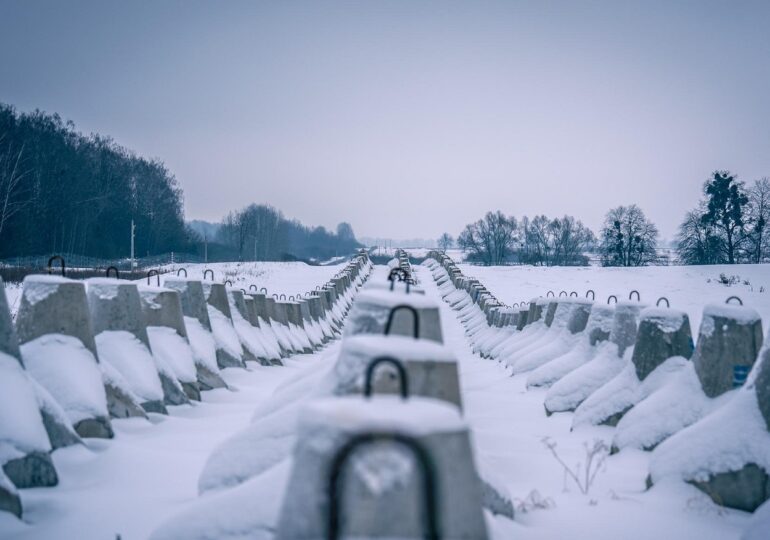
The Polish army placed anti-tank obstacles on nearly 65 kilometers of the border with Russia and Belarus last year. By the end of the year, Warsaw will strengthen another 200 kilometers of border with new defense systems.
Images distributed by the Polish Army General Staff showed extensive concrete „hedgehog” anti-tank elements from an unspecified location.
By the end of this year, Poland will have fortifications on approximately 38% of its eastern and northern borders, announced the Polish army.
The largest defense action in Poland's history
The works are part of Poland's Eastern Shield initiative, which Warsaw describes as "the most extensive action in history" to strengthen protection along its borders and NATO territory near Russia.
The works will intertwine trenches and anti-tank obstacles with natural barriers such as swamps and forests, plus systems and anti-drone shelters.
The role of these fortifications is to hinder the advance of Russian tanks and troops in case of invasion, while better protecting Polish forces and civilians, notes Newsweek.
The Polish fortifications will snake along areas close to the Russian exclave of Kaliningrad, the border with Belarus, part of western Ukraine, and the so-called Suwałki Corridor, linking Belarus to the vast Russian military capabilities based in Kaliningrad. Russia used Belarus as a staging point for its large-scale invasion of Ukraine almost four years ago.
We are not at war, but not at peace either
"Large-scale war is now a reality in Europe, hybrid warfare is a constant, and strategic competition is intensifying - we are not at war, but not at peace, and we must enhance deterrence and defense accordingly," said Lieutenant General Karol Dymanowski, the Deputy Chief of the Polish Army General Staff, to NATO officials last fall.
"The results achieved so far confirm the systematic increase in the state's defense capabilities and the resilience of border regions," said the Ministry of Defense in Warsaw.
The construction of the Eastern Shield began in the fall of 2024 and is set to be completed by 2028.
Formidable force on NATO's eastern flank
In 2025, Polish authorities blocked five border crossing points with Russia and Belarus and prepared to block another 12. Ten of the latter are border crossing points, and seven are railway links.
Poland is the NATO country with the highest military expenditure as a percentage of GDP, making it a formidable force on the alliance's eastern flank.
Like in the Baltic states of Estonia, Latvia, and Lithuania, the effects of the war in Ukraine have shaken Poland, and there is a significant multinational presence of NATO forces on Polish soil.
The European Union announced in September that it will increase its air presence along NATO's eastern flank, two days after around 20 Russian drones entered Poland on September 10.
Moscow claimed at the time that it did not deliberately target Poland, but Prime Minister Donald Tusk stated that the incident marked the closest point to open conflict his country has faced since the Second World War.
Network of bunkers and "dragon's teeth" in the Baltic states
NATO's easternmost members have repeatedly warned of a potential Russian attack on the alliance after a future ceasefire agreement in Ukraine comes into effect. Some officials have suggested that Moscow could attempt to take territories of a Baltic state in a small-scale military operation.
Estonia, Latvia, and Lithuania signed an agreement in January 2024 to build the Baltic Defense Line, a network of bunkers, support points, and distribution lines along their border areas.
Sections of the Baltic Defense Line are funded separately by each country and will include various types of defense, such as the anti-tank fortifications "dragon's teeth."
"Dragon's teeth" are concrete blocks used to stop tank advances and prevent mechanized infantry from gaining territory. This type of anti-tank fortification has spread across Ukraine.
Latvia announced it began reinforcing its eastern border in March 2024 and will spend a total of 303 million euros over a five-year period. And the Lithuanian Ministry of Defense stated in August that it will build defensive elements in multiple stages along a distance of up to 50 kilometers from the border, using bridges, trenches, and easily demolishable ditches.
T.D.