
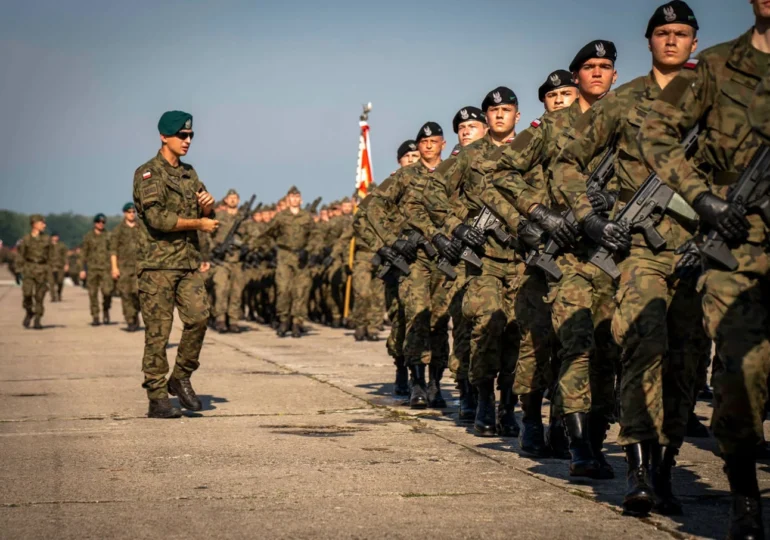
Poland is turning towards domestic defense companies and those from other Central European countries to reduce dependence on distant suppliers that cannot quickly increase deliveries.
Poland’s spending on defense acquisitions from domestic companies – including through joint ventures with other firms from Central Europe – nearly quadrupled from 2022, reaching 30.4 billion zlotys (8.15 billion dollars) last year, according to data from the Armaments Agency analyzed by Reuters.
The war in Ukraine has led to increased defense spending across Europe, but in Warsaw, this is a major priority, as Poland borders Ukraine and considers Russia an existential threat, Polish officials say.
"We are building the largest ground army in Europe. The fact that equipment is used by our army and is manufactured in Poland is becoming increasingly important," said Konrad Golota, deputy minister responsible for state assets, to Reuters.
Fourth largest defense budget in Europe
Polish state-owned defense companies have once again ramped up their capital investments in the past year. Several government officials, company representatives, and experts told Reuters that Warsaw's new initiative reflects a shift that creates opportunities for firms in the region.
It is estimated that this year, Poland will allocate approximately 53 billion euros for defense expenditures. It is the fourth-largest budget of its kind in the EU, after France, Italy, and Germany, according to NATO data, an increase from previous levels and equivalent to about 4.7% of GDP.
Larger systems such as American-made Patriot missile batteries, Abrams tanks, and F-35 fighter jets remain important, but Polish officials say expanding domestic and regional production of drones, ammunition, and other frequently used equipment has become a priority.
Regional change
Poland's strategy reflects a broader rethink at the European level as governments seek to rebuild their defense industrial capacity after the war in Ukraine showed how quickly modern conflicts can deplete ammunition stocks, Reuters notes.
"It's not just about an investment to ensure a highly developed defense industry that serves as an engine for the Polish economy, but about the independence of the supply chain. This guarantees independent supply to the front in case of need," said Defense Minister and Deputy Prime Minister Wladyslaw Kosiniak-Kamysz.
Until recently, defense companies from countries like the Czech Republic, Slovakia, and Hungary had limited presence in Poland, a country that largely relied on state manufacturers like PGZ and suppliers from the US.
Now, these companies see an opportunity in Poland. The most significant movements in Poland's arms production sector prove this:
- The Czech-based company CSG (CSG.AS), a major supplier of ammunition to Ukraine, has in recent months signed a series of agreements to expand its production in Poland. These include the transfer of production technology for propellants to MESKO (a PGZ group subsidiary) and an agreement with PGZ to expand production of drones, missiles, ammunition, and armored vehicles.
- CSG's Polish branch also acquired the company Domar MS, a producer of components for the defense industry.
- In August, CSG signed a contract worth over 100 million euros with Dezamet (a unit of the PGZ group) for the supply of components for 155mm artillery ammunition, as well as a separate contract worth 150 million euros with Huta Stalowa Wola for equipment for combat vehicles.
- Polish arms manufacturer Grupa Niewiadow – a subsidiary of Niewiadow PGM group (GNSP.WA) – is establishing a production line for 155mm ammunition in collaboration with KNDS Ammo France. Production volume is estimated to reach 180,000 units annually starting next year.
- In March, PGZ announced a partnership with Estonian company Frankenburg Technologies to manufacture short-range air defense systems in Poland.
German company Rheinmetall (RHMG.DE) stated that the increased demand from Poland was one of the reasons for establishing production capabilities in the country and developing a regional maintenance and repair center for ground combat systems.
Polish officials also told Reuters that they are discussing expanding industrial cooperation with countries like Slovakia and Hungary.
US Supply is no longer a priority
Zdenek Rod, a defense expert at CEVRO University in Prague, stated that Poland is emerging as a pioneer in efforts to relocate military production in Europe.
"For years, sourcing from the United States has been a priority to ensure interoperability within NATO," Rod said. "Currently, Poland is also trying to ensure resilience against global disruptions by increasingly turning to regional and European suppliers."
Another sign of Poland's defense industry ambitions: Warsaw proposed last month joint production, alongside Ukraine and the United States, of missiles for the Patriot air defense system.
"If you want to sell in Poland, you have to invest in Poland, you have to transfer technology, and you have to work on joint projects with us," Golota, the deputy minister responsible for state assets, told Reuters. "The more factories and know-how we have locally, the stronger our defense is."
The Polish Armed Forces have exceeded 220,000 personnel this year, being among the largest in Europe.
Additionally, Poland, along with Estonia, is one of the few NATO member states approaching the Alliance's commitment to allocate 5% of GDP for defense by 2035.
T.D.