

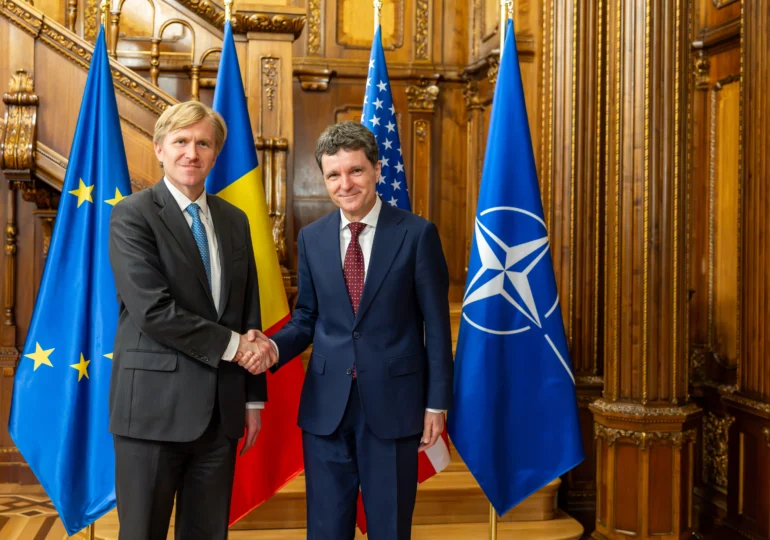
The United States wants Europe to take the lead in military support for Ukraine and the primary responsibility for the conventional defense of the continent. This message was conveyed by Elbridge Colby, one of the Pentagon’s most influential officials, who claims that this shift is already producing results. He named Romania among Washington’s important allies, at a time when the Trump administration is reassessing the American military presence in Europe, including in our country.
In a series of nine messages published on X, Colby, the U.S. Deputy Secretary of Defense responsible for Pentagon policy, outlined the directions of Washington’s new strategy, which he calls “NATO 3.0.”
The American official believes that European states have the industrial capacity and political will necessary to assume a much more significant role in the continent’s defense. “The transition to a Europe-led conventional defense is no longer just a concept. It is taking shape and producing concrete results. A stronger and more independent Europe is vital for a stronger NATO,” Colby stated.
By conventional defense, the Pentagon refers to the capacity of European allies to face a military conflict with land, air, and naval forces, without the use of nuclear weapons.
What the Pentagon asks of allies regarding Ukraine
Colby specified that military support for Ukraine must be led by Europeans and focused on two objectives: maintaining the positions of the Ukrainian army on the front and developing the capacity to carry out medium-range strikes. “We believe that we should focus our support for Ukraine’s admirable defense, with Europe at the forefront, on Ukraine’s ability to hold the front lines,” the American official wrote on X.
In his opinion, this approach is the most effective way to prevent new territorial gains by Russia and to create the conditions for lasting peace.
Colby pointed out that several discussions on this topic have already taken place with allies over the past week and that Washington intends to continue consultations. The message reiterates the position expressed by the American official at the Ukraine Defense Contact Group meeting on November 17, when he questioned the effectiveness of Ukrainian strikes deep inside Russian territory.
His position then sparked a dispute with the German Defense Minister, Boris Pistorius, who rejected Washington’s criticisms.
In the new messages, Colby acknowledged the existence of differences of opinion among allies, including on the effectiveness of long-range strikes, but insisted that these must be openly discussed.
Romania named among the US’s important allies
The American official dedicated a separate message to Romania, which he described as “an essential ally.” Colby recalled his visit to Bucharest at the beginning of November and meetings with President Nicușor Dan, Prime Minister Luca Niculescu, and Defense Minister Ștefan-Radu Oprea.
“Romania is an essential ally. It was a great honor to visit Bucharest earlier this month,” he wrote.
The Pentagon official praised Romania’s commitment to increase defense spending to 5% of GDP by 2031, considering that this demonstrates Bucharest’s capacity to take on greater responsibilities within NATO. “We greatly appreciate Romania’s role in the Alliance and our bilateral relationship,” Colby added.
In his messages, the American official also highlighted the contributions of Germany, Poland, and Finland, countries he considers examples of the transition toward the new European defense model.
What is happening with American troops in Romania
The Pentagon is nearing the completion of an assessment of the American military presence in Europe. The process, launched in June by U.S. Secretary of Defense Pete Hegseth, examines the personnel, bases, and distribution of U.S. military capabilities across the continent.
Colby previously stated that he hopes the assessment will be completed by December 1, without confirming, however, that a decision will be announced on that date, according to Reuters.
Romania has already communicated to Washington that it wishes to maintain the American military presence on its territory. At the meeting with Colby on November 4, Defense Minister Ștefan-Radu Oprea presented Romania’s strategic and operational advantages for Black Sea security, as well as investments in military infrastructure and defense capabilities.
Bucharest expressed interest in continuing military and industrial cooperation with the United States, including in air defense and counter-drone fields, according to the official statement of the Ministry of Defense.
President Nicușor Dan confirmed that Romania has proposed to the United States to bear part of the costs of maintaining American troops on its territory. The offer is comparable to that of Poland, where the contribution reaches about $15,000 annually for each American soldier. The head of state explained that the Romanian proposal also includes facilities, locations, and equipment, some of these details not being public.
So far, Washington has not announced what changes might occur in the American forces in Romania.
An analysis by the European Parliament Research Service shows that the American military review concerns not only the number of soldiers but also access to bases, overflight rights, and the capacity of European allies to take over missions previously carried out by U.S. forces.