
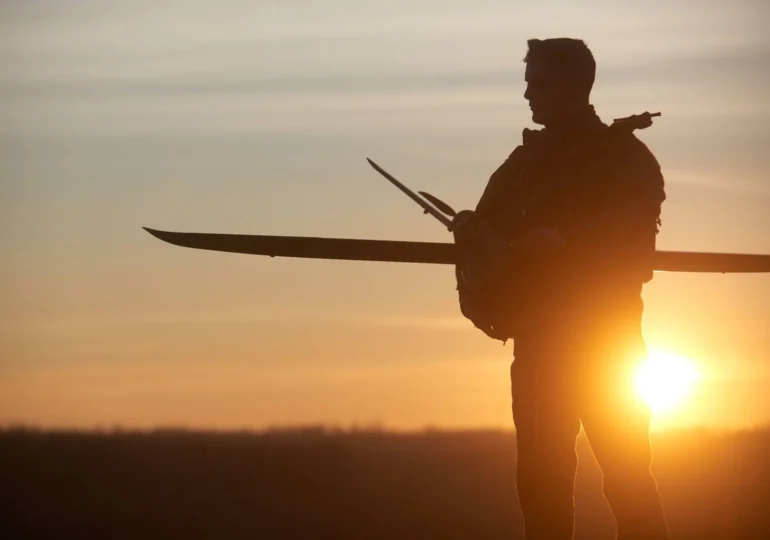
After more than four years of war, the balance of power in the drone war has significantly shifted in favor of Ukraine. Several tactical successes have led to this situation.
Ukrainian drone programs at all levels have begun to outperform those of Russia, and in a war increasingly defined by these unmanned platforms, this shift has started to yield tangible results not only on the ground but also in the skies over Russia.
"Moscow will never sleep again," wrote Robert Brovdi, commander of Ukraine's Unmanned Systems Forces, on Telegram on Sunday, after one of the largest aerial raids in this war against targets in Moscow. Drones and cruise missiles hit targets in the Russian capital, including the heavily defended Moscow refinery.
Coverage of the Ukrainian drone program and the ability to attack even heavily defended targets around the Russian capital explain the extreme precautions Russia's Vladimir Putin has taken to organize his Victory Day parade on May 9.
A comprehensive analysis published by Kyiv Independent explains how Ukraine managed to prevail in the drone war, where Russia started with several advantages.
Tactical Level
The multitude of issues Russia faces with Ukrainian drones begins at the tactical level, on the front line. Small drones carrying explosives now account for about 80% of total casualties on the battlefield, and each side widely uses them for both offensive and defensive operations.
"Russia achieved absolutely nothing during the spring offensive," said Dmytro Putiata, a drone operator in Ukraine's 20th Unmanned Systems Brigade and an expert in drone warfare, to Kyiv Independent.
Russia's advance on the battlefield largely stalled in 2026 because the Ukrainian army learned to counter the enemy's infiltration tactics, and Ukrainian drones continue to have a devastating impact on its advancing infantry. Now Ukraine kills or seriously injures more Russian soldiers than the Kremlin can recruit.
According to Ukrainian Defense Minister Mykhailo Fedorov, 35,203 Russian soldiers were "eliminated or seriously injured" in April, when Russia managed to occupy only an additional 141 square kilometers of Ukrainian territory, according to the Ukrainian monitoring group DeepState.
This is because Ukraine is advancing in certain aspects of drone use at the tactical level, as well as in developing techniques to counter Russian infiltration tactics, said Rob Lee, a senior researcher at the Institute for Foreign Policy Research, to the Ukrainian publication.
The consistently high losses caused by Ukrainian drones to Russian infantry for every kilometer it conquers have also led to deficiencies in manpower for the enemy. The military effectiveness of the Russians has correspondingly decreased.
The Ukrainian drone program has benefited from the use of Elon Musk's Starlink satellite communication system. After the American billionaire cut off Russia's access to this system, Moscow's troops were left isolated.
There is no comparable Russian equivalent to Starlink, which is relatively inexpensive, nearly impossible to jam, and offers extremely high connection speeds, Lee told Kyiv Independent, pointing out that the almost total elimination of Russia's ability to use the system was a radical change.
The combination of Russia losing access to Starlink, improved Ukrainian tactics, and mistakes in Russia's attempts to expand its own drone forces has tilted the power balance in favor of Ukraine, according to Putiata and Lee.
Russia's goal of rapidly expanding its own unmanned systems forces has stagnated because efforts to recruit younger, tech-savvy graduates for their unmanned systems forces (VBS) have largely failed, leaving the Russian military without operators.
Russia's attempt to expand its main drone unit "Rubicon," previously the most capable drone unit on the Russian side, has led to a much larger formation, but not an elite one, as entry standards have decreased. The centralization of Russia's drone units under VBS has meant that many Russian units lose their own organic drone units, to the detriment of overall Russian military effectiveness.
"Russian maneuver brigades are losing their drone capabilities. And maneuver brigades are, in their case, responsible for defense and advancement. They have fewer drones, fewer drone operators, fewer maneuvering capabilities in general," Putiata said.
Moreover, the increasing cost of fiber optic cable is impacting Russia's operations with FPV drones. Russia has heavily invested in FPV drones controlled by fiber optics, which are immune to jamming but significantly more expensive than radio-controlled equivalents.
A 50-kilometer spool of fiber optic cable, which used to cost around $300, now costs around $2500, reducing the ability of Russian drone units to use them en masse. For comparison, a standard radio-controlled FPV drone can cost as little as $350.
Both sides import most of the cables from China, often from the same suppliers, but Ukraine relies much less on cable-controlled drones, making Ukrainian drone operations less affected by external shocks in the supply chain.
Medium-Range Drone Strikes
Russia's problems on the front line are increasingly exacerbated by a resolute and increasingly effective Ukrainian campaign of intermediate attacks, targeting operational-level objectives 20 to 200 kilometers from the front line. Air defense systems, command posts, fuel and ammunition depots, and logistical vehicles are all targets of this campaign.
"The number of intermediate attacks has also increased significantly. There are now twice as many attacks at distances over 20 kilometers compared to March and four times as many compared to February. And there will be even more. This is a priority area," announced Volodymyr Zelensky on May 5.
Kyle Glen, an investigator at the Center for Information Resilience, told Kyiv Independent that he observed a 300% increase in Ukrainian attacks on Russian air defense and electronic warfare elements - a key target for Ukrainian medium-range drones - in March and April, with nearly 80 such systems targeted. These elements are not only expensive and slow to manufacture, but their continued wear makes Russia more vulnerable to subsequent drone raids.
Ammunition depots, fuel depots, and command posts are also targets of Ukrainian medium-range drones, forcing the Russians to move them further away from the front line, putting pressure on already affected Russian logistics and complicating command and control.
"Before this intermediate attack campaign, they kept everything at about 60 to 80 kilometers from the front line. Currently, it's about 100 kilometers, 120 kilometers, and in some cases even more. In some cases, they have literally moved their ammunition depots and command posts back to Russia, outside of occupied Ukraine."
Deep Strikes
Attacks by Ukrainian long-range drones have become commonplace in Russia, targeting economic and military objectives throughout the country.
The lack of a centralized program for long-range drones initially meant that Ukraine lagged behind Russia, which acquired Shahed drones and the technology for their production from Iran in 2022 and now mass-produces them in Tatarstan.
Various Ukrainian drone programs, developed from scratch since mid-2022, have matured into a formidable capability, frequently seeing hundreds of drones simultaneously attacking Russian targets, a fact well known to Russian commentators, the publication noted.
A key target for Ukrainian drones has been the Russian oil infrastructure, reducing the Kremlin's ability to benefit from rising oil prices following the war in Iran.
An analysis by Reuters estimated that Ukrainian drone attacks on Russian oil infrastructure in 2026 caused Russia to cut oil production by 300,000 - 400,000 barrels per day in April, the most significant monthly drop in oil production since the Covid pandemic.
FPV Interceptors
Ukraine has made significant progress in countering the threat posed by its own long-range drones from Russia.
Although Russia continues to launch a record number of attack drones on Ukraine - 1,567 attack drones of various types were launched during Russia's massive attack on May 13 and 14 - Ukraine is shooting down a record number of such drones.
Ukrainian interceptor drones have perfectly reversed the so-called "cost exchange problem," where the cost of an air defense interceptor significantly exceeds the price of the ammunition used to shoot it down.
A Ukrainian Sting interceptor, responsible for shooting down over 300 drones during Russia's aerial attack on May 13 and 14, costs around $2,300. That's just a fraction of the cost of a Russian Shahed drone, believed to cost at least $35,000 for the simplest models.
Furthermore, while Russian Shahed drones can be mass-produced, Ukrainian FPV interceptors like Sting are even more scalable, being made from commercially available parts with 3D-printed fuselages.
Impact on Russia
Ukraine's strong attack program has brought the war to the attention of ordinary Russian citizens in a way they can no longer ignore. And the Kremlin's response to the Ukrainian drone threat - including the introduction of a series of restrictions on mobile internet usage - has unsettled ordinary Russians, without any apparent impact on the ability of Ukrainian drones to find and hit their targets.
“Our long-range capabilities significantly change the situation - and, in a broader sense, the world's perception of Russia's war,” Zelensky said in his daily address from X, following the massive drone attack on Moscow on May 17.
The Ukrainian attacks have certainly changed the perception of the war inside Russia. The grand bargain Putin made with Russian society at the start of his "special military operation," whereby Russians did not need to support the war, but could effectively ignore it if they wished, has now been clearly violated, notes Kyiv Independent.
T.D.