

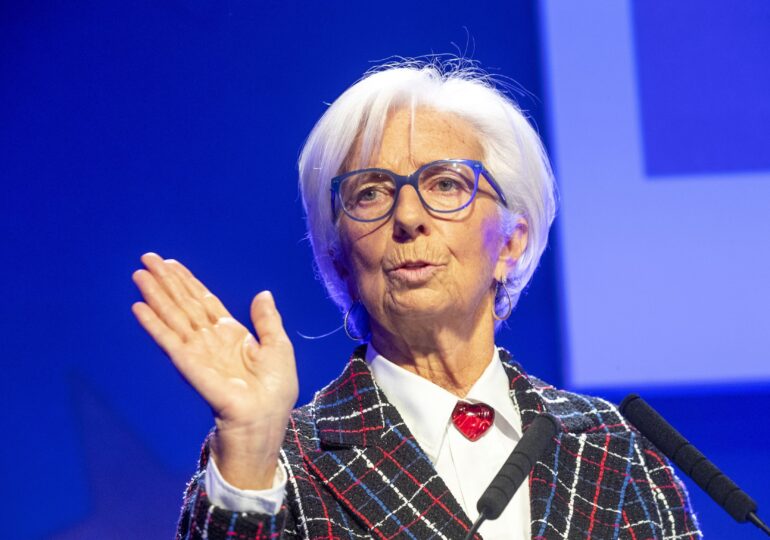
Christine Lagarde will leave the leadership of the European Central Bank (ECB) on February 7, 2027, nearly nine months before the end of her term.
The official announcement, made on Thursday by the ECB, confirms the speculations from recent months regarding her early departure.
Lagarde informed the ECB Governing Council and the President of the European Council, Antonio Costa, about her decision, AFP reports, cited by Agerpres. Her term was supposed to end on October 31, 2027.
According to Bloomberg, Lagarde is being courted by the World Economic Forum, the organization that hosts the annual meeting in Davos, to take on the role of president. She would be ready to accept the offer, but no official decision has been announced.
Who could take over the leadership of the ECB
Two former central bank governors are considered the main candidates to replace Christine Lagarde, according to Reuters.
The first is Klaas Knot, 59, who led the Central Bank of the Netherlands from 2011 to 2025. He could benefit from France’s support, although Paris would like the ECB’s chief economist position to go to a French candidate in return.
His main rival is Pablo Hernández de Cos, 55, former governor of the Bank of Spain and current general manager of the Bank for International Settlements.
On the list of possible successors are also Joachim Nagel, the current president of the German Central Bank, and Nadia Calviño, president of the European Investment Bank.
So far, there is no officially designated candidate. “To ensure a smooth transition to the next ECB leadership, the process of appointing her successor will begin today and continue without delay, so that the European Council can make a timely decision,” said European Council President Antonio Costa.
How the new ECB president is elected
According to Article 283 of the Treaty on the Functioning of the European Union, the ECB president is appointed by the European Council, after consulting the European Parliament and the ECB Governing Council.
A qualified majority is required for the appointment: at least 16 of the 21 eurozone countries must support the candidate, and these must represent at least 65% of the eurozone population.
Romania does not participate in the vote to appoint the ECB president, as it is not part of the eurozone.
The new president will have an eight-year term, which cannot be renewed.