
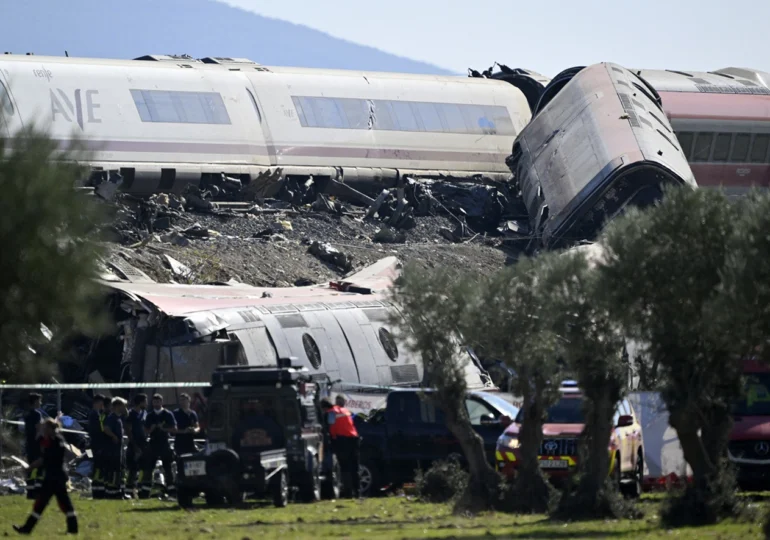
After the train accident in Spain, which resulted in at least 69 deaths, railway safety experts emphasized that the theory – broadly accepted – that it is best to sit in the middle of a train has its limits.
Wednesday’s railway tragedy raised a legitimate question: can a person’s seat on a train influence their chances of survival?
A general consensus has emerged: it is best not to sit at the front or the back of the train, but somewhere in the middle, facing opposite the direction of travel.
However, railway safety experts consulted by the New York Times state that there are too many variables in train accidents to draw a definitive conclusion.
Seat choice can slightly alter a passenger’s chances, but the type of accident matters much more than where they sit, they explain.
You can’t know what will happen
“Tell me what kind of accident will happen, and I will tell you the safest place you could sit,” said John Goglia, an independent safety consultant and former member of the National Transportation Safety Board (NTSB). There is no universally safe seat, he emphasized.
Robert Paaswell, emeritus professor of civil engineering at City College of New York, stated that serious train accidents are rare and their causes and circumstances can vary greatly. One accident might be a rear-end collision, while another could be a derailment caused by a faulty rail.
“In this case (in Spain – editor’s note), one train crashed full force into the rear of another train; therefore, the safest place would have been at the front of the train that was hit. But you had no way of knowing that this would happen,” Paaswell explained.
However, this did not prevent experts from trying to determine the safest place to sit.
It’s better to be in the middle of the train, but there’s no guarantee
The traditional answer has been that the middle of the train is the safest because the front car absorbs the force of a frontal collision, and the rear car takes the main impact in a rear-end collision.
Jim Mathews, executive director and president of the Rail Passengers Association – an organization advocating for improved passenger rail services in the U.S. – said he generally prefers to sit in the middle of the train.
However, this offers no guarantee. “I would make an important note: depending on the nature and severity of the accident, any safety device can become ineffective,” Mathews emphasized.
What is the best seat in the middle of the train
In the cars in the middle of the train, some experts say the best choice is an aisle seat, facing backward. For two logical reasons:
- In the event of a sudden stop, a passenger seated facing backward is thrown against the seatback, not forward; this reduces the risk of neck injuries and being hit by flying objects.
- An aisle seat also protects passengers from breaking windows.
However, Wednesday’s accident showed that this logic can change. The first car of the moving train — operated by the Spanish national company Renfe — was destroyed. The two cars at the rear of the stopped train — operated by the private company Iryo — overturned.
Regarding the passengers on the Iryo train, which was hit from behind, the safest place would have been at the front, Goglia explained. The farther you sit from the point of impact, the more cars there are between you and the oncoming train, absorbing the collision energy.
There is no 100% safety
Even choosing the “right seat” offers few guarantees. Unsecured luggage can become projectiles, and passengers standing in aisles, passageways between cars, or in restrooms are much more exposed. In such a violent accident, experts say, the seats themselves could fail.
“If you’re standing, you’re probably dead. If you’re seated, you might still be dead, because there are no seat belts,” Goglia said.
Allan Zarembski, director of the railroad engineering and safety program at the University of Delaware, said he has not encountered any study that definitively indicates the safest seat.
The usual recommendation – to avoid the ends of the train and choose a seat in the middle – mainly applies in collisions. However, when a derailment is caused by a defective rail or wheel, “practically any car on the train” can derail, he explained.
Passengers are most at risk of injury when a car derails and then overturns, he noted.
T.D.