
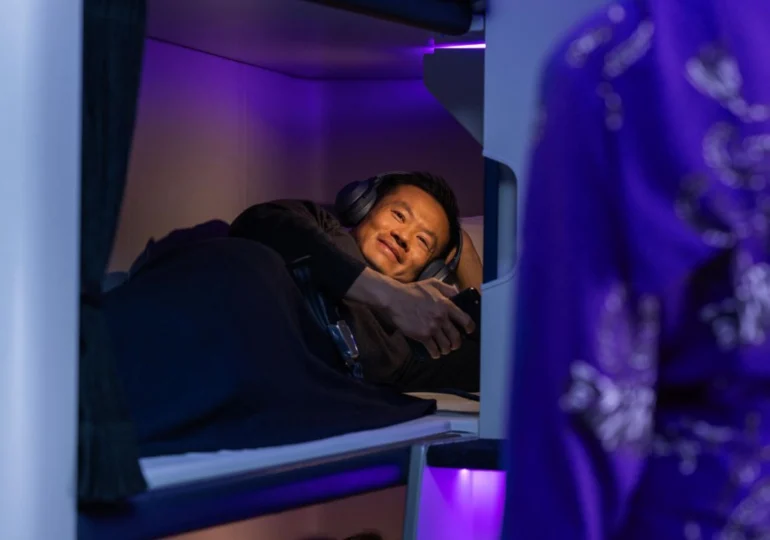
For passengers in the economy class, marathon flights of over 15–17 hours could become easier to bear with the emergence of a real alternative to restless sleep in a seat.
Air New Zealand is introducing a solution that until now seemed reserved only for the business class: sleeping compartments where you can fully stretch out.
The project, presented as a world premiere, promises more comfort on ultra-long routes – but it also comes with strict rules and additional costs, according to The Guardian.
What "Skynest" looks like, a world premiere in the economy class
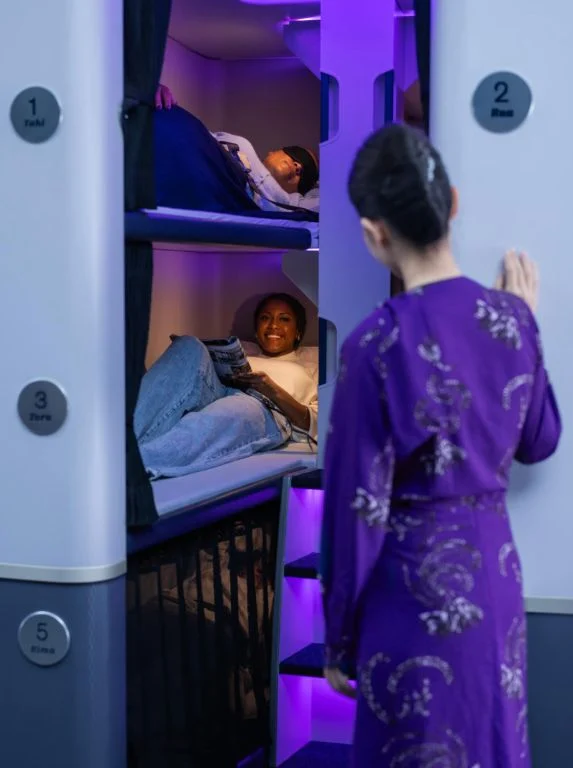
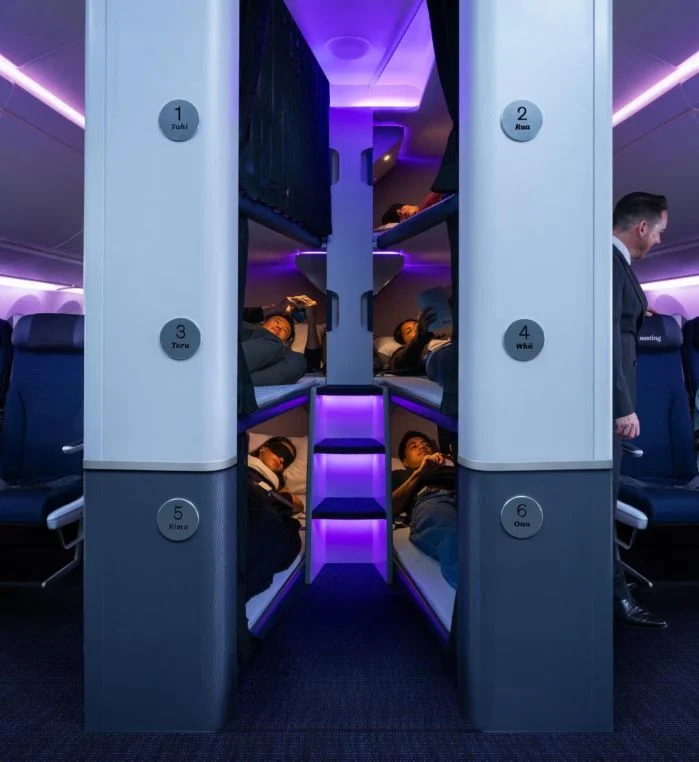
The company is introducing six mini sleeping cabins, mounted on the aisle of Boeing 787-9 Dreamliner aircraft. The system, called "Skynest," includes clean bedding, a privacy curtain, ambient lighting, and a comfort kit – eye mask, skincare products, earplugs, and socks.
Although access to the capsules comes at an additional cost, passengers still need to purchase regular seats for the approximately 17-hour flight. Beds can only be reserved separately and for limited time intervals.
How much it costs and how to book
Access to the capsules is available in four-hour intervals, starting from 495 New Zealand dollars (approximately 292 US dollars). In the initial phase, there will be two sessions per flight, and each passenger can reserve only one interval.
Space is limited: passengers will sleep in close proximity to each other and will not be able to sit upright inside the capsules.
The company enforces a clear set of rules: "sleeping in pairs" is not allowed, snacks cannot be consumed in the capsules, and children are not allowed.
There are also etiquette recommendations. Passengers are asked to avoid strong perfumes because "not everyone dreams in scents of vanilla, sandalwood, or musk." Snoring, however, is accepted: "Statistically, someone will do it. It might even be you. It's okay. Everyone gets earplugs."
"The journey matters" for an isolated country
Air New Zealand's Chief Executive Officer, Nikhil Ravishankar, says the project meets a real need.
He points out that for an isolated country like New Zealand, the flight experience is essential, and tourists' decision to get there depends on their willingness to spend many hours in the air. Providing real rest conditions makes these trips easier to bear.
Competition follows with similar ideas
The "Skynest" concept was announced back in 2020, and bookings will open from May 18 for flights starting in November.
Meanwhile, other companies are also testing solutions for economy class passengers. United Airlines aims to allow transforming a row of three seats into a bed starting in 2027, and Qantas is preparing a "wellness zone" for the future direct Sydney–London flight.
Bet on comfort in a challenging economic context
It remains to be seen whether these facilities, which are not very cheap, will convince more passengers to choose very long flights.
In the UK, demand and expenses for air travel have decreased for the first time in the last five years, amid rising fuel costs and tensions in the Middle East, according to Barclays.
In this context, Air New Zealand suspended profit estimates for the entire year in March and increased fares, citing fuel market volatility. In April, the company reduced approximately 4% of flights, affecting about 1% of passengers.
G.P.