

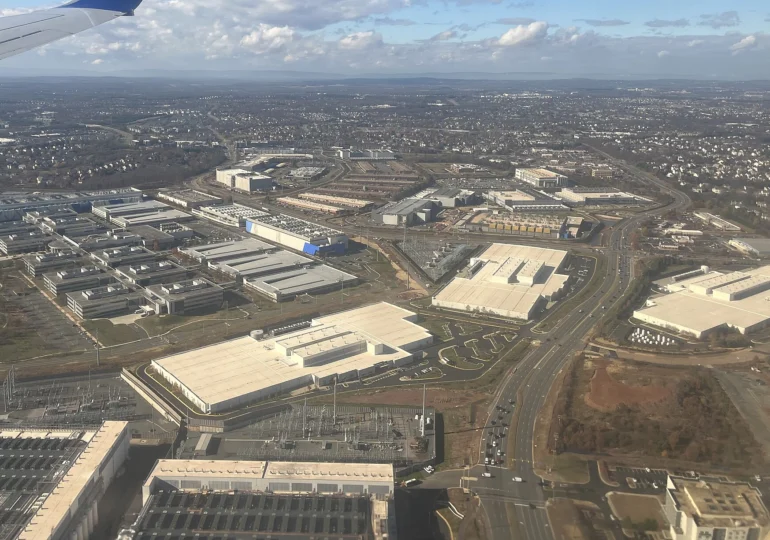
Artificial intelligence seems to live somewhere in the cloud. In reality, it needs huge buildings, thousands of servers, enormous amounts of electricity, and, in some cases, a lot of water for cooling.
And the people waking up to this infrastructure near their homes are starting to say „no.”
In rural communities, suburbs, and cities, data centers built for the AI boom are causing unexpected backlash. People fear higher electricity bills, pressure on water resources, noise, and the disappearance of farmland.
The phenomenon is most visible in the United States, where it has taken on a surprising political dimension: in a deeply polarized country, data centers manage to bring together people who almost never vote the same way.
Donald Trump supporters protest alongside environmentalists. Conservative farmers end up having the same demands as left-wing activists. And Republican and Democratic politicians, who until recently were competing to attract Big Tech investments, are beginning to pull back.
An analysis published by The Guardian tries to explain how data centers have become one of the few issues capable of crossing party lines and whether local revolt could become a serious electoral issue.
When AI Moves in Next Door
One of the places where the change is visible is Monrovia, a town of about 1,600 residents in Indiana. Google wants to develop a data center there on about 222 hectares.
Bryce Gustafson, organizer of Citizens Action Coalition, tells The Guardian that he spoke with about 50 people at a local festival and did not meet anyone who supported the project.
Some explicitly told him that they had voted for Donald Trump and do not understand why the president they support promotes such investments.
It is not an isolated case. Associated Press described a meeting in Murdock, Nebraska, where conservative farmers and Sierra Club environmental activists found themselves on the same side of the fence.
The reasons are very concrete: farmland that could disappear, pressure on water resources, massive electricity consumption, and the fear that some of the costs will end up in people's bills.
"It's not about blue versus red," says Samantha Barncastle Salopek, a Republican politician from New Mexico, referring to the traditional colors of Democrats and Republicans.
Seven out of Ten Americans Say "No"
The numbers show how strong the opposition has become. A Gallup poll conducted in March showed that 71% of Americans oppose the construction of an AI data center in their area. Nearly half, 48%, are strongly against it.
And the rejection crosses political boundaries. Democrats are the most categorical: 56% firmly oppose the construction of such a center in their community. But 39% of Republicans also say the same.
Another survey cited by Associated Press showed that 60% of registered Republicans do not want a data center near their homes. Even among MAGA voters, opposition reaches 53%.
Water, Electricity, and Noise
What scares people is also interesting. It's not the sci-fi scenarios of artificial intelligence getting out of control that are the main issue.
When Gallup asked those who do not want data centers in their community why they oppose, the answers were much more prosaic: water and electricity consumption, pollution, noise, changing the community's character, and the possibility of higher bills.
There are already about 4,000 data centers operating in the United States, according to an Axios analysis.
And the race is just beginning to accelerate. Amazon, Microsoft, Google, Meta, and Oracle are expected to spend over $750 billion this year on capital investments, with most of the money tied to the infrastructure needed for AI.
Data centers consumed about 4.4% of the electricity in the United States in 2023. By 2030, the share could reach nearly 12%.
In certain regions, electric grids are already under pressure from the new demand. And here the story about AI stops being one about technology and becomes one about money: who pays for the power plants, power lines, and other investments needed to power these huge centers?
Politicians Begin to Backtrack
The change in atmosphere has already reached politicians. In Texas, Republican Governor Greg Abbott, who until recently strongly promoted AI development in the state, has halted the approval of new data centers seeking to connect to the power grid until authorities assess the projects' impact. Those that do not meet the state's requirements must be denied connection.
His message to companies was unusually harsh: they have not collaborated enough with authorities and communities and have "dug their own grave."
In Michigan, Republican Mike Rogers, a U.S. Senate candidate, supports a one-year moratorium.
In Pennsylvania, Democratic Governor Josh Shapiro has tightened conditions for such projects, and in New York, Democratic Governor Kathy Hochul has ordered a one-year pause for major data centers.
The issue has even made its way into November election strategies. Associated Press reports that the organization coordinating Republican Senate campaigns has prepared a memorandum on how candidates should address voter dissatisfaction.
Axios has identified election ads that talk about data centers. All are against them.
Trump Wants More. Some of His Voters Don't
Here is where the political contradiction arises. Donald Trump strongly supports the development of data centers and sees AI infrastructure as essential for the technological competition between the United States and China.
The president says that investments bring jobs and revenues to communities and has supported accelerating the construction of infrastructure needed for the industry.
However, some of his own voters are no longer convinced. The Guardian reports the case of a woman from a conservative community in Texas, asked if she would even be willing to let the Senate go to the Democrats to stop data centers. "Yes," she replied. "My entire community will break ranks."
The Revolt that Unites Right and Left
This is where Aaron Regunberg's thesis starts, the author of the analysis published by The Guardian and a former Democratic legislator in Rhode Island.
He believes that we are not just witnessing a series of local conflicts. Data centers could move political anger beyond the traditional left-right confrontation and could create another one: local communities against big tech companies.
Signs are already there. Steve Bannon is trying to turn opposition to AI and data centers into a theme of MAGA populism. On the other side of the political spectrum, Bernie Sanders and Alexandria Ocasio-Cortez have called for a national moratorium on such projects.
Neither Republicans nor Democrats control this revolt. And perhaps this is the most interesting part of the story.
Artificial intelligence is presented as one of the technologies that will define the future. But for the people living near the infrastructure that makes it possible, the future is no longer something abstract. It needs land. It consumes power. It uses water. It makes noise.
And more and more, people are asking who pays for all of this.