
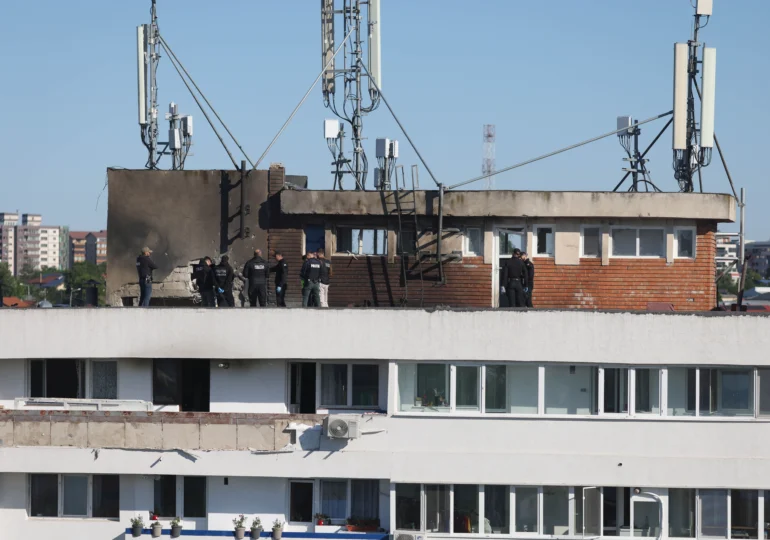
What can NATO do after the crash of a drone attributed to Russia on a residential building in Romania, a member country of the military alliance?
The organization is working on strengthening its defense capabilities on the ground, while also sending highly calibrated warnings to the Kremlin, as noted by AFP.
Colonel Martin O'Donnell, spokesperson for the NATO Supreme Headquarters Allied Powers Europe (SHAPE), confirmed to AFP that the drone that crashed in Galați, near the border with Ukraine, was "Russian".
Faced with this incident, NATO states that it is working on multiple fronts simultaneously.
Firstly, operationally, to strengthen its systems allowing the detection and interception of drones in flight. "We are assessing what more we can do to optimize Romania's and NATO's network of sensors and interceptors to fully neutralize such threats safely," a high-ranking Alliance military officer told AFP on condition of anonymity.
According to this source, one possibility could be for the Romanian anti-drone system, named MEROPS, to come under direct NATO control, as NATO already closely cooperates with Bucharest.
Another option would be to enhance the defense capabilities of Romania and other Alliance countries within the "Eastern Flank Deterrence Initiative," a program aimed at implementing cutting-edge technologies, including AI.
Moreover, NATO members will have the opportunity next month to discuss strengthening troops and capabilities deployed on the ground, during a meeting organized by Supreme Headquarters Allied Powers Europe, the officer detailed.
Calibrated Messages to Moscow
Simultaneously, NATO is striving to convey calibrated messages to Moscow.
In a first stage, NATO promptly expressed its "solidarity" with one of its 32 member countries, first through its spokesperson and then through its Secretary-General, Mark Rutte.
In a second stage, and only if the concerned country requests it, the allies could convene for "consultations," as provided for in Article 4 of the founding treaty.
Article 4, Invoked 9 Times
This text stipulates that the allies "will consult whenever, in the opinion of any of them, the territorial integrity, political independence, or security of any of the parties is threatened."
Far from being mere discussions, such consultations would have a very real impact, assures NATO, emphasizing that the Russians are very adept at distinguishing between each level of response.
Article 4 has been invoked nine times in NATO's entire history, three times before Russia's annexation of Crimea. The pace then accelerated, with six invocations in 2014, three of which were from the Russian invasion of Ukraine in 2022.
These "closed-door consultations" often lead to decisions, not always very visible, but all aimed at strengthening the Alliance's deterrence capability, a central element of this organization created in 1949.
A meeting under "Article 4," requested by Poland in September 2025 after a blatant incursion of Russian drones into its territory, led to the operation " Eastern Sentry." This resulted in "a greater number of fighter planes, helicopters, transport aircraft, air defense systems, surveillance aircraft, and frigates," as explained by SHAPE.
Furthermore, Article 4 was invoked twice in September alone. Following Poland, Estonia also requested "consultations" after three Russian fighter jets flew over its territory.
If the situation warrants it, NATO can also rely on Article 5 of its treaty, a clause of mutual assistance stating that an armed attack against a member state of the Alliance will be considered an attack against all. This article has been invoked only once: after the attacks on September 11, 2001, in the United States.