

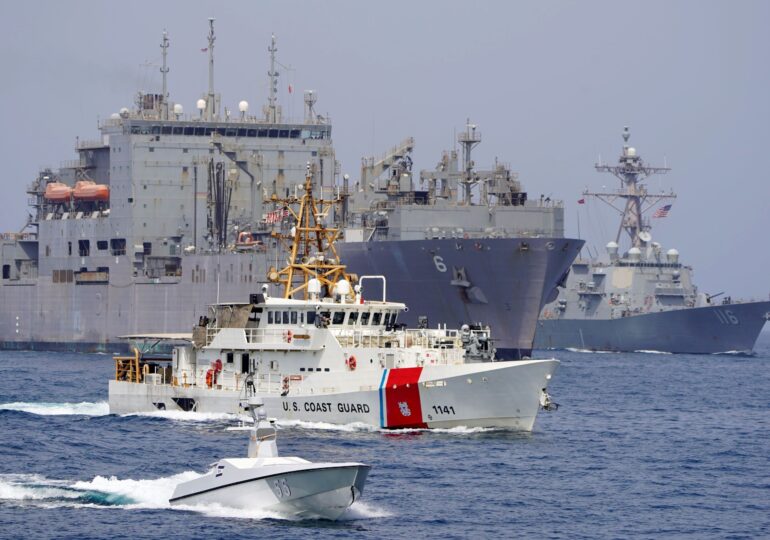
The administration of Donald Trump is facing one of the most difficult decisions of the Iran war: to accept the risk of a global economic shock or to send US Navy ships to one of the most dangerous maritime zones in the world.
The blockade of the Strait of Hormuz – the route through which approximately 20% of globally transported oil passes by sea – has already caused a major energy crisis, and yesterday the price of oil surpassed $100 per barrel for the first time in recent years.
CNN writes that discussions inside the White House and the Pentagon are dominated by a brutal question: how significant is the risk of sending American ships into the strait to escort oil tankers?
Oil disappears from the market, and production begins to halt
As the conflict with Iran escalates, the blockade in the Strait of Hormuz has begun to directly impact the global energy market.
Oil exports from the Gulf have been practically paralyzed, and producing states are facing an unexpected problem: they have nowhere to store the oil. As a result, some of them have started to shut down rigs.
Kuwait, Iraq, and the United Arab Emirates are already reducing production as their reservoirs fill up. Once shut down, these facilities cannot be restarted immediately, risking creating a massive supply gap in the market.
"These market conditions, if they persist or worsen, will force a reality where the scale and objectives of this operation will need to be reconsidered. There is an urgent need for a short-term solution," a former US official told CNN.
The only quick solution: American naval escort
Leaders in the oil industry and diplomats say that the only immediate solution to restart the flow of oil is an American naval operation to escort tankers. Donald Trump has already suggested this option, and plans are being intensively analyzed at the Pentagon.
"It is a matter being very carefully analyzed by the military and constantly discussed. Significant progress has been made in developing a plan that can do exactly what the president suggested," an administration official said, confirming that the military is working on a concrete plan.
However, the issue is that such an operation would send American ships directly into an active conflict zone.
Strait of Hormuz, described as the "Valley of Death"
An official involved in military planning described the current situation in the strait in an extremely harsh way: "Death Valley".
Iran controls the area through two different military structures: its conventional navy and the more aggressive Revolutionary Guard.
The latter can use a difficult-to-neutralize arsenal:
- fast boats for mine planting
- suicide boats loaded with explosives
- coastal rocket batteries
"The pressure on oil will reach a critical point faster than we will be able to eliminate the capacities we want to neutralize. The timeline does not fit," a source involved in the operation preparation said.
Iran could hit loaded ships
American intelligence services believe that Iran could avoid hitting ships entering the Gulf but could target those leaving, especially when fully loaded.
Analysts believe that the first targets could be liquefied natural gas (LNG) carriers, which could cause devastating explosions.
An expert quoted by CNN warns that such ships could "explode like the Beirut bomb".
After that, tankers could be targeted to create economic and ecological chaos on a global scale.
Sign that the naval operation is imminent
According to sources familiar with the plan, there is a clear indicator that the naval escort is close to launch: airstrikes on Iranian bases around the strait. The United States has already conveyed information to Gulf allies about these targets, including Iranian naval bases.
If these targets are attacked, it would mean that the naval operation is about to begin.
The White House tries to stabilize the oil market
In parallel with military plans, the Trump administration is also seeking economic solutions to reduce pressure on the market.
Energy Secretary Chris Wright is trying to calm fears of a prolonged energy crisis. "We have a temporary period of high energy prices, but it won't last long. In the worst case, we are talking about a few weeks, not months," he said.
The administration is in discussions with oil companies about increasing production and has even launched a $20 billion program to reinsure commercial vessels to persuade shipowners to resume shipments.
At the same time, Washington is considering politically sensitive measures, such as lifting sanctions on Russian oil or increasing production from Venezuela.
Political stakes for Trump
For Donald Trump, the oil crisis is not just a geopolitical issue. Rising fuel prices represent a major political threat ahead of the midterm elections in November.
At this moment, the consensus in the oil industry is clear: the crisis cannot be resolved without reopening the Strait of Hormuz. "The real priority must be the unblocking of the strait," a representative of the oil industry told CNN.
Until the US Navy can guarantee the safety of tankers, the global economy remains practically hostage to a maritime corridor just 34 kilometers wide.