
Teachers in Romania are among the lowest paid in Europe, with an average annual salary of 20,805 euros gross in primary education. The amount is over three times smaller than what a teacher in Denmark earns, placing Romania in 25th out of 28 in the ranking of primary education teachers’ salaries, based on OECD data.
The situation slightly improves when salaries are adjusted for the cost of living. Romania moves up four positions but remains in the lower half of the European ranking. Essentially, even though Romanian teachers earn much less than their colleagues in Western Europe, the differences decrease when salaries are adjusted for the cost of living. The explanation is that prices of goods and services are generally lower in Romania.
The data comes from the OECD's annual education report, Education at a Glance 2026. In a detailed analysis, Euronews compares both teachers' incomes and their purchasing power.
Romania, among the lowest places in teachers' salaries
The differences between European countries are huge. In 2025, the average annual salary of a primary education teacher ranged from 18,669 euros in Turkey to 74,086 euros in Denmark.
At the top of the ranking are also Iceland (73,752 euros), Ireland (69,747 euros), Germany (69,453 euros), and Austria (65,851 euros).
On the other hand, seven countries have average annual salaries below 25,000 euros: Czech Republic, Hungary, Slovakia, Romania, Latvia, Greece, and Turkey.
With 20,805 euros, Romania surpasses only Latvia (20,516 euros), Greece (18,746 euros), and Turkey (18,669 euros).
In comparison, a teacher in France earns an average of 41,968 euros per year, one in Italy 32,100 euros, and one in Poland 28,370 euros.
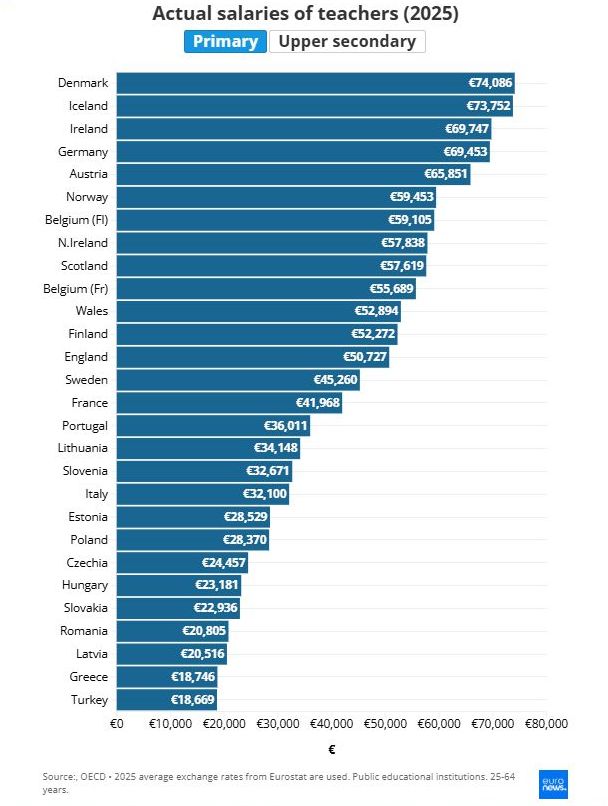
The data refers to the actual annual gross incomes received by full-time teachers aged 25 to 64. It includes base salaries, performance bonuses, and other professional activity-related payments.
Daniel Wisniewski, Secretary-General of the European Federation of Education Employers, explains that the differences are not due to a single factor but to the income levels in each country, salary structures, teachers' qualifications, and career progression.
Additionally, different taxation systems, social benefits, and various allowances complicate direct comparisons.
What changes when we consider the cost of living
Teachers' salaries should also be compared based on the prices in each country. For example, in Romania, where the cost of living is lower than in Germany, a lower salary can cover a larger part of the expenses for goods and services.
Euronews recalculated the ranking taking into account these price differences, based on Eurostat data.
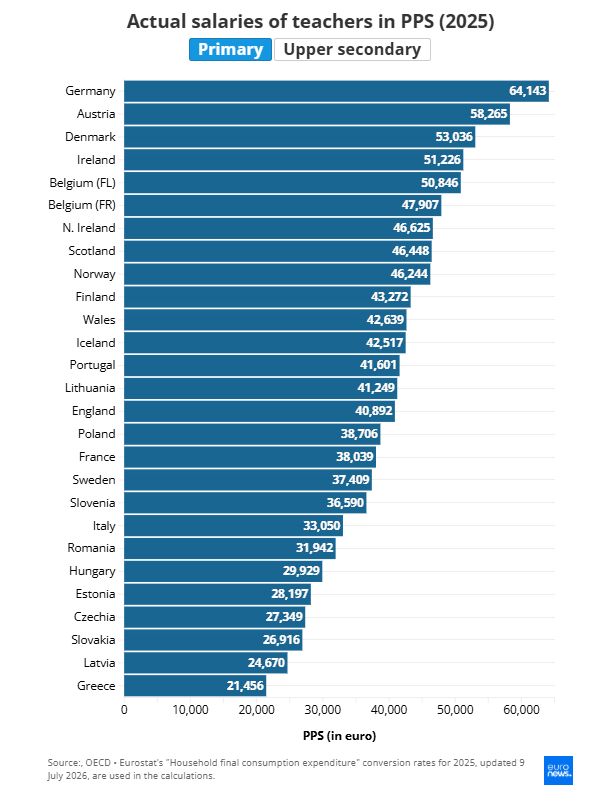
In this comparison, Romania moves from 25th to 21st place. The average annual salary of Romanian teachers is equivalent to 31,942 purchasing power standards (PPS), a measure used to compare what can be bought with incomes in different countries.
Romania thus surpasses Hungary, Czech Republic, Slovakia, Latvia, and Greece but remains below Poland and Italy.
Germany continues to lead the ranking, with 64,143 PPS, approximately double that of Romania.
High school teachers generally earn more
The report also shows differences between education levels. In most analyzed countries, teachers in upper secondary education are better paid than those in primary schools.
The highest salaries for high school teachers are in Iceland, where the annual average reaches 93,938 euros, followed by Denmark (85,999 euros) and Germany (80,163 euros).
The biggest salary differences between the two education levels are in Iceland, Finland, Belgium, Denmark, Austria, and Germany, where high school teachers earn at least 10,000 euros more per year.
G.P.