

From November 1, the VAT for thermal energy supplied to the population decreases from 21% to 11%. The reduction means saving a few dozen lei for each MWh consumed, but it does not guarantee lower maintenance bills. With the arrival of cold weather, consumption increases, and the price of heat varies considerably from one city to another.
What does the VAT reduction mean, concretely? Spotmedia.ro calculated the effect on the prices paid by the population in Bucharest, Cluj-Napoca, and Timișoara, based on the tariffs published by the heating operators and local authorities.
What changes from November 1
According to the Fiscal Code, thermal energy supplied to the population benefits from a reduced VAT of 11% during the cold season, from November 1 to March 31. The facility represents the application of the seasonal tax regime already provided by law.
The reduction applies to thermal energy supplied to the population and other categories provided by legislation, including hospitals, schools, and certain non-governmental organizations. However, those who heat their homes with their own gas boilers or electric devices do not automatically benefit from this reduction for the gas or electricity consumed.
However, the VAT reduction does not mean that the heating bill decreases by 10%. For example, for a quantity of thermal energy priced at 100 lei excluding VAT, the consumer paid 121 lei with the old rate and will pay 111 lei with the new rate. The saving is 10 lei, which is a reduction of 8.26% of the amount paid for the same amount of heat.
How much you save in Bucharest
In the Capital, the Municipal Thermoenergetic Company publishes a price of thermal energy billed to the population of 283.75 lei/MWh, excluding VAT.
Based on this tariff, Spotmedia.ro’s calculations show that one MWh costs 343.34 lei with 21% VAT and 314.96 lei with 11% VAT. The difference is approximately 28.38 lei for each MWh consumed.
For a hypothetical consumption of 2 MWh, the saving reaches 56.75 lei, and for 3 MWh, 85.13 lei.
These values are calculation examples for fixed amounts of thermal energy, not estimates of an average apartment’s consumption. How much each resident actually pays depends on the amount of heat consumed and how the costs are divided in the building.
Cluj-Napoca: how much the same amount of heat costs
In Cluj-Napoca, the price of thermal energy billed to the population is 376.19 lei/Gcal excluding VAT, according to the Local Council Decision no. 927/2022. The price was set in 2022 and is valid for the 2026–2027 cold season as well, according to information published by the Cluj-Napoca City Hall. With the reduced VAT of 11%, one gigacalorie costs 417.57 lei.
To correctly compare tariffs from the three cities, we converted gigacalories into MWh, the unit used by operators in Bucharest and Timișoara. Thus, the base tariff in Cluj-Napoca is approximately 323.68 lei/MWh, excluding VAT. At this price, one MWh would cost 391.65 lei with 21% VAT and 359.29 lei with 11% VAT.
The saving resulting from the VAT reduction is approximately 32.37 lei/MWh.
Timișoara: a significantly higher tariff
In Timișoara, the Local Council approved in 2025 a price of 466.19 lei/MWh, excluding VAT, for thermal energy billed to the population.
At this tariff, one MWh costs 564.09 lei with 21% VAT and 517.47 lei with 11% VAT. The difference is 46.62 lei for each MWh consumed. The price is higher than in Bucharest and Cluj-Napoca, even after the VAT reduction.
The differences between cities are due both to the costs of producing and distributing heat and to the subsidies granted by the city halls. In Bucharest, Cluj-Napoca, and Timișoara, the population does not bear the full cost of thermal energy, part of it being covered from local budgets.
How much 1 MWh of heat costs in the three cities
The table below compares prices for exactly the same amount of thermal energy, using tariffs without VAT published by the authorities.
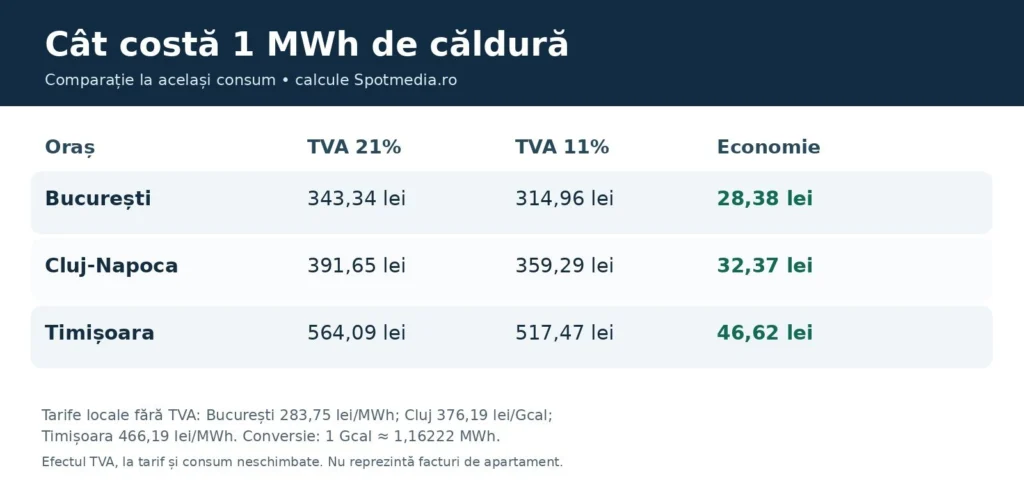
The calculations show how much the same amount of heat, 1 MWh, costs in the three cities, with 21% VAT and with 11% VAT. We used tariffs published by local authorities, and the amounts do not represent actual bills of apartments.
The comparison shows two things: the VAT reduction produces greater savings in lei where the base price is higher, but the differences between local tariffs remain significant.
At the same thermal energy consumption of 1 MWh, the cost is 314.96 lei in Bucharest and 517.47 lei in Timișoara. The difference between the two cities thus reaches 202.51 lei, even after the VAT reduction.
Why the bill may increase even if VAT decreases
The main explanation is consumption. A bill from November can be higher than one from October, even with reduced VAT, if temperatures drop and homes need more energy for heating.
For example, for a quantity of thermal energy billed at 500 lei excluding VAT, the final amount would decrease from 605 lei to 555 lei.
But if the consumption value increases to 700 lei excluding VAT, the bill reaches 777 lei, even with the new reduced rate.
Therefore, the VAT reduction cannot offset the increase in consumption. Moreover, maintenance includes other expenses: water, sewage, sanitation, electricity for common areas, administration, and other association costs. The VAT reduction on thermal energy does not apply to the entire maintenance list.