

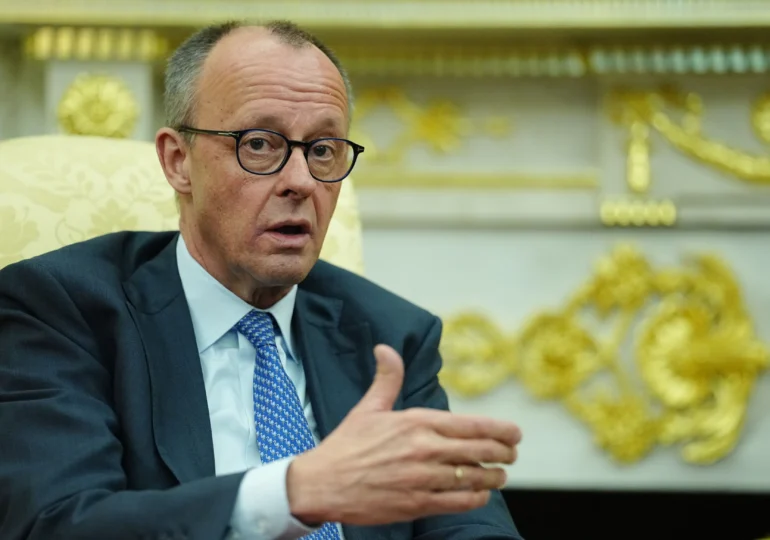
The overwhelming victory of AfD in Saxony-Anhalt moves on Monday from Magdeburg to Berlin, where Chancellor Friedrich Merz must respond to one of the heaviest defeats suffered by CDU in recent years.
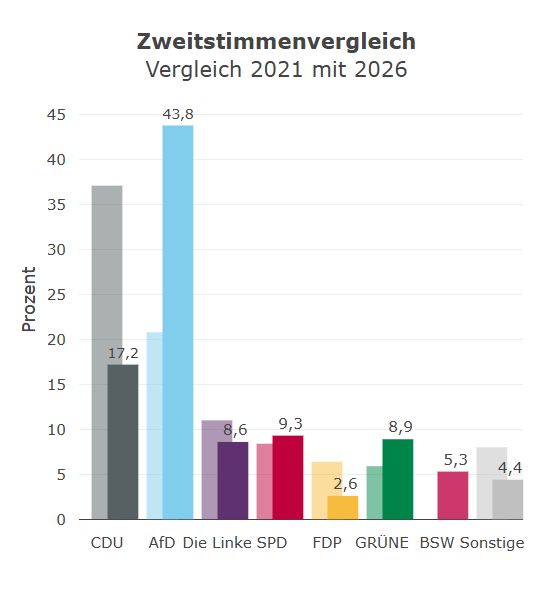
The Chancellor’s party lost more than half of the support it had in the state five years ago, while AfD doubled its score and reached nearly 44% of the votes.
The defeat is all the more painful for Merz as one of his major political promises was precisely to stop the rise of AfD. Since coming to power in May 2025, the Chancellor has reduced immigration and tried to win back voters attracted to the far right. However, Sunday's result shows that, at least in Saxony-Anhalt, the strategy did not work, reports AFP.
On Monday, Merz will meet with the CDU leadership to analyze the defeat before addressing the press.
Results after counting all votes
Official preliminary results, published after counting the votes from all 2,661 districts, confirm the extent of AfD's victory:
- AfD – 43.8%
- CDU – 17.2%
- SPD – 9.3%
- Greens – 8.9%
- Die Linke – 8.6%
- BSW – 5.3%
- FDP – 2.6%
Voter turnout reached 77.8%, 17.5 percentage points higher than in the regional elections in 2021.
AfD's leap is spectacular. The party gained 23 percentage points compared to the previous election when it had 20.8%. CDU, on the other hand, lost 19.9 points, from 37.1% in 2021 to only 17.2% now.
AfD will have 39 out of the 83 seats in the new regional parliament, three short of the 42 needed for an absolute majority. CDU will have only 15 seats, while SPD, Greens, and Die Linke will each have eight. BSW enters parliament with five seats, as reported by The Guardian.
"A very good campaign agent for AfD"
Ulrich Siegmund, the AfD leader in Saxony-Anhalt and the party's candidate for the position of state premier, immediately claimed victory and argued that voters sent a clear message that things cannot continue in the same direction.
Siegmund, 35, did not miss the opportunity to mock the Chancellor, describing Friedrich Merz as "a very good electoral campaign agent for AfD."
Alice Weidel, the co-chair of AfD at the national level, spoke of a "historic" result and a clear mandate for governance.
The issue is that AfD cannot govern alone, and the other major German parties continue to exclude an alliance with the far right.
Siegmund and Weidel spoke on Sunday evening about extending a "helping hand" to other parties. BSW, the party founded by Sahra Wagenknecht, could play an important role in the upcoming negotiations, although forming a majority remains extremely complicated.
CDU has led the state for 24 years
For Merz's party, the magnitude of the defeat is amplified by the fact that CDU has been governing Saxony-Anhalt continuously since 2002.
Just five years ago, the Christian Democrats had decisively won the regional elections with 37.1% and kept AfD at 20.8%. Now the balance of power has brutally reversed. CDU lawmaker Sepp Müller admitted that AfD is the party that "has the mandate to form a government" in the region.
Social Democrat Vice Chancellor Lars Klingbeil, who is also the Finance Minister, believes that AfD's victory sends a "message to Berlin," according to News.ro.
Oliver Lembcke, a political science professor at Ruhr University in Bochum, told AFP that for CDU, the result represents "more than a heavy defeat" and could lead to "a major reorganization of the German political landscape."
A victory with a strong symbolic charge
The result has a special significance in a country where the Nazi past continues to weigh heavily on political life.
The AfD branch in Saxony-Anhalt is classified as far-right extremist by the state's domestic intelligence service. The party promotes a tough immigration policy and supports resuming ties with Russia, while also being critical of the support given to Ukraine.
Charlotte Knobloch, one of the most well-known representatives of the Jewish community in Germany, expressed horror at the result. "Not even in my most terrible nightmares could I have imagined that the far right could win elections in Germany again in this way," she said.
AfD was founded in 2013 as a eurosceptic party but later veered strongly to the right, consolidating its support especially in the states of former East Germany in recent years.
Pressure mounts on Merz
The defeat in Saxony-Anhalt comes at an already difficult time for the German Chancellor.
His coalition has been affected by internal disputes, while the economy is stagnating. Inflation fueled by the Middle East war, tensions with the United States, and the threat from Russia pushing Germany towards accelerated rearmament are increasing the government's problems and providing political ammunition to AfD.
There were even rumors earlier in the summer that some leaders in the conservative camp would like to replace Merz.
On Sunday evening, Torsten Frei, the leader of the conservative MPs and former chief of staff to the Chancellor, tried to temper the speculations and urged the party not to "draw wrong conclusions." "It is essential to be and remain stable," he said.
However, Merz does not have much time to recover from Sunday's defeat. On September 20, two other important elections are scheduled. In Mecklenburg-Western Pomerania, another state in eastern Germany, AfD leads in polls with 35-37%, ahead of SPD at 28-32%.
At the same time, elections are also held in Berlin, where CDU, AfD, and Die Linke are very close in the polls.
Following the result in Saxony-Anhalt, these two elections become the next test for both the rise of AfD and Friedrich Merz's ability to stop the conservatives' loss of ground.