
But the road to Oxford is long and arduous. The competition is fierce, with candidates coming from all over the world being extremely intelligent and well-prepared. Additionally, the cost of courses is enormous. For a master’s program, around 50,000 euros must be paid, in addition to the accommodation cost.
To raise the necessary funds, Luca also registered on the crowdfunding platform „Adoptăm studenți”. If you want to invest in a future scientist born and educated in Romania, do not hesitate to help him.

Relevant Quotes:
- I strongly believe that even today physics needs philosophy and vice versa. It is not a genealogical argument. I believe that physics indeed needs philosophy continuously, not just as an intellectual curiosity.
- All physicists do philosophy sometimes - usually at the beginning of the exercise and at the end. They have a philosophical moment that they then struggle to forget.
- Romania is probably losing the most important thing it can lose. Not gold, gas, or mines, but intellect.
- You do not have the mandate to blame others for not returning. From yourself, you can ask - but it is not acceptable to ask that from someone else.
- Here, everything has become a race for the student's attention. This is not how physics or philosophy is done. Exceptional people save us, not the system.
Why did you choose to study physics and philosophy simultaneously?
Starting from the tenth grade, the idea of a "Physics and Philosophy" program first came to my mind. Immediately after finishing high school, I intended to follow such a undergraduate program in the UK. There is one at Oxford, one at King’s College - in the UK, we can talk about a tradition in this direction, founded by Oxford. Such programs started in the '60s, and American universities also adopted them. Due to financial reasons, I couldn't do it then. I thought the best thing was to stay in Romania, study both faculties at the same time, take the best of each - and then pursue my dream, which is now about to come true.
What concrete connection exists between the two disciplines? At first glance, they seem totally opposite.
It's a frequent but fundamental question. The answer is not trivial at all. If we had had this discussion 300 years ago, it would have been easier - it was natural to see them together then. Many philosophical questions have been answered through physics, through the study of nature.
I firmly believe that even today physics needs philosophy and vice versa. I believe that physics indeed needs philosophy continuously, not just as an intellectual curiosity.
All physicists do philosophy sometimes. Usually at the beginning of the exercise and at the end, when they interpret the results and pose the problem. They have a philosophical moment that they then struggle to forget. Many of the foundations of modern theoretical physics originated from philosophical misunderstandings and unresolved issues of 80-90 years.
Can you give a concrete example of the crisis in which theoretical physics finds itself today?
The world has heard of the particle accelerator in Geneva. There is talk now about building an even larger one - the Future Collider -, with a diameter of one hundred kilometers, which is expected to be completed around the year 2080 and would cost around 100 billion dollars. The goal would be to confirm quite fanciful theories of quantum physics - supersymmetry, quantum gravity - theories that should have been clarified long ago.
Theoretical physics is in a sort of crisis today because experimental equipment has reached its limit. We need a new leap. Physicists are trying to do it through extremely bold, almost fantastic theories that have no basis in reality and cannot be experimentally confirmed. This is very serious for a scientific theory. I think this is where a philosophical eye is needed. Philosophy would play, in addition to its creative role, a hygienic role: it would bring order to the structure of science.
How did you go about being admitted to Oxford? What did the application file involve?
I had to write a statement of purpose - a combination of a personal cover letter and a research proposal. I had to present myself as an individual, show my ambitions and interests, and at the same time demonstrate that I understand the field.
In addition to that, I submitted a sample paper - a fragment of work at a high scientific standard, to demonstrate that I am well-versed in the secondary bibliography and know what I will face.
There were also the CV and the recommendations. I needed the recommendation of at least three professors who would put their names on the line for me. I had a recommendation from a philosophy professor from here, with international reputation, one from a professor at the London School of Economics, London, a specialist in the philosophy of science - that was probably decisive for admission to the master's program - and one from my professor of relativity theory, from the Faculty of Physics. I obtained the recommendation from the British professor by participating in a conference here in Romania, to which he was invited, and a professor of mine introduced me to him. We talked and then corresponded.
How much did you work on the Oxford admission file?
I worked very hard. I polished it, seriously, every day, every night, more than usual, for three months. The presentation work had 5,000 words, somewhere between 15 and 20 pages. The difficulty was to write so little: they require conciseness, which is the main virtue. If I had let myself, I would have exceeded the limit by far.
The subject was related to the problem of energy conservation in the theory of relativity and the status of spacetime, which has an ambiguous role. Is it a substance? It is not? Is it composed of relations? It is not? My thesis was that these two problems are linked and that is why we have this ambiguity in energy conservation: because we have not yet decided what spacetime is.
Why do you think they chose you?
I would like to believe they chose me for exactly the same things I see in myself: that I love physics and philosophy, that I have pursued both so far, and that my research field - relativity theory and aspects related to spacetime - is truly important. I think that's what drew attention to my file, especially since their department has a very similar orientation to mine. I was lucky with that: we have the same interests, which is extremely important in the academic world.
What does it mean to be a student at Oxford?
I expect it to be extremely intense. They also warned me about this. But I also expect perspectives to open up because the cream of this field gathers there. Not in number, but the essence is there. Every Thursday afternoon, there is a seminar attended by philosophers of science from all over the world. Students present, discuss, and stay there until late at night.
There is the tutorial system: each professor sits face to face with their student, not as an official coordinator, like in a Ph.D., but every week, at most two, you have the chance to sit face to face with people who are leading figures in their field. Including Nobel laureates, with whom you can sit at a table for two hours. It is extremely motivating.
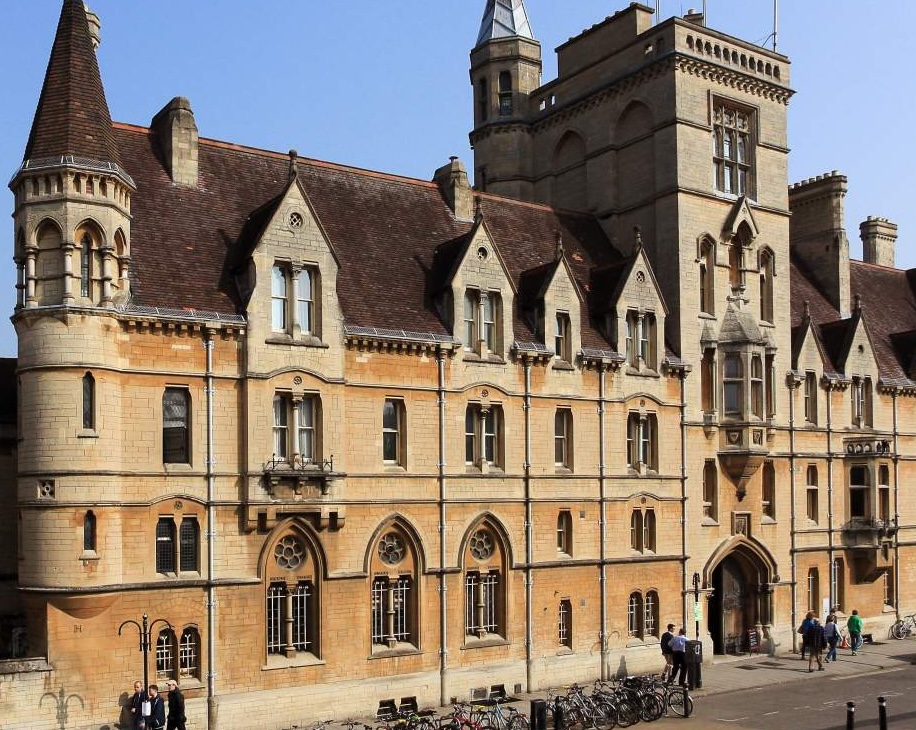
I will be at Balliol College - the University of Oxford is divided into colleges - the second oldest college in the entire university, founded in 1260. The room where I will live is 400 years old. I think I will adapt. I don't see myself staying there all my life, but Oxford is truly a wonderful place to study.
What is your opinion on higher education in Romania?
I have had many disappointments. Not scandals, not extraordinary stories, but things that are not done as they should. Physics should be taught on a chalkboard. Even at Oxford, they have a chalkboard. Here, everything has become a race for the student's attention, presentations are in PowerPoint, everything is a kind of intellectual TikTok: let's see as many slides at the same time. This is not how physics or philosophy is done.
But, as in the last few hundred years of our history, people save us. With my colleagues from physics, we had a saying: there are always 10 people in this faculty who, if they disappeared tomorrow, if they took sick leave, the faculty would collapse.
On the other hand, a single college in Oxford has a larger budget than the entire University of Bucharest. How could we compare? At the end of the day, it's about investments, resources, and how they are used.
There is a debate in Romania about the fact that the best students leave the country to study and then stay abroad. What do you think about this phenomenon?
Yes, it is true that Romania is losing, and probably the most important thing it is losing. Not gold, gas, or mines, but intellect. That is the most important thing it is losing.
The fact that I am leaving for a master's degree and then a Ph.D. does not mean I am abandoning. I do not want to leave the country permanently. I am seriously considering returning. I know plans can change, but this is, in principle, the scenario I desire.
There is also an important asymmetry that many do not consider: from yourself, you can demand, reflect, and recognize that you did not return and that you could have. But you do not have the mandate to blame others for not doing so. That it was their duty and why they did not return. This is an asymmetry that many do not apply in any aspect — and even less so in this debate.