
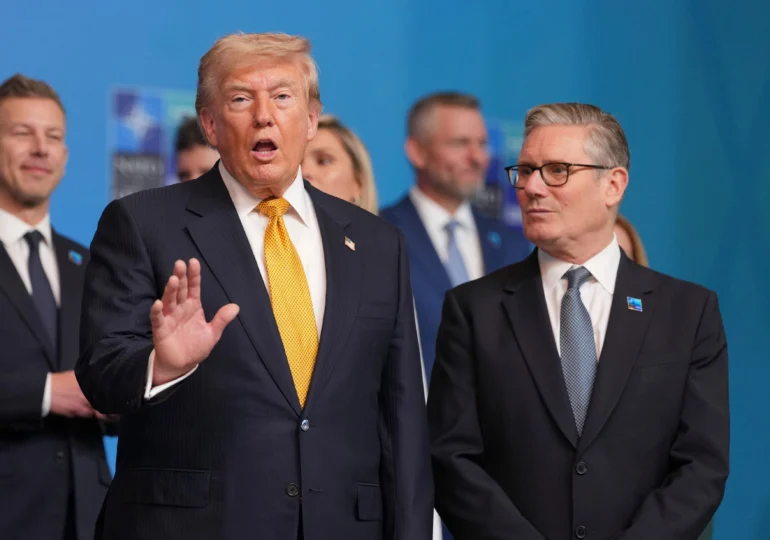
European allies have done everything possible to put Donald Trump in a good mood at the NATO summit in Ankara. Their efforts have had mixed success – but this is no longer their top priority anyway.
European countries and Canada are moving further away from the policy of unconditional appeasement and fear of the US president, adopting a more balanced approach. The experience gained from Trump’s repeated threats has given them more confidence in how they handle them, and this change is also reinforced by their increased defense spending, writes Politico.
At the core of this shift is a change in message: We spend more on defense for ourselves, not for you.
"I didn't come here to please Trump... If I came, it was simply to take responsibility in a security situation focused on deterrence," said Luxembourg's Foreign Minister, Xavier Bettel, to Politico. "We did what we had to do."
"I'm tired of panicking because of Trump," added a senior NATO diplomat, who, like other sources quoted in this material, requested anonymity to speak freely. "We have to do this for ourselves."
After a year of unprecedented tensions within the alliance - in which Trump threatened to take over Greenland, announced plans to withdraw thousands of American troops from Germany, and questioned NATO's collective defense clause - member states came to Ankara determined to avoid a new crisis.
On Wednesday, the 32 alliance leaders approved a statement committing to invest in new military capabilities, such as drones, stating that Iran should never obtain nuclear weapons, and highlighting new military procurement contracts worth over $50 billion - measures largely aimed at responding to long-standing requests from Trump.
At the end of the summit, Trump expressed satisfaction.
"There is one word that defines this day: unity," the American president told journalists after the meeting, describing it as "an extraordinary meeting" and praising the "affection" that countries showed each other during the discussions.
A more moderate Trump
However, the beginning of the conference seemed much more tense. Trump reiterated his usual criticisms of the allies he believes do not spend enough on defense and those who did not support the US in the war against Iran. He also revisited his old idea of acquiring Greenland from Denmark.
"I'm not satisfied with NATO because of what they did about Greenland and I'm not satisfied with NATO because they didn't want to help us in. Iran," he said, also threatening to restrict trade relations with Spain due to its low defense spending.
However, the allies were not impressed. Leader after leader - including Washington's traditional allies like Latvia - expressed solidarity with Denmark.
"Greenland is an indispensable part of Denmark," said the President of Latvia, Edgars Rinkēvičs. "The red lines are very clear: Greenland belongs to the people of Greenland," also stated the Prime Minister of Iceland, Kristrún Frostadóttir.
Belgium's Prime Minister, Bart De Wever, also criticized American intervention in Iran. While the campaign is "justified" to prevent Tehran from obtaining nuclear weapons, he told journalists that "if the operation was well planned and well executed is another matter - but it doesn't seem to be going too well."
According to two people present in the room, in closed-door discussions, Trump took a more moderate tone with other leaders. He praised Poland, Germany, and the Baltic states for increasing defense spending. Although he complained again that some countries spend too little, he did not mention Spain and said nothing about Greenland.
However, Trump interpreted the situation in his own way. "If you could see the respect and affection in the room - and it is indeed affection for our country," he said after the summit. "They like what we're doing. They told me, 'We love you, Mr. President, we love you.' There are people of all kinds who say that. Isn't that nice?"
Yet the key to the change in tone from other alliance members was not so much the desire to please Trump, but their growing confidence in their own capabilities.
Europe asserts itself
Although he insisted, during the leaders' meeting, on the importance of the transatlantic relationship, German Chancellor Friedrich Merz emphasized that increasing defense spending is in Europe's own interest, according to one of the sources previously cited.
"Trump's speeches made us realize that it would be good to be able to rely on ourselves," said Bettel. "We want to provide ourselves with the necessary means, but if it all comes down to a parade and flattering someone, that's not why I'm here."
Ed Arnold, Senior Associate Research Fellow at the Royal United Services Institute and former NATO official, stated that increasing allies' defense spending reduces the United States' ability to pressure them.
Last year, Europe and Canada increased their defense spending by 20%, and according to provisional data published Tuesday by NATO, these are set to rise by another 11% by 2026. In total, the 31 allied states (excluding the US) now represent 43% of the alliance's total defense spending.
Although Europeans "do not want the US to immediately withdraw from NATO," Arnold said, "there is still a change in attitude" compared to last year when allies were much more careful not to upset Trump as he criticized them for low defense spending.
According to Arnold, allies now view Trump's threats with more skepticism, after his numerous reversals on troop withdrawals and lack of concrete action regarding Greenland.
"No one was surprised" by Trump's latest criticisms of the alliance, confirmed a second NATO diplomat. "We still have to take them seriously, but people tend to take them less seriously," he said. The situation is starting to resemble the story of 'The Boy Who Cried Wolf.'
As a result of increased defense spending, Belgian Defense Minister Theo Francken told Politico that Europe will be able to take over responsibility for its own conventional defense in the next "five to ten years."
After the summit, he summarized the attitude change as follows:
"While at the previous NATO summit there was still fear of Trump's wrath, this year it was much less visible. European armed forces are rapidly and decisively strengthening," he wrote on social media. "We are no longer doing this to please Trump, but out of a regained European self-respect. This continent is our home."