
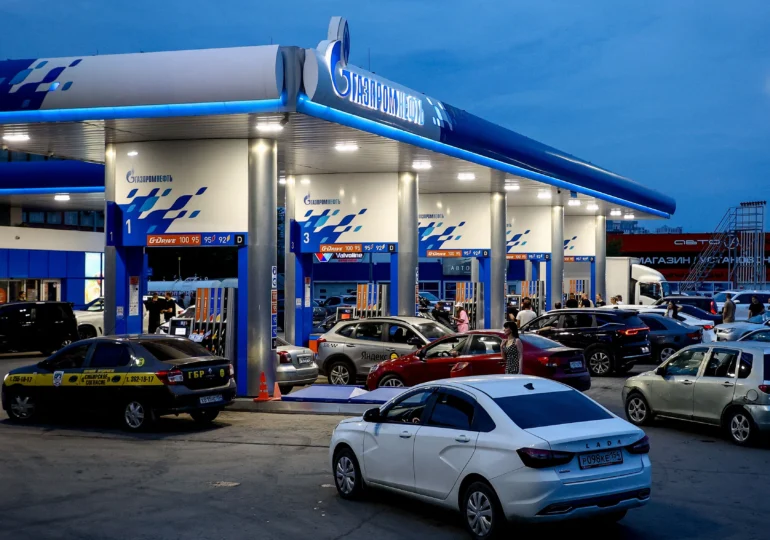
Russia, one of the world’s largest oil exporters, has started to import fuel to cover its domestic needs. The repeated attacks by Ukraine on Russian refineries and depots have reduced gasoline production, leading to issues reaching Moscow, where queues at gas stations and restrictions on the amount of fuel that can be purchased have appeared.
Russian Deputy Prime Minister Alexander Novak confirmed that Russia has begun importing fuel, without specifying the quantities or countries of origin.
He tried to calm the market and explained that the shutdown of several refineries is temporary. According to the Russian official, some of them are expected to resume operations soon after "scheduled maintenance work."
Kyiv Post raises the question of why so many important refineries in Russia are shut down at the same time. In recent months, Ukraine has repeatedly attacked refineries, depots, and oil terminals located hundreds or even thousands of kilometers from the border.
The strikes have reduced Russia's capacity to convert its own oil into fuels, precisely at a time when domestic gasoline demand is high.
Russia Sells Oil and Buys Gasoline
The situation is even more unusual as Russia continues to export large quantities of crude oil, including to India. At the same time, it has started to purchase fuels derived from oil from abroad.
In early August, a tanker under the flag of Oman unloaded around 68,000 tons of gasoline from the Indian port of Vadinar at the Russian port of Vitino in the Arctic region. From there, the gasoline was transported by train to domestic buyers.
At least two more shipments of gasoline from India were expected at Russian ports, according to maritime transport data cited by Reuters.
Russia imports gasoline by rail and from Belarus and Kazakhstan. In Russia's Far East, diesel fuel from Asia is also starting to arrive.
Russia is thus in an unusual situation: it continues to sell oil abroad but needs refineries from other countries to obtain enough fuel for its own market.
Queues up to One Kilometer in Moscow
The supply issues have also reached the capital. Witnesses quoted by Reuters reported that queues up to one kilometer long formed at some gas stations in Moscow and the surrounding region. Some stations were closed, and others only had diesel left.
Drivers recounted having to try multiple gas stations to find gasoline and, once they reached a station with fuel available, they waited for hours.
Major oil companies have started to limit the amount of gasoline each driver can purchase.
Rosneft, a state-controlled company, has imposed a limit of 30 liters of gasoline per car at all its stations in Russia. Gazprom Neft allows a maximum of 40 liters at automated stations and 60 liters at regular ones in Moscow, while Tatneft has set a limit of 50 liters.
Lukoil has also introduced restrictions, attributing them to high demand and "unscheduled maintenance work at refineries."
Russian authorities have taken other measures to try to stabilize the market: they have banned fuel exports, relaxed some fuel quality requirements, and resorted to imports.
Why is Ukraine Targeting Refineries
For Kiev, attacks on oil infrastructure are a way to exert pressure on Russia, which has much greater military and economic resources.
Refineries are a significant target precisely because Russia may have enough oil but could face a shortage of gasoline or diesel if it lacks the capacity to refine it at the necessary pace.
The effects of the attacks, which until now may have seemed distant to Russians hundreds of kilometers from the front, have become much more visible: gas stations without fuel, queues, and restrictions on the amount that can be purchased.
The situation also marks a symbolic reversal from the early years of the war. The Kremlin warned then that Europe could be left without energy after giving up Russian oil and gas. Four years later, Russia still has abundant oil but needs to import fuel for its own market.
G.P.