
After weeks of tension during which a delayed budget destabilized already by the military conflict in the Persian Gulf, the main parties in the coalition felt the need for political bureau meetings for clarifications and revision of the action strategy.
Sorin Grindeanu and PSD emerged battered from these budget negotiations, reaching a climax in the „opposition within the coalition” campaign.
The reason the influence of the social democrats was contested lies in their failure to collaborate with AUR to push through a number of populist amendments in the budget construction without a funding source, aiming to derail the deficit targets set by Prime Minister Ilie Bolojan, the president of PNL.
In these weeks and months, we have lived in this uncertainty that we want to clarify...
Sorin Grindeanu, PSD President
Not only did Sorin Grindeanu fail to find common ground with AUR, but he was also forced to transfer around one billion lei from the funds of the magistrates to finance social assistance for some vulnerable pensioners.
Thus, the party that imposed and supported the formation of privileged professional classes over the years, including that of magistrates, has reached a point where it has acted against them.
What Sorin Grindeanu wants
Sorin Grindeanu's situation is even more complicated. He is the only party leader in the coalition whose trust level is below the party's score.
In the most recent opinion poll, conducted by INSCOP and published two weeks ago, PSD is rated at 17%, and Sorin Grindeanu at 12%, a deficit of 5 points. While Ilie Bolojan enjoys a trust level 10 percentage points higher than PNL, the party he leads, and Dominic Fritz has 1.5 percentage points more than USR.
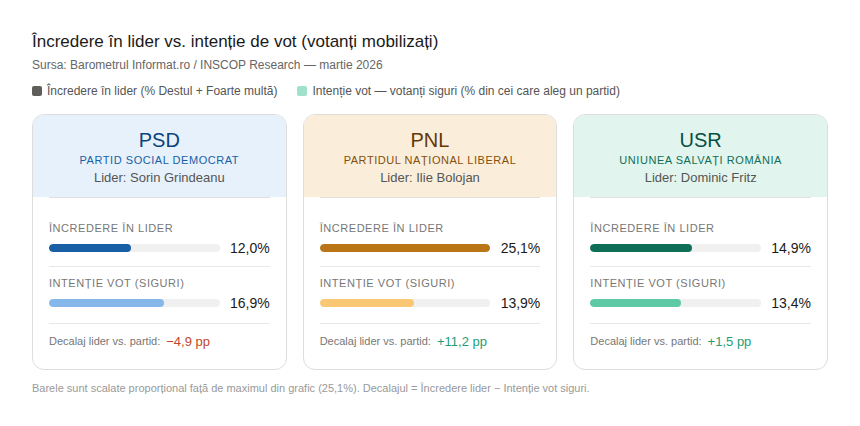
The above data indicate a vulnerability of Sorin Grindeanu, thus explaining his bellicose attitude, an attempt to remain at the center of public attention at all costs to project the image of a leader fighting for the interests and goals of the social democrats within the party.
"Do you know what I want the most? And this is what I will tell my colleagues when we have our first regional meeting. What I want the most is a clarification of the situation. And I expect this to happen after our internal consultation," stated Sorin Grindeanu at the beginning of the week in a press conference.
The position of the PSD president conveys that at this moment he does not have many solutions, as these are with the party leaders, somewhat acknowledging that the strategy so far has proven to be a failure.
"If it is desired to continue in this form, very well," Sorin Grindeanu further stated. "Then we are committed, and everyone moves forward. We can also move into the Opposition or, although the chances in Romania for snap elections are small, maybe we can go in that direction," added the social-democratic leader.
"I want clarification and the strength given by the elected PSD members, the 5,000 people who will vote, the political force you have as a result of this consultation...," concluded Sorin Grindeanu.
Two complicated situations
According to the statements above, in reality, the consultation within PSD is a vote of confidence requested by Sorin Grindeanu from the party and, to a lesser extent, a decision regarding future political actions.
Sources within the party told spotmedia.ro that at the party level, there is no critical mass regarding leaving the government, although there is a fear that there are no clear solutions for recovery after the disaster caused by Marcel Ciolacu and the electoral failures in 2024 and 2025.
The social democrats have to choose between two complicated situations. The first one is entering the opposition, where they will be in tough competition with AUR, which will defend its populist and anti-PSD position, aiming for a good score in the 2028 elections. Additionally, upon entering the opposition, something that the social democrats have not experienced before will happen, a quasi-total disconnection from public resources.
They have been in such a situation for a few months in 2021, but the pandemic and then President Iohannis' decision to bring them into government blocked the "de-Pesedization of Romania," a term frequently used by Ludovic Orban, the former PNL leader, after becoming prime minister.
The opposition scenario now spans a three-year period, one in which many things can happen, being an unknown territory for Sorin Grindeanu and PSD.
The second situation is the decision to remain in government. In this case, whether he changes his attitude or not, Sorin Grindeanu will be second fiddle in the coalition, with fewer and fewer levers to compromise Ilie Bolojan. But in this scenario, the PSD leader at least has the certainty that he will become prime minister in a year, with a chance to retain his position until the parliamentary elections at the end of 2028.
Being in government, the party representatives remain in positions, connected to public resources, having a fairly strong communication platform and aiming for an electoral score between 20 and 25%. This situation also comes with risks, but at least it is not a leap into the unknown for a party that has never truly been in opposition and especially with a populist behemoth like AUR breathing down their necks.
The party of pensioners
In reality, the shock of the 2024 elections, when PSD, for the first time, did not have a candidate in the presidential final and obtained a weak score in the parliamentary elections, has not been absorbed at the party level.
The influence of local barons, corruption, the lack of any strategy to attract valuable people to the party, coupled with a huge ideological breakdown, have pushed PSD into its biggest internal crisis since the founding of FSN in December 1989.
"A valid question is whether PSD has not abandoned the electorate from poor areas and rural areas, which formed the party's electoral base. Over the years, these people have shown less and less interest in the party, which has become obsessed with pensioners. And not even with all pensioners...," observed sociologist Barbu Mateescu in an episode of the podcast Comunitatea Liberală 1848.
"While Sorin Grindeanu strongly supported maintaining special pensions for magistrates, in focus groups, we found that this was a hot topic for Simion's voters, AUR supporters from the diaspora, and probably also from the country, a clear example of the inequalities they hate.
I would also add a thesis from Professor Daniel David, the rector of Babeș-Bolyai University and former Minister of Education: these people woke up from the semi-feudal reign that PSD exerted over them for decades, and the first step of awakening was anger," sociologist Barbu Mateescu further explained.