
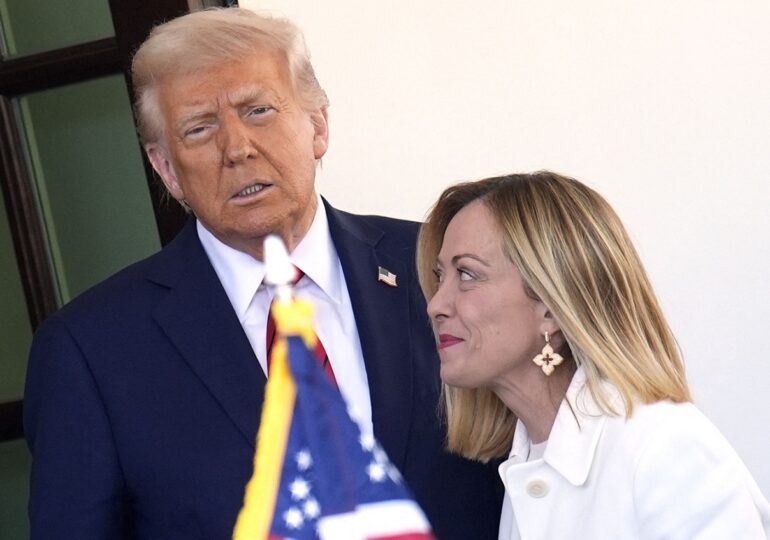
Donald Trump has once again put Giorgia Meloni in a difficult situation on Monday, but this time she fought back.
The Prime Minister of Italy and a long-time ally of Trump formulated her first direct criticism of the US President since his re-election in 2024, in an attempt to maintain her traditional Catholic electoral base on her side, writes Politico.
The American leader attacked Pope Leo XIV over the weekend - who has become a strong moral critic of the US-Israel war in Iran, denouncing him as senseless and calling for peace - bringing to the surface long-simmering tensions between the White House and the pontiff.
"I consider President Trump's statements regarding the Holy Father unacceptable. The Pope is the head of the Catholic Church, it is natural and correct for him to call for peace and condemn all forms of war," Meloni said in a statement on Monday.
Trump's remarks have put right-wing Italian politicians under pressure to defend the Pontiff, given that their electorate combines nationalist conservatism with a strong attachment to the Catholic tradition. Deputy Prime Minister and leader of the far-right League party, Matteo Salvini - a long-time supporter of Trump - was particularly vocal on Monday, stating for the local television station Telelombardia that "if someone works hard for peace and conflict resolution, that is Pope Leo."
"Attacking the pope, a symbol of peace and spiritual guide for billions of Catholics, does not seem like a useful or intelligent thing to do," he added.
Meloni was initially more cautious, caught between loyalty to Trump on the global political stage and respect for a religious leader with moral authority among conservative voters, as she prepares for the 2027 elections. However, she was forced to take a stand as public pressure and opposition criticism increased on Monday.
Five Star Movement President Giuseppe Conte condemned Trump's "indescribable" attacks on Facebook and mocked Meloni for refusing to take a clear stance, despite her self-proclaimed Christian identity, recalling her position on the Iran war as being "neither condemnation nor support."
Carlo Calenda, leader of the centrist opposition party Azione, called the Prime Minister's failure to defend the Pope "embarrassing." He said that this exposed Meloni's political weakness and labeled the Prime Minister as subservient to Trump, while also arguing that the relationship has brought no benefit to Italy.
"The government has not yet understood that the pro-Russian and pro-Trump right has become toxic and is destined to lose," Calenda told Politico.
Trump has been a dominant force in shaping the tone and direction of global right-wing politics for over a decade. However, since the Iran war, his perceived influence has become increasingly toxic.
Meloni's allies acknowledge that her relationship with the US President and the Iran war played a decisive role in the defeat of her constitutional reform referendum last month, while Viktor Orbán suffered a crushing defeat in Hungary, despite Trump administration support.
In a speech to Parliament last week, the Italian Prime Minister attempted to reset her premiership by distancing herself from the American leader, listing cases where she claimed not to agree with him, from Greenland to tariffs and Iran. In practice, however, she has often aligned herself with Trump's diplomatic initiatives and even supported him for the Nobel Peace Prize.
Leo Goretti, from the Italian Institute for International Affairs, told Politico that the political cost for Meloni could be hard to control.
"Meloni's strategy is part of a pattern of avoiding distances between Trump and the Italian public opinion, which is increasingly dissatisfied with the perceived closeness of the government to the Trump administration," he said.
Italy is already feeling the economic effects of Trump's policies, and his attack on the pope - "a symbol of Italian culture and identity, intangible for most Italians," as Goretti put it - will only intensify scrutiny over its alignment with Washington.
"This is a very difficult moment for the government, and there is no way out of it without scratches in the eyes of public opinion," he said.
And with the Iran war, which reduces the space for ambiguity and makes Meloni's balancing act much more precarious, the Italian leader was ultimately forced to draw a line on Monday.
However, it may be too little, too late.