
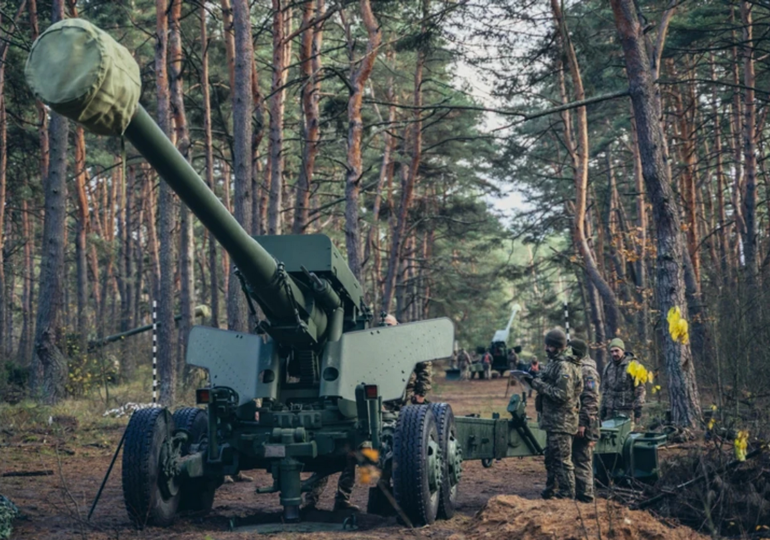
The Bogdana self-propelled artillery system represents one of the emblematic successes of the Ukrainian defense industry. It is a large 155mm gun mounted on a truck, allowing operators to precisely hit the enemy and quickly change positions. Ukrainian artillerymen say it is as accurate as a sniper rifle.
The realities of the battlefield are constantly evolving. Drones operating tens of kilometers away from the combat zone pose a threat to all large vehicles, making towed howitzers mounted on trailers increasingly relevant on the front lines. They are easier to camouflage and can better withstand drone strikes.
Towed artillery has its own combat limitations but currently represents a defining trend on the modern battlefield. This is why the manufacturer of the Bogdana self-propelled system, the Kramatorsk Heavy Machine Tool Plant, has developed a towed version of its howitzer, named Bogdana-BH.
For a year now, the howitzer has been carrying out combat missions within the artillery units. To further strengthen its artillery capability, the Air Assault Forces Command 7 provided its artillery brigade with Ukrainian-made towed guns.
Training and unit coordination lasted for two months, after which the artillerymen, together with the newly delivered Bogdana-BH systems, were deployed to the east, in the Pokrovsk sector, as reported in a frontline report by Ukrainska Pravda.
A Heavier and Deadlier Gun
The towed Bogdana gun is nearly two and a half times heavier than the British M777 howitzer commonly used by Ukrainian forces. While a Humvee is sufficient to tow the M777, the Bogdana-BH is towed by a standard military KrAZ-6322 truck. In some cases, an armored tracked MT-LB transport vehicle is also used.
The self-propelled artillery system measures 13.5 meters in the deployed configuration, making it three meters longer than an M777.
The gun has a caliber 52 barrel, the same as the French CAESAR howitzer. On the other hand, the M777 has a caliber 39 barrel. The longer barrel length improves accuracy due to the higher projectile acceleration, but it also makes the system heavier and more visible.
The maximum firing range of the towed Bogdana gun is 41 kilometers, with a minimum range of 4.7 km.
Everything Must Be Controlled from A to Z
"The design of the Bogdana gun is quite successful. This weapon is like a sniper rifle. Its precision is very high. However, achieving such results also depends on people. We need precise target coordinates, we need to make all calculations, update meteorological data, adjust the temperature of the charge. In other words, everything must be controlled from A to Z," emphasizes the battalion's chief of staff, Volodymyr (alias "John").
"The ground gun commander also needs to receive and transmit firing data correctly. They must ensure the correct type of cartridge and charge are used. The fuse must be set identically for each cartridge. Therefore, a complete set of measures is necessary to hit the target with the first shot," he adds.
Despite the advantages of the howitzer, the military also expects certain technical deficiencies to be remedied as they affect the firing range and sometimes limit the use of certain types of ammunition.
Most artillery units consist of mobilized soldiers who have learned shooting skills from scratch. Many of them are experiencing combat for the first time.
How Bogdana Strikes
The main crew of the Bogdana-BH howitzer consists of a commander, gunner, loader, and ammunition handler - all four ensure the firing capacity of the system.
Upon receiving the order from the battery commander, the howitzer commander orders the crew to prepare for battle. The crew quickly exits the shelter and removes the gun camouflage. Through the communications officer, the commander transmits the target coordinates to the gunner, who sets the sight and deflection angle.
At the howitzer commander's command, the loader prepares the ammunition for firing. The type of projectile is selected at the command post based on the distance from the target and its characteristics. For example, it could be a high-explosive fragmentation projectile, a projectile specialized for mining enemy roads, or a long-range rocket projectile.
Meanwhile, the ammunition handler selects the propellant charge, which determines the firing range of the gun. Unlike systems from the Soviet era, Bogdana uses powder packed in cloth bags instead of metal casings.
The fire adjustment follows. The fire control post transmits the results of the previous fire, and the gunner, under the senior officer's command, adjusts the sight accordingly.
The Job Doesn't End After the Last Salvo
Each gun is supported by a crew and a driver who assist in mounting and dismounting the gun, as well as preparing it for transport to another position.
The closer the howitzer is to the contact zone, the greater the risk of encountering fiber optic drones or other threats. Consequently, each gun delivery to a firing position is planned as a large-scale special operation within the brigade.
The gun can be safely transported to and from positions only at night.
The Bogdana-BH is mounted on the axis of a towed gun with a 2A36 Giatsint-B Soviet vehicle. The military appreciate this solution: the base withstands both firing and transportation very well.
If a Russian FPV drone detonates near the axis and destroys two wheels on one side, the soldiers can take a wheel from the undamaged side and mount it there, then continue transporting the gun to a repair shop without major difficulties.
How the Howitzers Are Defended
Long before the Bogdana series appeared, troops prepared positions for howitzers. This is essential because otherwise, the systems would have been quickly detected and destroyed. The situation was complicated by the extremely rugged terrain, and specialized equipment could not approach under enemy fire, so soldiers did everything manually.
The guns are covered with five layers of camouflage and anti-drone netting. A protection frame is prepared just before the howitzer is brought into position and then installed on-site.
Camouflage work is carried out under difficult conditions. In winter, artillerymen endure the cold, and when it rains, they remove water and mud from shelters with buckets.
Russians constantly target the deployed guns. To repel the attacks, each gun is assigned a small fire support group equipped with special rifles, drone net launchers, as well as jamming systems. They defend the gun when it is in a storage position.
If a drone threat is declared while firing, the artillerymen cease firing with the howitzer, take up rifles, and join the defense. Only in the event of a large-scale enemy attack on Ukrainian positions are the artillerymen required to continue firing with shells, while the gun defense is entirely left to the security unit.
Russian forces primarily target the running gear and breech of the gun. Damaging the running gear immobilizes the howitzer, while damaging the breech (the rear part of the barrel where the breechblock is located) makes loading impossible.
Fortunately, the Bogdana gun is easy to repair: most damages caused by drone attacks or counter-battery fire can be remedied in two to three days.
The manufacturer's representatives are in constant contact with the artillerymen. They advise the troops on how to independently carry out repairs and also assist in repairing the howitzers at repair workshops behind the front lines. The necessary spare parts are delivered to the unit within a few days.
Today's War Is Not Like Four Years Ago
According to him, maintaining and supplying towed artillery in the critical area ("kill zone") is particularly challenging. The cannons need to be supplied with ammunition and evacuated behind the front line for servicing. Even cleaning the barrel after a certain number of shots requires special fluids, which are very difficult to use at the firing position.
"Before moving the cannons, we analyze the peak activity periods of enemy drones - what types of drones fly, where they operate, and at what altitudes. Based on this analysis, we build our entire logistic system," says the commander.
All brigade KrAZ-6322 tractor vehicles have been equipped with additional armor and electronic warfare systems.
To supply the cannons with ammunition, the brigade has established a network of "control points" where shells and supplies are delivered by trucks. From there, they are distributed using vans, Humvees, or GAZ-66 trucks.
Both organizationally and technologically, Ukraine's modern artillery differs greatly from what was facing the enemy in 2014 and even in 2022, notes Ukrainska Pravda.
"Today, positioning a cannon on the front line requires a creative approach and a careful analysis of all risks," emphasizes Viktor Dovhal. "It's not just about building additional firing positions, but also about deceiving the enemy. The tactical calculations that worked in the past no longer apply in a modern war shaped by 'kill zones'."
T.D.