
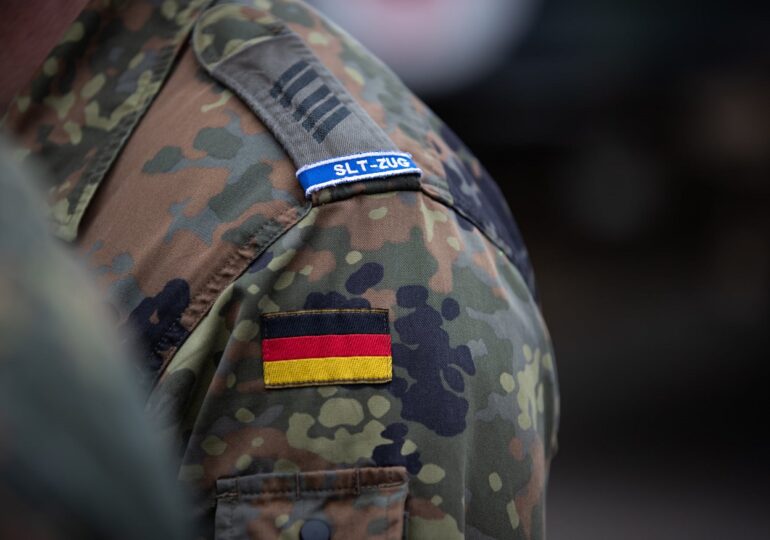
The number of young people applying for conscientious objector status and refusing armed military service in Germany has significantly increased this year, affecting Berlin’s efforts to create the strongest conventional army in Europe and to deter the threat posed by Russia.
A conscientious objector is a person who refuses to perform compulsory military service citing sincere and profound religious, ethical, or moral reasons. This status allows exemption from military training and its replacement with an alternative civilian service, protected internationally by the European Convention on Human Rights.
According to data provided on Tuesday by the German government, in the first half of 2026, more people have applied to be exempted from military service for religious or moral reasons than in the entire previous year, writes The Guardian.
By June 30, the institution handling these requests has received 5,862 applications. In comparison, in the entire year 2025, 3,879 requests were filed, and in 2024, 2,249 were recorded.
The German constitution guarantees the right to conscientious objection, stating: "No one can be compelled, against their own conscience, to perform military service involving the use of weapons."
The request for conscientious objector status is preventive in nature, as Germany currently does not have compulsory military service.
- German men under 45 years old must request Army permission if absent from the country for more than 3 months
- More and more Germans refuse military service
On the other hand, in an attempt to revitalize the army, which is affected by personnel shortages, the government introduced this year the obligation for all German men reaching the age of 18 to complete a form declaring their readiness to serve in the military and undergo a medical examination.
Women are encouraged to volunteer for military service, but they are not required to participate in the selection process under this plan introduced by Defense Minister Boris Pistorius, a member of the Social Democratic Party.
Compulsory military service could be reintroduced
The ruling conservative parties, the Christian Democratic Union and the Christian Social Union (CDU/CSU), have stated that if Pistorius fails to achieve the goal of having 260,000 active volunteer military personnel by 2035, compulsory military service – suspended since 2011 – could be reintroduced. However, such a measure would require the adoption of new legislation.
In 2011, the year recruitment was suspended, 4,348 individuals applied for conscientious objector status.
The increase this year is considered to be driven by concerns about potential military involvement in tension zones, such as the Strait of Hormuz, or in a potential peacekeeping mission in Ukraine.
Germany, like many Western states, has significantly reduced its military capabilities after the end of the Cold War, currently having approximately 186,000 active military personnel and facing major capacity deficiencies that Berlin is urgently trying to address.
The increasingly pronounced geopolitical instability, the threat posed by Russia following its large-scale invasion of Ukraine, and the pressures exerted by Donald Trump have led Germany to gradually abandon the pacifism that characterized its post-war policy and adopt a firmer military stance.
Chancellor Friedrich Merz, who took office last year, promised to transform the German armed forces, Bundeswehr, into "the strongest conventional army in Europe."
There are also individuals requesting the cancellation of conscientious objector status
Individuals applying for conscientious objector status must submit a short personally signed statement of intent, a curriculum vitae, and a declaration explaining the reasons for refusing armed military service to the Bundeswehr.
Although the increase in the number of applicants has drawn attention from the German press, the number of individuals requesting the cancellation of previously obtained conscientious objector status is also on the rise.
The Neue Osnabrücker newspaper reported in April that 233 individuals renounced, in the first quarter of 2026, the recognized right to refuse military service, after 781 had done the same throughout the entire year 2025.
Individuals granted conscientious objector status may still be mobilized for civilian duties in case of a national security emergency.
Opinion polls indicate considerable support in Germany for rearmament and for increasing the military's personnel. However, thousands of young people have organized protests at a national level this year and "school strikes" against this policy, arguing that the government is trying to turn them into "cannon fodder."
I.O.