

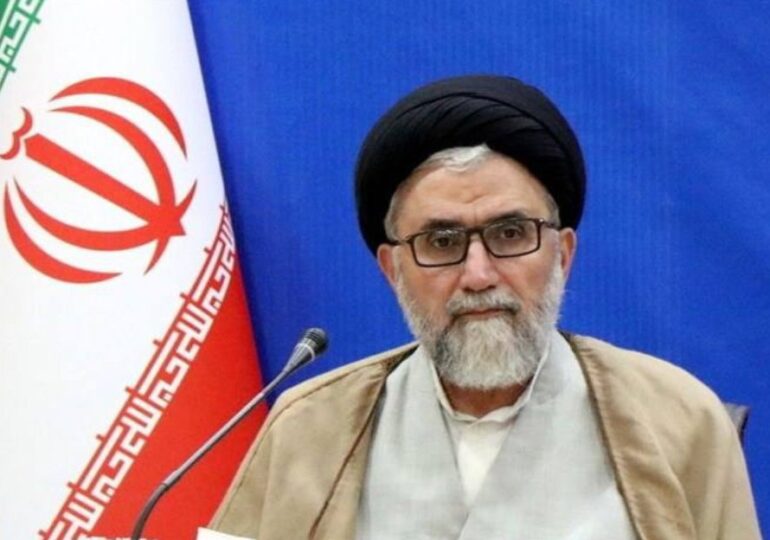
Israeli Defense Minister, Israel Katz, announced on Wednesday that the army had killed Iranian Minister of Intelligence, Esmail Khatib, in a nighttime attack in Tehran. Iran has not yet confirmed his death.
Killing Khatib removes yet another key figure from the core of Iran’s political and security system at a time of acute crisis, following the death of Ali Larijani – a central figure in the system and the most important figure killed since Ali Khamenei – and Basij commander, Gholamreza Soleimani, along with other high-ranking paramilitary figures.
Esmail Khatib had been serving as Iran's Minister of Intelligence since August 2021, appointed by the then-president, Ebrahim Raisi, writes The Guardian.
His exact age is not known. Some sources say he was born in 1960, others in 1961.
A cleric deeply rooted in the security apparatus of the Islamic Republic, he held positions within the Islamic Revolutionary Guard Corps (IRGC) and the judiciary system throughout his career.
According to Israeli sources, he was close to the new Supreme Leader Mojtaba Khamenei.
The Israeli army stated that the Intelligence Ministry led by Khatib was "the main source of information for the Iranian terrorist regime, which also played a key role in supporting the repression and terrorist activities of the regime."
The Ministry "possesses advanced intelligence capabilities, overseeing espionage and carrying out secret operations worldwide, especially against the State of Israel and Iranian citizens," the IDF stated.
Sanctioned by the US Treasury
In 2022, the US Treasury sanctioned Khatib for "the involvement of the Intelligence Ministry in cyber activities against the United States and its allies," according to Associated Press.
Khatib "leads multiple cyber actor networks engaged in espionage and ransomware attacks in support of Iran's political objectives. In addition to conducting malicious cyber activities that have affected Albanian government websites, Intelligence Ministry cyber actors have also been responsible for leaking documents believed to originate from the Albanian government and personal information associated with Albanian residents," the Treasury stated at that time.
Additionally, the Treasury named the Intelligence Ministry of Iran, in another round of sanctions, "one of the Iranian government's main security services, responsible for serious human rights abuses."
"Under his leadership, the Intelligence Ministry has aggressively targeted human rights defenders, women's rights activists, journalists, filmmakers, and members of religious minority groups," it noted.
The Intelligence Ministry "has also aggressively persecuted individuals who have reported abuses and human rights violations in Iran, as well as their families, and subjected detainees to torture in secret detention centers during his tenure."
Confiscated documents from Israel's nuclear program
In June 2025, Khatib claimed that Iran had confiscated documents from Israel's nuclear program.
The head of the International Atomic Energy Agency later stated that the information Iran claimed to have confiscated regarding Israel's nuclear program "appears to refer" to the Soreq Nuclear Research Center in the country.
Soreq, located 20 kilometers south of Tel Aviv, is a laboratory established in Israel in 1958, dedicated to nuclear science, radioactive safety, and applied physics.