
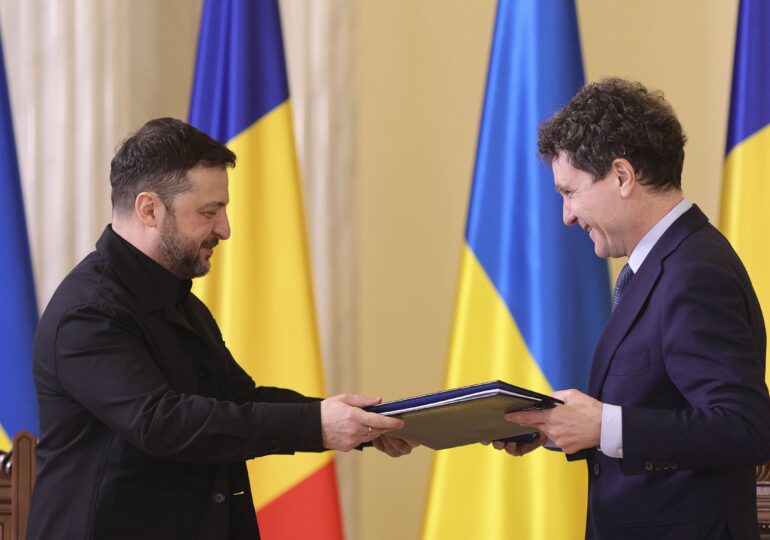
The President of Romania, Nicușor Dan, and the President of Ukraine, Volodymyr Zelensky, signed on Thursday at the Cotroceni Palace three major documents that strengthen cooperation between the two states: a Romania-Ukraine strategic partnership and two agreements on cooperation in the energy and joint armament production fields.
The documents establish the framework for extensive collaboration in political, military, economic, and energy fields, in the context of the war launched by Russia against Ukraine.
Strategic Partnership between Romania and Ukraine
The joint declaration on establishing the strategic partnership envisages expanding cooperation between the two states in numerous areas: political, defense and security, economy, energy, infrastructure, environment, culture, and education, writes Digi24.
Romania and Ukraine commit to collaborating internationally to achieve a "just and lasting peace" for Ukraine, to punish the war crimes committed by Russia, and to obtain compensation from Moscow for the aggression against the Ukrainian state.
The document also includes commitments regarding the protection of minorities. The two states affirm that they will protect the Romanian minority in Ukraine and the Ukrainian community in Romania. Additionally, Romania reaffirms its support for the continuation of reforms in Ukraine.
In the political and diplomatic field, the partnership envisages the launch of a High-Level Strategic Commission, the annual organization of joint government meetings, and periodic consultations between the parliaments and Foreign Ministers of the two states.
In the field of security and defense, cooperation will take place "based on the firm belief that the future of Ukraine lies in NATO." Romania commits to supporting and promoting Ukraine's accession to NATO among allies as soon as it meets the necessary conditions.
The two states will also cooperate in the field of cybersecurity and countering disinformation, exchange expertise in combating organized crime, and collaborate in border security and combating arms and human trafficking.
Furthermore, Romania will support Ukraine in aligning its legislation with European Union norms in the critical infrastructure protection field. The partnership also includes commitments regarding regional cooperation, transportation, energy, trade, goods transit, agriculture, business environment, and legislation.
The full document can be consulted > HERE.
Joint Armament Production in Romania
A second document signed at Cotroceni provides for cooperation between the two states in developing production capacities for Ukrainian defense systems on Romanian territory.
In the context of Russian aggression against Ukraine and the need for Kiev to strengthen its defense capabilities, Romania and Ukraine will enhance cooperation between the defense industries of both states.
The aim is to facilitate the joint production of Ukrainian defense systems and capabilities in Romania and to capitalize on the experience gained by the Ukrainian defense industry during the war.
Most of the production is intended for the Ukrainian army, as well as the Romanian army.
Romania will provide support, including financial support, to facilitate cooperation, while Ukraine will provide the necessary technology for the production of defensive equipment.
The full document can be consulted > HERE.
Energy Cooperation and New Electrical Interconnections
The third document signed by Nicușor Dan and Volodymyr Zelensky is a framework agreement for cooperation in the energy sector, in the context of the destruction caused to Ukraine's energy infrastructure by Russia's attacks.
The two states will cooperate to increase the capacity for electricity export and import by building a 400 kV overhead line between the city of Chernivtsi in Ukraine and the city of Suceava in Romania.
Additionally, the commissioning of a 110 kV electrical line between Porubne in Ukraine and Siret in Romania is planned.
The agreement also includes the development of the Vertical Gas Corridor capacity linking Greece, Bulgaria, Romania, Moldova, and Ukraine. The goal is to diversify gas supply routes for Europe and find a long-term solution to reduce natural gas transportation tariffs.
Furthermore, Romania and Ukraine will explore the possibility of using underground gas storage facilities in Ukraine for storing gas transported through the Vertical Corridor, as well as gas from the Neptun Deep project in the Black Sea.
The full document can be consulted here > HERE.