
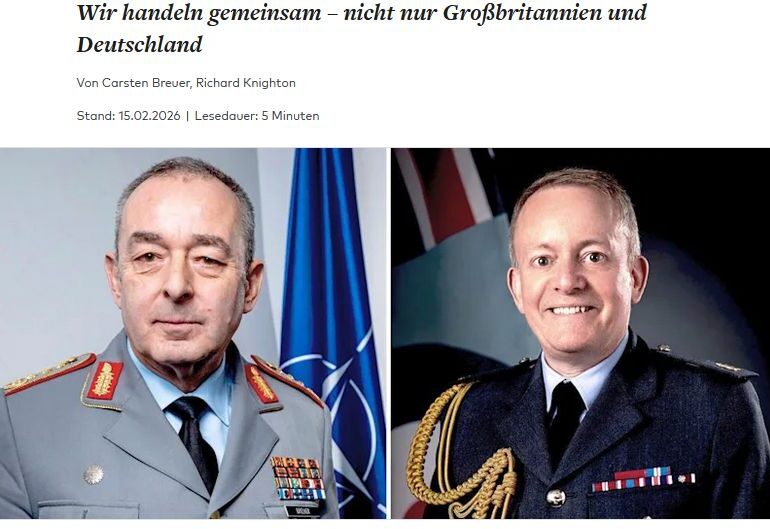
The chiefs of the armies of the United Kingdom and Germany have issued an unprecedented joint appeal to the population, calling for support for rearmament and readiness in the face of the threat of a possible war with Russia.
Air Force Marshal Richard Knighton, the Chief of the Defence Staff of the United Kingdom, and General Carsten Breuer, the Chief of Defence of Germany, have published a joint article in The Guardian and the German daily Die Welt, shortly after the Munich Security Conference.
The two military leaders explained that they are writing not only as commanders of some of the largest European armies but "as voices for a Europe that must now confront uncomfortable truths about its own security."
"As military leaders, we see every day from classified information and open sources that Russia's military posture has decisively shifted westward. Its forces are rearming and learning from the war in Ukraine, reorganizing in ways that could increase the risk of conflict with NATO countries. This is a reality for which we must prepare. We cannot stand idly by," the two stated in their appeal.
Moscow's military development, combined with its willingness to wage wars on our continent, as painfully demonstrated in Ukraine, poses an increased risk that requires our collective attention and a major change in the field of defense and security, the signatories further state.
"There is a moral dimension to this endeavor. Rearmament is not incitement to war; it is the responsible action of states determined to protect their citizens and maintain peace. Strength deters aggression. Weakness invites it," wrote the two.
"In the early years of our careers, Europe was emerging from the shadow of the Cold War. Governments of all political stripes chose to accept what was known as the 'peace dividend' – investments in public services and reduced defense spending.
This was an understandable choice at that time. Now it is clear that the threats we face require a radical change in our defense and security. European leaders, together with military and civilian officials, have just discussed the necessary consequences at the annual Munich Security Conference," the two added.
Public Reluctance Towards Defense Costs
The appeal comes at a time when a significant part of the electorate in the United Kingdom and Germany is reluctant to accept the economic costs of increasing military spending, even though majorities in both countries believe that the outbreak of a third world war is likely in the next five years.
A YouGov survey conducted this month in the United Kingdom shows that only 25% of respondents would support tax increases to fund the military, and 24% would accept budget cuts for this purpose, as noted by The Guardian.
In Germany and France, support for increased defense budgets decreases when people learn that this would entail compromises in other areas.
Knighton and Breuer argue that there is a need for "an honest conversation, at the level of the entire continent, with our citizens, to understand that defense cannot be solely the responsibility of uniformed personnel."
They advocate for "defense at the level of the entire society," which should include resilient infrastructure, private investments in research and development, and national institutions ready to operate under increased pressures.
"History teaches us that deterrence fails when the enemy senses division and weakness.
If Russia perceives Europe in this way, it may be encouraged to expand its aggression beyond Ukraine. We know that Moscow's intentions extend beyond the current conflict.
But the good news is that Europe is strong. NATO is the most successful military alliance in history, and today, together, its military power is unmatched.
We have sophisticated capabilities in land, maritime, air, and cyber domains, as well as nuclear deterrence. And we have long been adapting to the new reality of security: by building a new model of European security, supported by engagement, readiness, and collaboration," the two military leaders further write.
UK and Germany Significantly Increasing Military Capabilities
They recall that the United Kingdom and Germany have committed to deepening security cooperation through the agreement signed in 2024, known as Trinity House.
Germany has decided on the permanent stationing of a combat brigade of 4,000–5,000 soldiers on NATO's eastern flank and amended the Constitution to allow practically unlimited funding for defense. It has also begun the procurement of thousands of armored vehicles and the expansion of industrial capacity.
Meanwhile, the United Kingdom is constructing up to six ammunition factories to ensure a permanent capacity for production and replenishment of stocks.
The context is marked by nearly four years since Russia's large-scale invasion of Ukraine and uncertainties regarding American support for NATO following Donald Trump's return to the White House.
At last year's NATO summit, Alliance leaders agreed on a defense and security spending target of 5% of GDP by 2035.
"Freedom Can No Longer Be Taken for Granted"
At the Munich Security Conference, German Chancellor Friedrich Merz warned that "freedom can no longer be taken for granted."
"We must understand that in the era of great powers, our freedom is no longer guaranteed. It is at stake. We will have to show firmness and determination to defend this freedom," he stated.
Merz also revealed preliminary discussions with French President Emmanuel Macron regarding the possibility of Germany coming under France's nuclear umbrella, emphasizing the need for a more autonomous European security strategy.
In this tense context, the joint appeal of the two military chiefs represents one of the most direct public interventions by European military leaders in recent decades, highlighting the moral responsibility of rearmament and the need for society to be prepared for an extended conflict scenario.
"When Europe acts together, we are a formidable force. And if we act together, we are not just the United Kingdom and just Germany," is their final message.
B.B.