
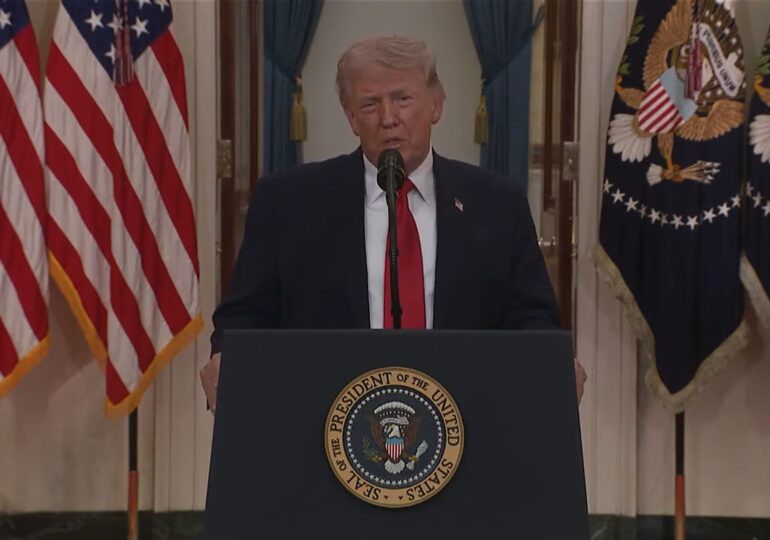
On Wednesday evening, American President Donald Trump delivered his most extensive speech to date on the war in Iran, attempting to explain why he decided on military intervention. However, his message failed to address the essential question: how and when will the conflict end, as reported by CNN.
In a speech of about 20 minutes delivered at the White House, Trump presented the most coherent justification so far for the offensive, but left open the prospect of a major escalation and did not offer a clear exit strategy.
Justification of the war: We could not allow Iran to have nuclear weapons
Trump argued that the intervention was necessary to prevent the regime in Tehran from obtaining nuclear weapons, after "47 years of threats" against the USA.
He invoked the failure of diplomacy and the violent repression exercised by Iranian authorities over their own population, insisting that America must project strength.
However, CNN's analysis shows that some of his statements - including that Iran was "on the brink" of a nuclear weapon - contradict assessments by Western intelligence services. Additionally, the president did not present concrete evidence to support these claims.
No final plan. Instead, threats of escalation
Although many expected the speech to outline an end to the war, Trump did not provide such a perspective.
Instead, he issued a harsh warning: "In the next two to three weeks, we will bring them back to the Stone Age, where they belong."
The president threatened that the USA could target Iran's energy infrastructure - including power plants and oil facilities - if Tehran does not accept his terms for peace.
This rhetoric raises questions about the direction of the conflict and the risk of a major escalation.
Strait of Hormuz and global economic risk
Another sensitive point is the blockage of the Strait of Hormuz, crucial for global oil transportation.
Trump downplayed the issue, stating that the strait "will naturally open" because Iran has an interest in selling its oil.
However, the reality on the ground contradicts this optimism: not even the US Navy has crossed the area due to the risks posed by Iranian missiles and drones.
CNN warns that maintaining the blockade could push the global economy into recession and keep pressure on energy prices - including in the USA.
Questions Trump does not answer
The speech left several major issues unanswered:
- Trump claims to have caused a regime change by eliminating some Iranian leaders, including Ali Khamenei, but the power structure in Tehran remains intact and could become even more radical.
- It is not clear what will happen with enriched uranium stocks, which could allow the resumption of the nuclear program.
- The lack of a strategy to reopen the Strait of Hormuz leaves the global economy vulnerable.
Americans, increasingly skeptical: declining support for war
The speech comes at a difficult time for Trump, both politically and economically.
According to a CNN/SSRS poll:
- only 35% of Americans approve of his presidency;
- 34% support military intervention in Iran;
- 68% oppose sending ground troops.
At the same time, confidence in managing the economy has dropped to 31%, and two-thirds of Americans believe his policies worsen the economic situation.
A war that can define his mandate
CNN concludes that the speech did not succeed in reducing public anxiety about the war and its economic effects.
Trump's assurances that fuel prices will drop and markets will quickly recover seem more optimistic than grounded in a clear strategy.
In the absence of a coherent exit plan, there is a risk that this conflict could define his mandate and affect his political legacy.

G.P.