

Wolfgang Ischinger, former ambassador of Germany to the USA, currently the president of the Munich Security Conference (MSC), opened this year’s edition of the event in a joking manner on Friday.
He said that everything that happened at the World Economic Forum in Davos (European unity in the face of Donald Trump – ed.) should not stay in Davos, and while speaking, to the amusement of those present, he put on aviator-style sunglasses, just like French President Emmanuel Macron did at Davos, who was suffering from an unsightly eye condition at that time, reports POLITICO.
Reset this weekend
After the unexpected moment of improvisation, Ischinger emphasized that this year the Munich conference takes place at a time of „growing concerns about global security, or rather, insecurity.”
"Never in the over 60 years of existence of this conference have there been so many simultaneous fundamental challenges and bloody wars in Europe, around Europe, and worldwide," said Ischinger.
"There is a reason why our Munich security report this year is titled Undermining," he pointed out.
Ischinger mentioned "unprecedented challenges" in transatlantic relations, but had warm words for US Secretary of State Marco Rubio and the US Congress delegation (predominantly composed of Democrats): "It is not the time to avoid the subject. We must be honest about the differences between us, but we should try to contribute to organizing a constructive transatlantic reset, if possible, this weekend."
Incisive questions for the EU, UN, and China
Ischinger challenged his audience, asking incisive questions about their policies.
He asked EU leaders: "What concrete measures do you propose, beyond speeches, to contribute to creating a more respected international actor European Union, more capable of defending our freedom, values, and borders?"
Then he addressed the five permanent members of the UN Security Council, asking them what they are willing to do regarding nuclear non-proliferation, and asked US representatives if the Trump administration "truly believes it needs allies and partners" and if it is "truly ready to treat allies as partners."
Referring to China, he asked Beijing's leadership – with the country's Foreign Minister present in the room – "to what extent China will be willing to invest to get Russia to end aggression and withdraw from Ukraine."
Merz spoke about Europe's guilt
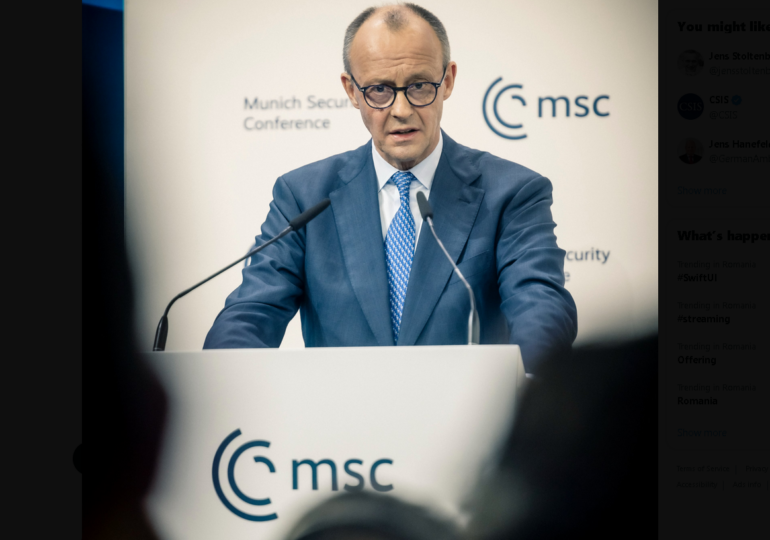
It was then Friedrich Merz's turn to speak. It is always an important moment for a German chancellor to speak at the Munich Security Conference. This is the first conference Merz has attended since taking office last year. However, unlike his predecessors, he chose to speak in the opening session on the first day, which will be seen as an attempt to set the tone of the meeting, notes The Guardian.
Merz said that the MSC motto, "Undermining," is a bit "grim," but acknowledged that "we need to formulate it in even harsher terms" because "this (world) order no longer exists."
"Europe has just returned from a holiday from history," the German leader said, explaining that the world is now facing an era "marked by the politics of great powers," including the "violent revisionism" of Russia, which dictates its aggression against Ukraine.
Addressing alternately in German and English, Merz said that Europe must address its "self-imposed" dependence on the US to rebalance transatlantic relations.
The Chancellor acknowledged that the blame also lies with Europe. "No one forced us to reach this recent excessive dependence on the United States. This dependence was self-imposed, but we are now giving up this state as quickly as possible," he demanded, as quoted by The Guardian.
He explained that this can be achieved by strengthening the European pillar of NATO, while being aware that there will be different viewpoints.
"I assume that we will have different opinions more often than in the past, we will have to negotiate the right path, and we may have to argue about it. But if we do this with new strength, new respect, and self-respect, it will benefit both parties," he assured.
What about "mutual assistance" in case of an attack
Merz also called for further discussion on Article 42 of the EU treaties, which refers to "mutual assistance" in the event of an armed attack on Europe. He said he wants the EU to "clarify" how this should work – "not to replace NATO, but as an autonomous and strong pillar within the alliance."
In this context, the chancellor announced that he has started "initial discussions" with Emmanuel Macron about a European nuclear deterrence program "integrated into nuclear sharing within NATO." "Let's change the mindset" to make Europe a superpower and deal with the chaos of the new world order, urged Merz.
Message to Americans: MAGA's cultural battle in the US is not Europe's
Switching to English, the German chancellor directly addressed the US delegation in the audience. He said that for generations, "the trust among allies, partners, and friends has made NATO the strongest alliance of all time."
"Europe knows very well how precious this is," he added before warning Americans: "In the era of great power rivalry, not even the United States will be strong enough to act alone."
"Dear friends, NATO membership is not only a competitive advantage for Europe, but also for the United States. So let's repair and revive transatlantic trust together. We Europeans are doing our part," he assured after responding to last year's aggressive speech by Vice President JD Vance, agreeing with him that a gap has been created between Europe and the US on several issues.
But the German chancellor made it very clear: "MAGA's cultural battle in the US is not ours in Europe," and added, referring to Washington's reproaches, that "freedom of speech here (in Europe) ends when spoken words are against human dignity and fundamental law."
Merz said he can understand why some people are "unsettled" about the current state of relations with the US and "shares" some of these concerns, but still believes that calls to abandon the US as a partner are unrealistic. He argues that "they ignore the harsh geopolitical realities in Europe and underestimate the potential that the partnership with the US still has, despite all the existing difficulties."
Europe is heading towards other partners
Merz believes that the US claim to global leadership "has been countered and probably lost."
In his view, Europe should continue to focus on creating and promoting its own program to cope with the new order, through a united European Union. "Great power politics in Europe is not an option for Germany. Leadership in partnership, yes. Hegemonic fantasies, no," he emphasized.
Merz then referred to other European alliances, speaking about the importance of the E3 format with France and the UK and the broader format with Italy and Poland. "In the long run, we will only be successful if we involve other Europeans, and we Germans are doing this, we have no other choice. We are in the heart of Europe. If Europe is divided, so are we. Germany is divided," he stated.
In this context, Merz said that Europe can seek new commercial and political partners globally, as "partnership is not an absolute term in this context; it does not require complete convergence of all values and interests." In this context, he mentioned Canada, Japan, Turkey, India, Brazil, South Africa, Gulf states, and others.
About China and Russia
Regarding China, it "wants to be a leader in shaping the world," but "systematically uses the dependencies of others and redefines the international order in its favor." In his opinion, the US has now realized the need to "recover in certain areas" against China, which "does not slow down this trend, but rather accelerates it."
Merz also spoke about Germany's and Europe's support for Ukraine, emphasizing his government's efforts to amend the Constitution to increase defense spending.
"A striking example is that Russia's GDP is currently about 2 trillion euros, while that of the European Union is nearly 10 times larger. However, Europe is not ten times stronger than Russia at present. Our military, political, economic, and technological potential is huge, but we have not exploited it to the necessary extent for a long time. So, the most important thing is to change the mindset now," explained the German chancellor.
Germany does not forget what a world where might makes right looks like
In the opinion of the German Chancellor, "the politics of major powers" is "a reflection of unsettled and agitated societies in times of revolutionary change." However, Merz also warned that this tests the limits of the democratic system, as it pushes people towards "strong and easy answers."
The Chancellor says that Europeans must accept that this is the reality they are facing and confront it - rather than deny the issue.
Merz concluded his speech with a stern warning: "We, Germans, know that a world where might makes right would be a dark place. Our country went down this path in the 20th century, to a bitter and horrifying end." Therefore, he said, this time a different response is needed.