
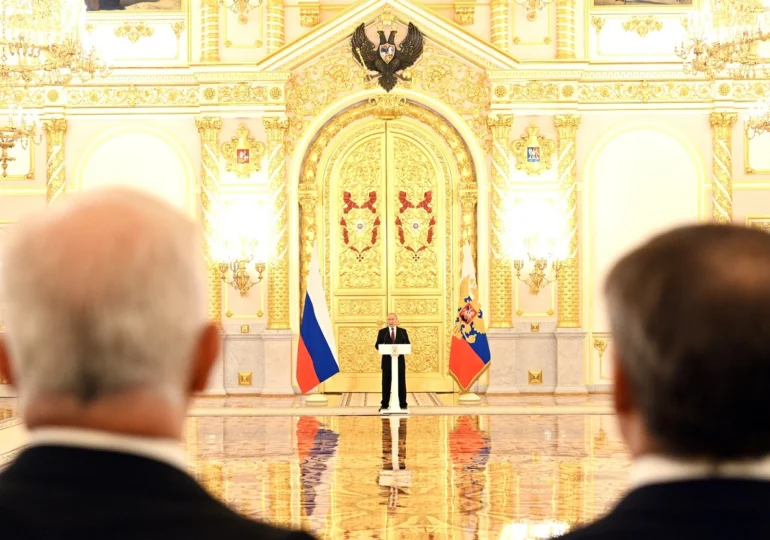
Security measures targeting Russian President Vladimir Putin have been drastically reinforced amid a wave of assassinations targeting personalities in the military sector and the risk of a coup, according to a report from a Western intelligence service.
The Kremlin has installed surveillance systems in the homes of personnel working for the President of Russia. Putin’s chefs, bodyguards, and photographers are forbidden from using public transportation.
Additionally, those received by the Kremlin leader must be double-checked, and those working in his vicinity can only use phones without internet access, as stated in a report from a European intelligence agency obtained by CNN.
The report, transmitted to the television station and other media institutions by a source close to a European intelligence service, suggests a growing unease in Kremlin circles as Russia faces increasing challenges both domestically and internationally, including economic issues, growing signs of dissent, and failures on the Ukrainian front.
The Killing of a General Sparked System Paranoia
Some of the measures have been implemented in recent months following the killing of a high-ranking general in December, which sparked a dispute within the top ranks of the Russian security system, according to the document.
Russian security officials have significantly reduced the number of places Putin regularly visits, the report states. The President and his close associates have stopped going to their usual residences in the Moscow region and Valdai, the President's secluded summer property located between St. Petersburg and the capital.
The report indicates that Putin has not visited any military base this year, although he traveled periodically in 2025. To mask these restrictions, the Kremlin releases pre-recorded images of him, the report mentions.
Since the invasion of Ukraine in 2022, Putin spends weeks in modernized bunkers, often in Krasnodar, a coastal region bordering the Black Sea, a few hours away from Moscow.
Shoigu Suspected of Plotting a Coup
According to the report, since the beginning of March 2026, the Kremlin and Vladimir Putin himself have been concerned about potential leaks of sensitive information, as well as the risk of a plot or coup attempt targeting the Russian President. "He is particularly cautious about the use of drones for a possible assassination attempt by members of the Russian political elite," the document states.
But the most striking conclusion concerns former Putin confidant, Sergei Shoigu, as mentioned by CNN. The former Defense Minister, now marginalized, who currently serves as Secretary of the Security Council, "is associated with the risk of a coup, as he retains significant influence within the high military command," the report states.
The arrest of former deputy and close associate of Shoigu, Ruslan Talikov, on March 5 is considered "a breach of tacit protection agreements between power circles, weakening Shoigu and increasing the likelihood of him becoming the target of a judicial investigation," the document further states.
The Russian Investigative Committee stated in a release in March that Talikov was arrested on charges related to embezzlement, money laundering, and bribery. Reports of corruption among the military elite are frequent, but have increased since the beginning of the Ukraine invasion.
Putin survived a previous coup attempt in June 2023 when the head of the mercenaries, Yevgeny Prigozhin, led a failed march towards Moscow.
The report does not provide evidence to support the accusations against Shoigu, who was previously considered very close to Putin. Considering that the publication of the document could aim to destabilize the Kremlin, it should be noted that the European intelligence service would warn the Kremlin about a possible coup attempt, as noted by CNN.
Internal disputes within the Moscow elite often spark intense speculation but are rarely revealed. And amidst the invasion of Ukraine, as US support for Kiev wanes, European intelligence services have a significant reason to suggest an increase in conflicts and paranoia within the Kremlin.
The nature of this information makes some details difficult to verify, as highlighted by the American television station, which mentioned contacting the Kremlin for comments.
Putin Has Further Isolated Himself
It was previously known or suspected that among the security measures around Putin included thorough body searches, avoiding smartphones at the Kremlin, and restricting the President's movements. Putin still appears periodically in public, meeting this week with his ally Ramzan Kadyrov and Iranian Foreign Minister Abbas Araghchi.
The Russian President began isolating himself during the Covid-19 pandemic, often sitting at the end of a long table until he ordered the invasion in February 2022.
Details of the new security measures come just days after Moscow announced significant changes to the May 9 Victory Day parade in Red Square commemorating victory over Nazi Germany. This year's event - the fifth since the large-scale invasion of Ukraine - will take place without heavy armaments such as tanks and missiles.
Kremlin spokesman Dmitry Peskov indicated that the recent threat and success of longer-range Ukrainian attacks were behind these modifications. "In the face of this terrorist threat," he said, "of course, all measures are being taken to minimize the danger."
Previous parades were a demonstration of Kremlin's military power but have been scaled down since the start of the Ukraine invasion, citing operational and security concerns.
Renegades of the Kremlin
The intelligence report also evokes an intense exchange of remarks between high-ranking officials during a meeting at the Kremlin at the end of last year with Putin, which partially triggered the new security measures.
Three days after the assassination of Lieutenant General Fanil Sarvarov in Moscow on December 22, 2025, likely by Ukrainian agents, Putin summoned key security personnel.
During the meeting, Chief of the General Staff Valery Gerasimov blamed the head of the Federal Security Service (FSB), Alexander Bortnikov, for not protecting his officers. In turn, the FSB complained about the lack of resources and personnel to fulfill their duties, as stated in the report.
"Emphasizing the fear and demoralization this caused among the personnel (military), Valery Gerasimov vehemently criticized his counterparts in the special services for their lack of foresight," the report states.
"At the end of this tense meeting, Vladimir Putin called for calm, proposing an alternative working format and instructing those present to present concrete solutions to this problem within a week," the document continues.
That quick solution involved Putin expanding his own Federal Security Service (FSO) - which at the time only protected Gerasimov in the military command - to provide security to ten other senior commanders.
The report suggests that Putin's intensified security measures took place after this FSO mandate expansion.
Western intelligence agencies rarely disclose detailed reports of secret decisions by hostile actors, likely obtained from human or electronic sources that could be compromised if exposed, as noted by CNN.
However, the publication of the report may reflect an attempt by European decision-makers to capitalize on an opportunity that critical voices have long argued was their sole strategy to defeat Russia in Ukraine: waiting for its internal collapse, the source concludes.
T.D.