
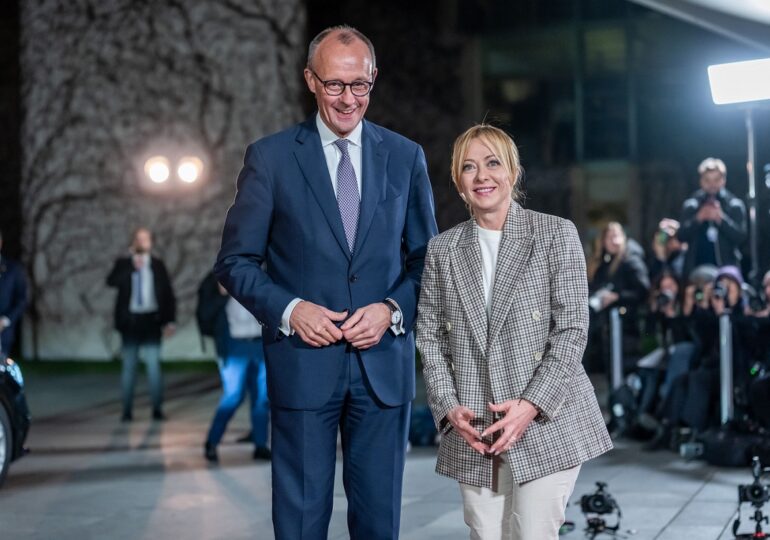
As the traditional Franco-German engine of Europe sputters, German Chancellor Friedrich Merz increasingly seeks to collaborate with Italian far-right Prime Minister Giorgia Meloni to have her as a co-pilot in leading the EU.
The two are set to meet on Friday at a summit at the opulent Villa Doria Pamphilj in Rome to strengthen their budding alliance. Both are right-wing Atlanticists aiming to ease tensions with U.S. President Donald Trump. And both are frustrated with French President Emmanuel Macron, Politico writes.
In the past, Germany traditionally turned to France in crucial moments to devise plans for the EU, so it is significant that Merz is now aligning with Meloni in his effort to promote fundamental European priorities in trade and industry.
A Language Paris Dislikes
Part of Merz's attraction to Meloni is fueled by dissatisfaction with France. Berlin is irked by Paris attempting to undermine the historic Mercosur trade deal with South America, long sought by the Germans to boost industrial exports. Germany is also considering pulling out of a joint €100 billion fighter jet program due to disputes with the French.
In this context, aligning with Rome makes compelling sense.
During Friday's summit, Merz and Meloni are expected to sign a defense cooperation agreement, according to diplomats involved in the preparations. It is unclear what this entails, but Germany's Rheinmetall and Italy's Leonardo already have a partnership for building tanks and other military vehicles.
In total, 21 high-ranking ministers from both countries are expected to participate in the meetings and sign 10 agreements, according to the Italian government.
Perhaps the most ambitious project is the collaboration between Italy and Germany to develop a new action plan to revitalize the EU industry and expand exports, according to a joint position document prepared for the European Council summit on February 12. Berlin and Rome self-identify as the "two main European industrial countries" and condemn delays in the Mercosur agreement.
But this language will irk Paris.
Macron Will Exit the Stage
For Giangiacomo Calovini, a parliamentarian from Meloni's Brothers of Italy party who leads the Italian-German friendship group in parliament, the Merz-Meloni alliance makes sense, especially given Macron's imminent departure from the European stage after next year's French elections. "Our two countries have stable governments, especially compared to France," he said. "It's clear that Meloni and Merz probably have a long way to go together," the Italian deputy affirmed.
Maintaining the relationship with Trump is crucial for both leaders, and both Merz and Meloni have sought to avoid transatlantic conflicts. Their efforts have been supported by their foreign ministers, Johann Wadephul and Antonio Tajani.
"Giorgia Meloni and Friedrich Merz represented the most open European wing to dialogue with President Trump," said Pietro Benassi, former Italian ambassador to Berlin and the EU. "The somewhat surreal acceleration driven by the American president confirms a convergence of positions between Italy and Germany, rather than between Italy and France or France and Germany," Benassi confirmed.
Unlike Rome and Berlin's soft approach, Calovini accuses Macron of "contradictory" and unhelpful behavior towards Trump. "He acts as if he wants to provoke the United States of America, but then sends messages – which Trump elegantly made public – asking Trump to have dinner with him," the parliamentarian pointed out.
A Good Chemistry Between Merz and Meloni
Officials in Berlin are now privately enthusiastic about the growing cooperation with Meloni, describing the relationship with Rome as trustworthy.
"Italy is trustworthy," said a senior German government official who wished to remain anonymous to speak candidly. It's not an adjective Berlin has used frequently lately to describe its French counterparts.
"France is more vocal, but Italy is much more pragmatic," said Axel Schäfer, a prominent lawmaker from Germany's Social Democratic Party who has long focused on German-Italian relations.
An Italian official also praised the "good chemistry" between Merz and Meloni on a personal level. This starkly contrasts with the notoriously tense relations between Meloni and Macron, who have clashed frequently.
In their efforts to draw closer, Merz and Meloni have sometimes resorted to hyperbole. During his inaugural visit to Rome as chancellor last year, Merz declared that there was "practically complete agreement between the two countries on all European policy issues."
Meloni responded in kind. "It is simply impossible to question the relations between Italy and Germany," she said at the time.
Where Berlin and Rome Disagree
However, the two leaders have significant differences.
Meloni refused to support a doomed plan, promoted by Merz, to use frozen Russian assets to fund military aid for Ukraine. Meloni also initially opposed the Mercosur trade deal to secure concessions for Italian farmers before eventually backing it.
Critically, Rome and Berlin are likely to be very uncomfortable allies when it comes to public finances. Italy has long pushed for a more flexible European fiscal policy – and has been a natural ally of France in this regard – while Germany has advocated for strict fiscal discipline on the continent.
Yet, even here, there has been some convergence, with Meloni cutting Italy's expenses and Merz presiding over a historic debt-fueled expansion of spending on infrastructure and defense.
Meloni Seizes the Opportunity to Approach Merz
Essentially, much of the growing alliance between Merz and Meloni is a result of changes made for their own internal political survival. Meloni has pulled her nationalist Brothers of Italy party toward the center, especially regarding foreign policy. Meanwhile, the rise of the far-right Alternative for Germany (AfD) in Germany has forced Merz to abruptly steer his conservative party to the right on migration.
This ideological fusion has allowed for an improvement in relations. As Merz sought European partners to drastically reduce the influx of asylum seekers into Europe, ease regulations, promote trade, and counterbalance Macron, Meloni has become an increasingly important figure for the chancellor.
However, Stefano Stefanini, a former senior Italian diplomat and NATO representative, says the relationship will always have limits. "It's very tactical," he said. "There is no coordinated strategy. There are several issues where Meloni and Merz find themselves on the same side," he pointed out.
Stefanini also noted that spending regulations – especially for military projects – would be an area where Rome would once again find itself in a more natural alliance with France.
"Regarding defense spending, Italy and France are closer because Germany has the fiscal capacity to spend alone, while Italy and France need to secure as much financial support as possible from the EU," he stated.
Despite these differences, Meloni has seized the opportunity to approach Merz. "Meloni understood that, given the existing tensions in the Franco-German relationship, she could infiltrate and get closer to Germany," says Marc Lazar, an expert in Franco-Italian relations who teaches at Luiss University in Rome and Sciences Po in Paris.