

On the 27th day of war in the Middle East, we learn that Israel has removed the Foreign Minister of Iran and the President of the Parliament from Tehran from the target list at the intervention of Pakistan. This comes after Islamabad emphasized that after the elimination of the two officials, the US would have no one to negotiate with.
On the other hand, Hezbollah has rejected any „under-fire” negotiations with Israel, which has continued its attacks on the strongholds of the pro-Iranian group in Lebanon.
Meanwhile, Russia is about to complete a delivery of drones, medicines, and food to Iran, according to sources from Western intelligence.
Amidst the ongoing attacks, the effects of the conflict continue to spread across all levels of the global economy. The price of oil has risen again this morning, and essential fertilizers for agriculture are also becoming more expensive.
The war in the Middle East will be on the agenda of the G7 Foreign Ministers' meeting today and tomorrow.
Highlights of the day:
- Iran: Powerful explosions occurred this morning around the city of Isfahan, which hosts an important Iranian airbase and other military sites, as well as one of the nuclear sites bombed by the US in June.
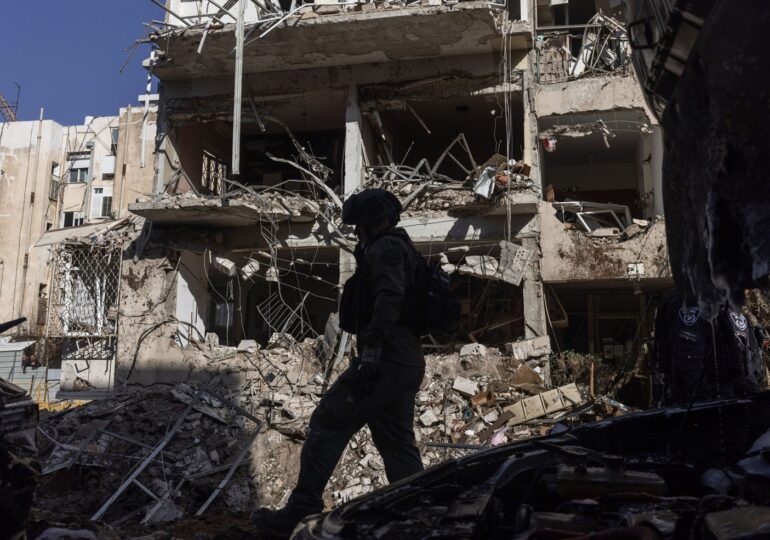
- Israel: Iranian rockets have hit several points in the metropolitan area of Tel Aviv. Six people were injured in the predominantly Arab city of Kafr Qasim. Overnight, mortar fire targeting the Tel Aviv area was also reported, launched from Iran and Lebanon.
- UAE: Two people died in Abu Dhabi after debris from a ballistic missile intercepted by air defense systems fell, and three people were injured.
Spotmedia.ro keeps you informed, even on the 27th day of war, with the most important information about the war in the Middle East:
- Trump attacks NATO allies again - President Donald Trump has a new post on Truth Social criticizing NATO entirely in uppercase letters, stating that the alliance countries did nothing to help regarding Iran, although he specifies that the US did not need this help. Trump issues what seems to be a veiled warning: the US will "never forget" this very important moment, writes the White House chief.
- Pakistan intervened for the Iranian Foreign Minister - Israel removed the Iranian Foreign Minister from the target list after an intervention by Pakistan, a Pakistani official told Reuters, according to Sky News. Abbas Araqchi and the parliament president, Mohammad Baqer Qalibaf, were on the target list until Pakistan asked Washington not to kill them. In turn, the US asked Israel not to assassinate the two, said the official. "The Israelis had their coordinates and wanted to eliminate them. We told the US that if they are also eliminated, then there is no one left to talk to. Therefore, the US asked the Israelis to withdraw," said the Pakistani official.
- Two dead in Abu Dhabi, drones and missiles intercepted in the Emirates - Two people died in Abu Dhabi after debris from a ballistic missile intercepted by air defense systems fell, and three people were injured. Several cars were damaged, as reported by BBC. The United Arab Emirates announced this morning that it intercepted missile and drone attacks from Iran above its territory.
- Fertilizers are also becoming more expensive - The blockade of the Strait of Hormuz is affecting not only the oil and gas market but also the global supply of agricultural fertilizers, leading to significant price increases and concerns about food security, CNBC reports. Approximately one-third of global maritime trade in fertilizers passes through the Strait of Hormuz, according to the UN. Futures contracts for fertilizers are less liquid than those for other commodities, making prices less transparent. According to Oxford Economics’ Alpine Macro, urea prices have increased by about 50% since the beginning of the conflict, and ammonia prices by about 20%. Other fertilizers, such as potash and sulfur, have also become more expensive. Experts warn that if farmers do not have access to the necessary amount of urea, agricultural production will inevitably decrease.
- Russia on the verge of sending drones to Iran - Russia is about to complete a delivery of drones, medicines, and food to Iran, according to sources from Western intelligence, as revealed by Financial Times. Secret negotiations between Russian and Iranian officials began a few days after the US and Israel attacked Iran. Moscow already provides logistical support to the Iranian power with satellite images and secret information.
- Iranian rockets hit Tel Aviv - Iranian rockets launched at Israel hit several points in the metropolitan area of Tel Aviv this morning, as announced by the Israeli army, dpa reports. Six people were injured in the predominantly Arab city of Kafr Qasim, east of the coastal city, according to Israel's emergency service Magen David Adom. Emergency crews arrived within minutes of the impact and found significant damage to a building, with injuries caused by the shockwave, a medic said. Mortar fire targeting the Tel Aviv area from Iran and Lebanon was also reported overnight, according to local media.
- Powerful explosions around the city of Isfahan - Activists in Iran reported intense attacks this morning around the city of Isfahan, located about 330 km south of Tehran. The pro-reform newspaper Ham Mihan reported online about the explosions in the area, as reported by AP. Isfahan hosts an important Iranian airbase and other military sites, as well as one of the nuclear sites bombed by the US in June. The semi-official Fars news agency, close to the Revolutionary Guard, described the attacks as targeting "two residential areas," without providing details. Earlier, the Israeli army declared that it had completed "a wave of large-scale attacks" across Iran, including in Isfahan.
- And oil prices are rising - Oil prices rose today by over a dollar per barrel, following the declines from the previous day, due to fears of the prolonged conflict in the Middle East after the US sent a peace plan to Iran, but Tehran rejected the discussions. The price of Brent crude oil increased by 1.65 dollars, or 1.61%, reaching 103.87 dollars per barrel, Reuters notes. US West Texas Intermediate (WTI) oil appreciated by 1.49 dollars, or 1.65%, to 91.81 dollars per barrel. This development comes after both benchmarks fell by over 2% in the previous session.
- US hits Iranian ammunition factories - The United States has attacked over two-thirds of Iran's ammunition factories, stated the head of the US Central Command. US Navy Admiral Brad Cooper made these comments in a video released this morning by the Central Command. "Today, we have damaged or destroyed over two-thirds of Iran's missile, drone, and naval ship facilities and yards - and we're not done yet," Cooper said. "We are on the verge of completely eliminating Iran's military production apparatus in general." Satellite images analyzed by Associated Press, although delayed by two weeks by Planet Labs PBC, showed Israeli and American attacks targeting shipyards and missile facilities.
- Hezbollah rejects any "under-fire" negotiations with Israel - In a statement broadcast by Hezbollah's channel, the leader of Hezbollah, Naim Qassem, stated that any "under-fire" negotiations with Israel represent a "surrender," while the Lebanese government calls for discussions with the enemy country. He urged Lebanese authorities to reconsider their decision to "incriminate" his group's military action, which Beirut decided to ban at the beginning of March.
- Iran on the agenda of the G7 Foreign Ministers' meeting near Paris - G7 foreign ministers are meeting on Thursday and Friday to discuss, in particular, the ongoing conflict in the Middle East that shows no signs of improvement, AFP reports. The G7 ministers' meeting will officially begin today in the early afternoon, without US Secretary of State Marco Rubio, who is detained in Washington, according to a diplomatic source. He will join his German, British, Canadian, Italian, French, and Japanese counterparts on Friday morning at the Abbaye des Vaux-de-Cernay, near Rambouillet, about 50 km from Paris. Foreign ministers of major emerging economies (India and Brazil) have also been invited, as well as their counterparts from Ukraine, Saudi Arabia, and South Korea.