

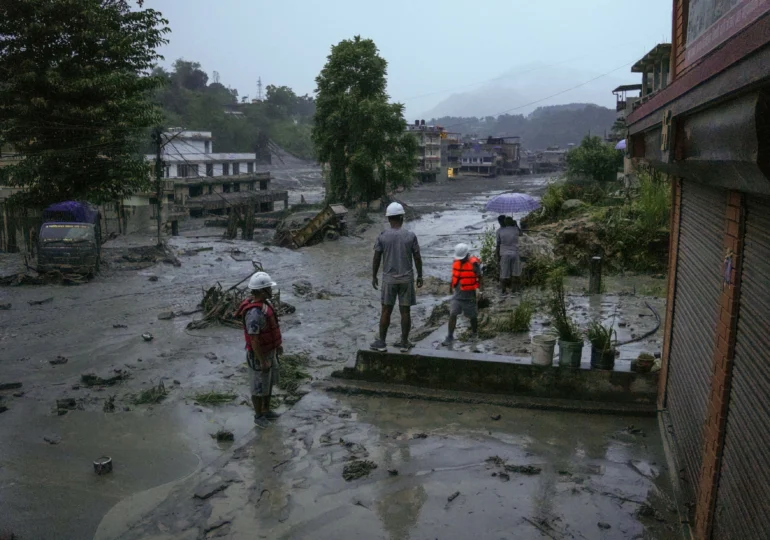
The disaster that swept entire villages on the Nepal-Tibet border was not caused by an earthquake, as initially believed. Seismic data analysis and satellite images show that the collapse of a glacier triggered the massive torrent of mud and debris.
At least 165 people have died, and over 1,000 are reported missing on both sides of the border. Among them are hundreds of foreign tourists, according to a report by The Guardian.
Search operations continue in a region that is difficult to access, where the flood has destroyed roads, bridges, and buildings. Authorities warn that the danger is not over: a blockage formed upstream could give way and trigger a new surge.
The Nonexistent Earthquake
In the initial hours after the catastrophe, experts believed that the region had been hit by a magnitude 4.4 earthquake. The movement was located approximately 66 kilometers north of Kathmandu, near the border with Tibet.
However, the data was reinterpreted. The U.S. Geological Survey (USGS) announced on Thursday that no earthquake had occurred.
Analysis of nearby seismic stations, long-wave signals, and satellite images showed that the signal was produced by the collapse of a glacier and the mass of debris set in motion.
Huge amounts of ice, rock, and soil detached and descended forcefully towards the valley, dragging water and turning into a devastating torrent.
A Wave Taller Than Buildings
Surveillance camera footage from the Chinese side of the border shows a huge wave of mud and debris hitting a multi-story building and almost completely covering it. Dozens of people are trying to flee as the torrent sweeps away buses and cars.
Other recordings show entire villages covered in mud and extensive areas where water advances at an enormous speed.
The International Federation of Red Cross and Red Crescent Societies says that entire villages have been destroyed. The organization has sent blankets, first aid kits, stretchers, and body bags to the region.
UN Secretary-General António Guterres announced that the organization's teams and partners are mobilizing personnel and aid for the affected communities.
Over 1,000 People Are Missing
Nepalese police had recovered 162 bodies by Wednesday evening. In Tibet, the Chinese state media reported three more deaths.
In Nepal, 486 tourists, including foreign citizens, are reported missing. The Ministry of Tourism stated that among them are 142 Indians, 47 Americans, 34 Australians, 33 British, and 24 Canadians.
The list also includes tourists from South Korea, the Netherlands, Malaysia, Portugal, and South Africa. At least 28 Nepalese police officers are also missing.
China has reported 558 missing persons in Tibet, of whom 260 are foreign citizens.
Information is difficult to obtain from isolated areas, and the extent of the destruction makes verifying the situation of tourists and residents a lengthy process.
The Danger of a New Surge
Almost 800 rescuers, accompanied by specially trained dogs, have been mobilized in Tibet. Chinese authorities have also dispatched 150 vehicles and fast boats.
Chinese President Xi Jinping stated that the priority is the search and rescue of the missing persons.
However, efforts are complicated by destroyed roads, landslides, and the risk of a new surge. Experts have identified a persistent blockage upstream on the river at the Nepal-China border. A large amount of water could accumulate behind it.
If the natural dam suddenly gives way, downstream communities could be hit by a second surge while the search operations are still ongoing.