

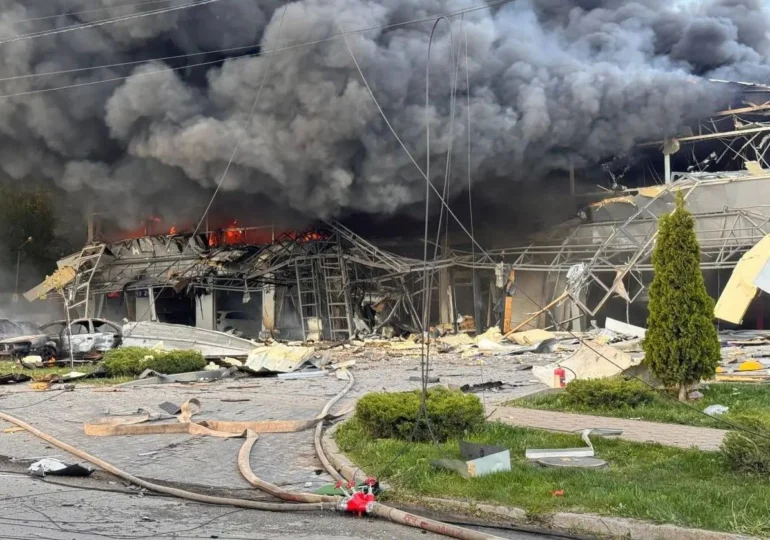
Day 1533 of the war in Ukraine began under the sign of a failed ceasefire before it could have any effect. Ukraine announced a unilateral ceasefire from midnight on May 6 in response to the 8-9 May break proposed by Vladimir Putin, but Russia continued the attacks from the first minutes.
Explosions were reported in Dnipro, and air alerts targeted extensive regions in eastern, southern, and northern Ukraine. Throughout the night, Russia launched two Iskander-M ballistic missiles, an air-launched Kh-31 missile, and 108 drones, including Shahed. The Ukrainian defense announced that they had shot down or jammed 89 of them, but strikes were still recorded in eight locations.
Two Russian drones hit a kindergarten in the center of Sumy in the morning, where Ukrainian authorities initiated a rescue operation.
President Volodymyr Zelensky accuses Moscow of feigning openness to peace but continuing attacks on cities. Kiev's message is that what is needed is not a pause for a few hours for the May 9 parade, but a real, verifiable, and lasting ceasefire. The same line is supported by several European states and American lawmakers, who urge the Kremlin to accept Ukraine's proposal.
Meanwhile, Washington has approved a possible arms sale of $373.6 million to Ukraine, including JDAM systems that convert conventional bombs into guided munitions.
At the same time, a WSJ investigation shows that Chinese firms continue to send components for Shahed drones to Russia and Iran, including engines and microchips delivered through networks of front companies.
Frontline Situation
- Russia violated the ceasefire in the first minutes - Russia attacked Ukraine with drones and guided bombs right in the first minutes after the ceasefire announced by Volodymyr Zelensky came into effect on May 6, at 00:00. Explosions were heard in Dnipro, while air alerts targeted regions in the east, south, and north: Dnipropetrovsk, Chernihiv, Zaporizhia, Kharkiv, Donetsk, and Sumy. During the night, the Ukrainian Air Force reported Russian drones heading towards Pavlohrad, Kharkiv, Izium, and Vilshany, as well as guided bomb launches on Sumy, Kharkiv, Donetsk, and Zaporizhia regions.
- Kindergarten in Sumy hit by drones - Two Russian drones struck a kindergarten in the center of Sumy on Wednesday morning, announced local Ukrainian authorities. They specified that a rescue operation is underway at the scene. The number of victims and the extent of the damage were not yet established at the time of the announcement. Authorities warned that the Russian attack on the city was ongoing and urged the population to remain in shelters.
- 108 drones and three missiles launched overnight - Russia attacked Ukraine with two Iskander-M ballistic missiles, a guided air-launched Kh-31 missile, and 108 drones of various types. According to the Ukrainian Air Force, the anti-aircraft defense shot down or jammed 89 drones in the north and east of the country. However, strikes from the two ballistic missiles, the Kh-31 missile, and nine attack drones were recorded in eight locations.
- Zelensky: Russia wants breaks for parades, not peace - Volodymyr Zelensky accused Russia of cynicism after another day of heavy bombardments on Ukrainian cities, resulting in dozens of deaths and injuries in Zaporizhia, Dnipro, and Kramatorsk. The Ukrainian president said the attack on Zaporizhia was "an absolutely cynical terrorist attack, without any military justification," and conveyed condolences to the families of the victims. He stated that Ukraine needs a real cessation of strikes "every day, not just for a few hours" related to "celebrations." The statement comes after Kyiv proposed a ceasefire starting from midnight on May 6, while Vladimir Putin had announced a break for May 8-9, Victory Day.
What's Happening in Russia
- Five dead in a Ukrainian attack in Crimea - Five people were killed in an attack with Ukrainian drones in Russian-occupied Crimea, announced Sergei Aksionov, the head of the Moscow-installed administration on the peninsula. The attack targeted the city of Djankoi.
- Russia cuts mobile internet ahead of May 9 parade - Russian authorities temporarily restricted mobile internet in Moscow and St. Petersburg ahead of the May 9 parade, citing the risk of Ukrainian drone attacks. According to Kiev Independent, the blockages affected electronic payments, navigation, and mobile communications. The Russian Ministry of Digital Development later announced that access was starting to be restored for sites approved by authorities. Similar issues were reported in other regions as well.
- Major refinery halts operations - The Kirishi refinery in the Leningrad region suspended oil processing after a Ukrainian drone attack on the night of May 4-5, Reuters reports. Three of the four main distillation units were damaged, along with other secondary units. The refinery, controlled by Surgutneftegaz, has an annual capacity of about 20 million tons and represents around 7% of Russia's total refining capacity.
- Russian oil reaches highest price in 12 years - The average price of Russian Urals oil rose to $94.87 per barrel in April, the highest level since September 2014, due to the crisis in the Middle East and restrictions in the Strait of Hormuz. According to Kiev Post, the over 23% increase from March brought significant additional revenues to the Kremlin, despite Ukrainian attacks on Russian oil infrastructure. Russian Finance Minister Anton Siluanov stated that the federal budget has already received approximately 200 billion rubles in additional oil revenues. The price hike follows blockades in the Strait of Hormuz, which reduced maritime traffic and pushed up global oil prices.
Other Relevant Information
- US approves $373.6 million arms sale - The US State Department approved a possible sale of military equipment to Ukraine worth $373.6 million. The package includes Extended Range JDAM systems and related equipment. Ukraine requested 1,200 KMU-572 kits and 332 KMU-556 kits, as well as firing systems, logistical support, and technical services. The primary contractor will be Boeing. JDAM converts conventional, unguided bombs into precision munitions with inertial navigation and GPS. The approval comes days after the Pentagon unlocked a $400 million military aid package for Ukraine after months of delays.
- China accused of fueling Shahed production - Chinese companies continue to supply engines, microchips, and other components used in the production of Shahed drones in Iran and Russia, despite US sanctions, writes the Wall Street Journal, cited by Ukrainska Pravda. Chinese customs data show shipments of hundreds of containers to factories in Iran and Russia. An example is Xiamen Victory Technology, which allegedly sells Limbach L550 engines, key components for the Shahed-136 drones used by Russia against Ukrainian cities. According to former US officials, China has long acted as a transit hub for redirecting Western components to the Russian and Iranian military industries.
- The West calls on Russia to accept the ceasefire - European officials and American lawmakers have supported Ukraine's proposal for an immediate ceasefire and urged Russia to show seriousness about peace. Foreign Ministers from Germany, Sweden, Belgium, Finland, Spain, Latvia, Lithuania, and Estonia sent messages of support to Kyiv, emphasizing that a ceasefire should not be tied to Moscow's May 9 parade. Belgium called the break proposed by Russia on May 8-9 an image exercise, while Lithuania stated that the ceasefire cannot be dictated by the Russian propaganda calendar. In the US, the parliamentary group for Ukraine said that the "responsibility" now lies with the Kremlin.