
The drinking water crisis in Prahova and Dâmbovița, which has left over 100,000 people without water resources in recent days, is accompanied by documents and statements that contradict the official explanations.
While reports indicate that authorities were aware of the risks, a hidden camera recording captures Florin Ghiță, the director of Romanian Waters, speaking „unofficially” about the lack of communication and ignored scenarios.
"A roundtable discussion should have been held"
In the recording made by Antena3 with a hidden camera, Florin Ghiță indicates that local institutions did not communicate enough and that possible scenarios were not fully analyzed.
"Now unofficially, ABA Buzău-Ialomiţa took care of the work and the water level reduction. Some papers were sent, but in my opinion, ABA Buzău-Ialomiţa should have involved all local administrative territories, all operators, and explain that there might be difficulties in water supply. They should know, be prepared that the supply might decrease, have reserves so that they can provide water rationally from those reserves. The lack of communication was the main problem," says the head of Romanian Waters.
When asked if he acknowledges this problem, Ghiță responds: "Yes, I acknowledge it. A roundtable discussion should have been held. Some papers were officially issued. More scenarios should have been considered. The people working at ABA Buzău have been there for 30 years. They knew that high turbidity could occur, but we at the central level could not have known that. No one anticipated that the rains would come."
When explicitly asked "Were you taken by surprise?", he replies, "Yes."
"Official" statements
In an official interview, Florin Ghiță's tone is similar, but the formulations are cautious. He admits that the institution he leads made mistakes.
"I consider that there was a lack of communication and not all scenarios were taken into account, including this one."
When asked if the ignored scenario is that of flooding, Ghiță confirms.
However, he becomes evasive when asked how the specialists missed an orange code issued 48 hours before the rains: "I don't know. We are waiting for the investigation and we will see who is to blame."
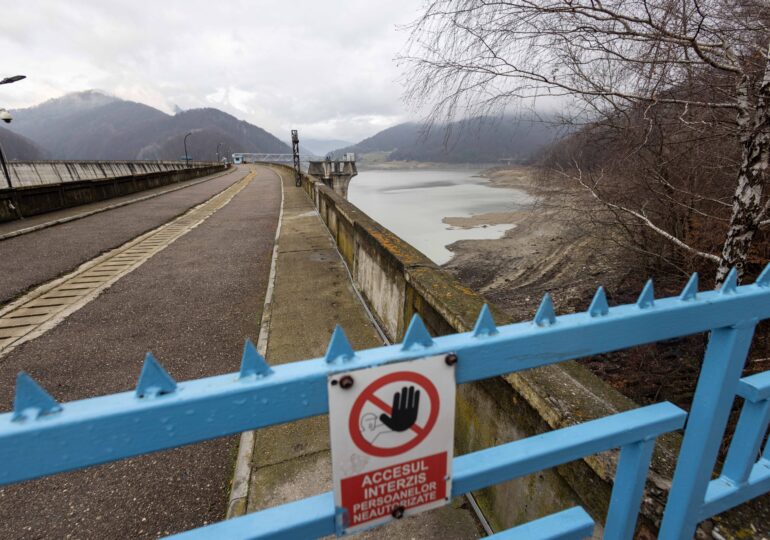
The official also explains the critical moment that triggered the crisis. "The incident occurred when colleagues wanted to maneuver the bottom drainage and it was seen that it didn't work. That's when the decision was made to lower the level to 620 meters. An expertise was done, some experts decided to lower the dam level, because we could have ended up in a scenario where we wouldn't provide any water downstream. All scenarios should have been considered, including taking into account weather phenomena, rains, torrents," Ghiță added. He confirms that this did not happen.
Documents showing that the risks were known
Although the management of Romanian Waters claims that the rains came "unexpectedly," official documents show otherwise.
- Minutes from October 22
In a note drafted after a visit to the Paltinu dam by representatives of Romanian Waters, the Ministry of the Environment, ABA Buzău-Ialomiţa, and ESZ Prahova, it is clearly recorded that "there is a risk of increased turbidity during the works period."
The same document notes that the works continue "in a state of emergency situation generated by the imminent risk of interrupting water supply for the population and industry."
- Notification from November 6 to the Prahova Prefecture
Romanian Waters request the urgent convocation of the County Emergency Situations Committee, explicitly mentioning an "imminent risk in dam operation."
- CJSU Decision - November 6
The Prahova Prefecture makes public the decision of the County Emergency Situations Committee, once again discussing the "possibility of an emergency situation." The prefect of Prahova County, Daniel Nicodim, states that the institution was informed by Romanian Waters and the Prahova Water Management System about the seriousness of the situation.