
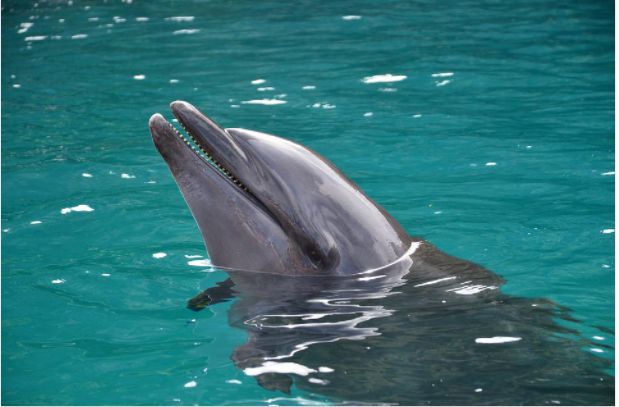
US Secretary of Defense, Pete Hegseth, denied information that Iran could use dolphins equipped with mines to attack American ships.
Instead, he neither confirmed nor denied the existence of US kamikaze dolphins, according to CNN.
Amid concerns that Iran might place mines in the Strait of Hormuz, Hegseth was asked on Tuesday whether Iran could resort to dolphins to assist in confronting the US Navy.
He stated that he can "confirm" that Iran does not have dolphins to deploy in operations, but added that he will "neither confirm nor deny if we have kamikaze dolphins."
A source familiar with US operations in the Strait of Hormuz told CNN that the US military does not use dolphins in that area. However, the US Navy has had a program for decades to train dolphins for mine detection.
Dolphins do not sacrifice their lives
The Marine Mammal Program is part of the Information, Surveillance, and Reconnaissance (ISR) Department within the Naval Information Warfare Center Pacific.
The dolphins in this program are not "kamikaze" in the sense that they do not sacrifice their lives to detonate mines but are used for detection.
- Rubio announces that Epic Fury has ended. Trump suspends operation in the Strait of Hormuz just a day after launch
- What is "Project Freedom," the operation in the Strait of Hormuz put on hold by Trump. "Extremely risky and escalatory"
"We use marine mammals to assist in detecting underwater objects and to protect ports by identifying intruders," said Scott Savitz, senior engineer at RAND and former collaborator of the former US Mine Warfare Command, to CNN.
The US is not the only country to have used dolphins for military purposes - Russia has used them for port security, and Iran purchased dolphins in 2000, according to the BBC.
Those dolphins would likely be too old to be used today, and there are no indications that Iran still has an active dolphin program, although the Wall Street Journal reported last month that Iran was considering using mine-carrying dolphins as an unusual method to counter US efforts to reopen the strait.
The question posed to Hegseth came in the context of discussions about the ceasefire between the US and Iran, following exchanges of fire from both sides amid escalating tensions in the Strait of Hormuz.
CNN reported in March that Iran had started to place mines in the strait, and Hegseth stated in April that such an action would violate the temporary ceasefire agreement and that the US military "will react."
What do US Navy dolphins do
The US Navy's dolphin program has been in existence since 1959 and focuses on training bottlenose dolphins and California sea lions for detecting and recovering objects from the seabed.
According to the US Navy Marine Mammal Program (NMMP) page, dolphins "possess the most sophisticated echolocation system known to science", and underwater drones are "far from matching these animals."
"Both dolphins and sea lions have excellent low-light vision and directional hearing underwater that allows them to detect and track underwater targets, even in dark or murky waters.
Dolphins are trained to search for and mark the locations of underwater mines that could threaten the safety of those aboard military or civilian vessels," the site states.
During a detection mission, the dolphin usually travels with 2–3 trainers in a small boat. To indicate if it has found something, it touches a paddle in front of the boat, and to indicate that it has found nothing, it touches another paddle, according to the Naval Undersea Warfare Museum.
Dolphins leave "marking buoys" near discovered mines to help divers locate and neutralize them.
Dolphins choose to stay in the program
However, dolphins are not usually used in an active combat environment, such as the current one in the Strait of Hormuz. Instead, they have been used for mine detection after conflicts have ended, Savitz said.
He referred specifically to the time in 2003 when dolphins were deployed to detect potential mines blocking access to the Iraqi port of Umm Qasr after the US and allies captured southern Iraq.
"Hostilities had essentially ceased. You're not trying to fight your way through using dolphins," he said.
An important aspect of the program, Savitz explained, is that dolphins and sea lions have the ability to leave every time they are taken into open waters for training or missions.
"They choose to return because they like the fish offered as a reward; they enjoy the game of 'can you find this object at the bottom of the sea?', 'can you find the person trying to swim near the docks?'; they appreciate protection from predators," Savitz said.
"There are always questions about animal welfare, but these animals actively choose to remain in the program, although they could simply return to the wild," he emphasized.