

More than half of Romanians are convinced they can differentiate between real and false information when news about security or war emerges. However, when assessing the population’s overall ability to do the same, the majority declare themselves skeptical.
The data comes from the Barometrul Informat.ro – INSCOP Research, conducted between June 2-8, 2026.
More than half of Romanians believe they can identify false information
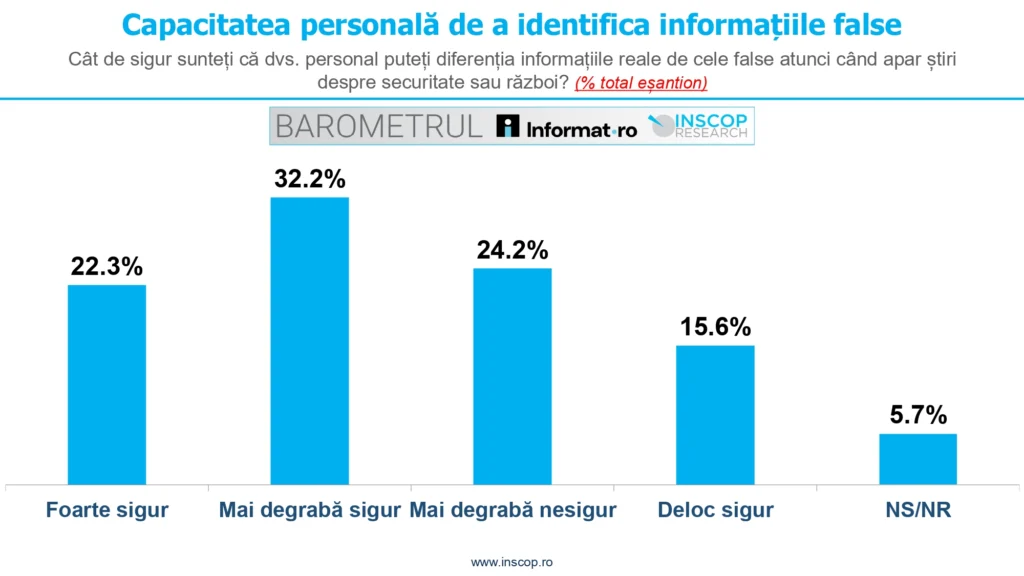
Asked how confident they are in their ability to differentiate between real and false information when news about security or war emerges, 22.3% of respondents declared themselves "very confident," and 32.2% "rather confident." Thus, 54.5% of Romanians say they trust their own ability to identify misinformation.
On the other hand, 24.2% consider themselves "rather unsure," and 15.6% "not at all confident." Another 5.7% did not provide an answer.
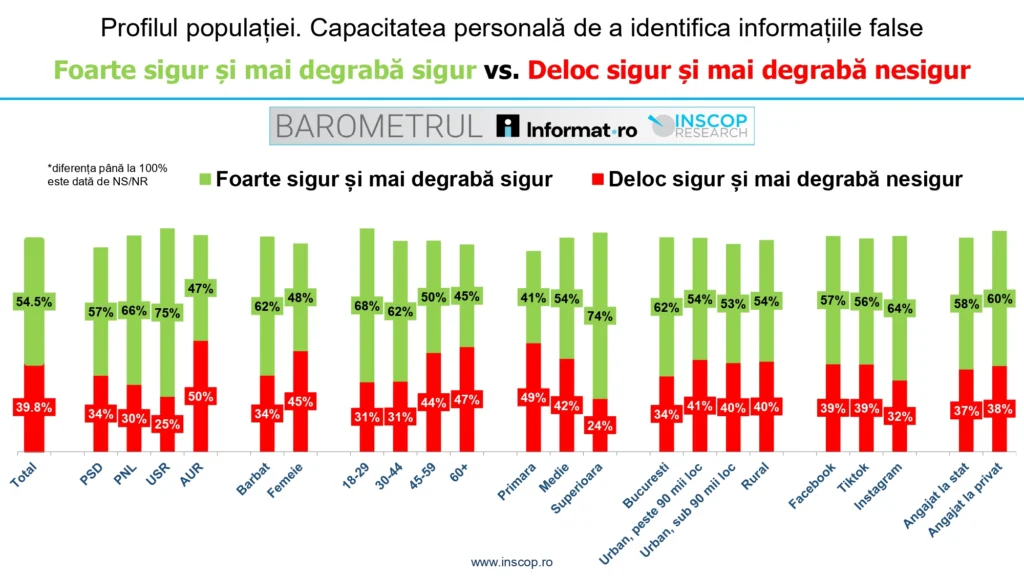
An analysis based on socio-demographic categories shows that voters of the PNL and USR parties, men, individuals aged between 18 and 44, those with higher education, residents of Bucharest, and private sector employees have more confidence than the average in their own ability to detect false information.
On the opposite end are AUR voters, women, individuals over 45 years old, and those with primary education, who have the lowest confidence in their own informational discernment.
Romanians are much more skeptical when it comes to others
However, the perception changes when respondents are asked about the general population's ability to differentiate between real and false information.
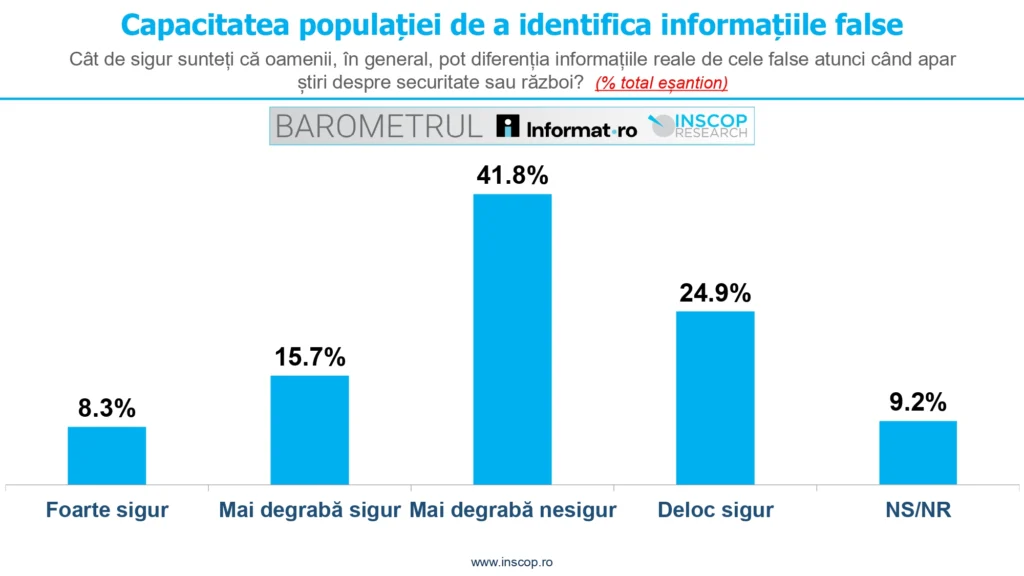
Only 8.3% say they are "very confident" that the public can make this distinction, and 15.7% consider themselves "rather confident." In total, only 24% have confidence in the public's ability to identify false information.
On the other hand, 41.8% are "rather unsure," and 24.9% are "not at all confident," meaning that two-thirds of respondents (66.7%) believe that the population is vulnerable to misinformation. The percentage of those who did not respond is 9.2%.
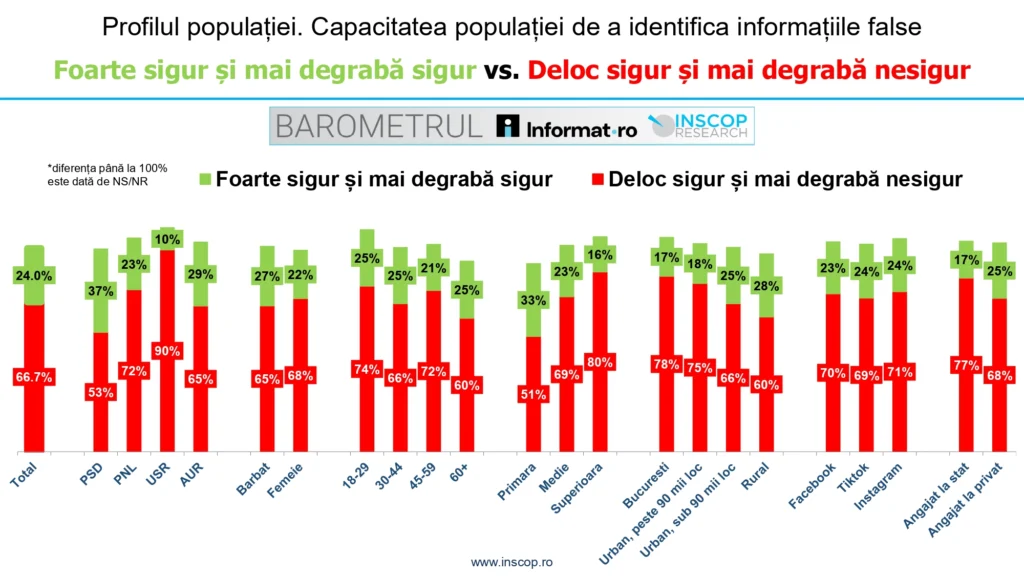
According to the survey, voters of the PSD party, men, individuals with primary education, and residents of rural areas are more confident than the average in the public's ability to detect false information.
On the other hand, the most skeptical are voters of the PNL and USR parties, individuals under 30, those aged between 45 and 59, individuals with higher education, residents of Bucharest and major cities, as well as public sector employees.
The Difference Between "Me" and "Others"
The results highlight a contrast between how Romanians evaluate their own discernment and how they assess society's ability to protect itself from misinformation. INSCOP Director, Remus Ștefureac, believes this difference reflects an "informational control illusion," whereby people tend to perceive themselves as less vulnerable to manipulation than those around them.
"Romanians have much more confidence in their own ability to detect false information than in the ability of others, a sign of a strong informational control illusion. The difference between self-assessment and population assessment suggests that the issue of misinformation is perceived as being 'about others,' not a personal one. Each individual sees themselves as more resistant to manipulation than the societal average, which can reduce vigilance towards their own vulnerabilities. Paradoxically, although most believe they can distinguish truth from falsehood, that same majority considers that society as a whole is easily misled," stated Remus Ștefureac, cited by Informat.ro.
How the Survey Was Conducted
The survey is part of the Barometrul Informat.ro - INSCOP Research, conducted monthly by INSCOP Research at the request of the Informat.ro platform, in partnership with Strategic Thinking Group.
The data was collected between June 2-8, 2026, using the CATI method (telephone interviews). The sample consisted of 1,100 individuals, representative of the non-institutionalized population of Romania aged 18 and over. The maximum margin of error is ±3%, with a confidence level of 95%.