

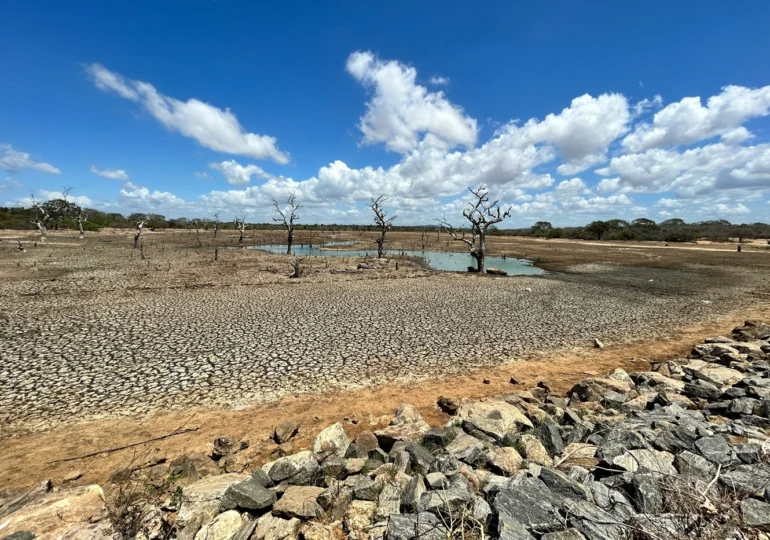
The European Commission intends to amend the Water Framework Directive (WFD), the main European regulatory act protecting rivers, groundwater, and wetlands, in order to accelerate the development of critical minerals mines considered essential for the European Union’s economy and security.
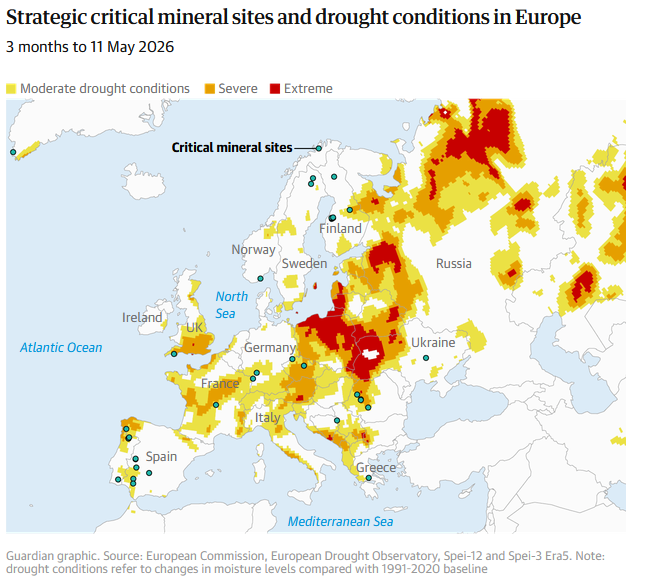
According to an analysis conducted by Watershed Investigations and consulted by The Guardian, more than half of the 33 new or expanded mining projects designated by the EU as „strategic projects” are located in regions that have experienced a drying process over the past two decades, according to NASA satellite data.
Furthermore, almost half of these projects are in areas affected by drought in the last three months, and a quarter are located in regions already considered at risk in terms of water resources.
Spain, Portugal, and Greece in the spotlight
Six of the strategic mines are planned in areas of Spain severely affected by water scarcity, while other projects are planned in Portugal and Greece.
These three countries are among the European states with the greatest water deficit issues, according to the European Environment Agency.
In Catalonia, authorities declared a state of emergency in 2024 due to the most severe drought ever recorded, while water consumption restrictions were introduced in Andalusia. In Portugal, almost the entire country faced severe or extreme drought in 2022, according to European data.
Projects in Romania
And Romania has three strategic mining projects included by the European Commission under the Critical Raw Materials Act (CRMA).
The three projects are:
- Rovina (Hunedoara County) – a project for the exploitation of copper and gold, developed by the Canadian company Euro Sun Mining;
- Baia de Fier (Gorj County) – a project by the state-owned company Salrom for the exploitation of graphite;
- Budureasa (Bihor County) – a project for the exploitation of magnesium, developed by Verde Magnesium.
Romania's three strategic mining projects approved by the European Commission also appear on the map published by The Guardian in areas affected by moderate to severe drought in recent months. However, the British publication does not include Romania among the states most exposed to the risk of water deficit associated with new mining operations.
Moreover, the Baia de Fier project officially states that it will use closed-loop water systems and technologies to reduce the impact on water resources.
Demand for critical minerals is rising
Global demand for critical minerals such as lithium, graphite, and cobalt has tripled since 2010, driven by the development of artificial intelligence, the expansion of the electric vehicle industry, renewable energy, and defense investments.
Estimates show that demand will continue to grow rapidly until 2030, and the need for certain raw materials could be nearly five times higher in 2050 compared to the 2020 level.
Concerned about import dependence, the European Union has designated 47 exploitation, processing, and recycling projects as "strategic," of which 33 are mines. These projects benefit from accelerated authorization procedures and can receive political and financial support from Brussels.
Concerns about weakening environmental protection
The Commission's intention to amend water legislation has raised concerns among environmental organizations, which warn that the measures could weaken ecosystem protection.
The European mining industry association, Euromines, supports the changes and calls for more flexible deadlines to achieve water quality objectives and a less strict interpretation of the rule that water bodies should not deteriorate.
A Euromines spokesperson stated, "Our main priority remains constructive collaboration with decision-makers to ensure solid guarantees for environmental protection, alongside legal clarity and predictability for the authorities issuing permits."
In turn, the European Commission has stated that the strategic projects have been evaluated by independent experts and must comply with European environmental legislation.
The European executive has specified that the review of the Water Framework Directive will explore ways to improve access to critical raw materials while maintaining environmental and public health protection.
Critics, however, warn that relaxing regulations could have serious consequences.
Sara Johansson, responsible for water policies at the European Environmental Bureau, stated that the mining industry "has not presented even a trace of evidence" that the current legislation represents an obstacle to the development of mining projects.
Kaveh Madani, Director of the UN Institute for Water, Environment, and Health, also warned of risks.
It may seem like a short-term economic boost, but a single serious failure in the wrong place can negate many of the promised benefits, especially when the damages to people, rivers, aquifers, and ecosystems are long-lasting or irreversible," he said.