
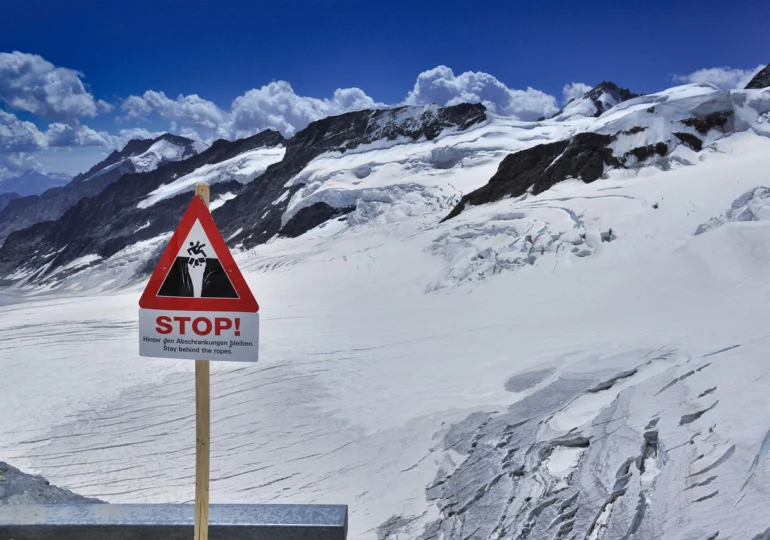
The heatwave suffocating Europe is dramatically accelerating the melting of the Alpine glaciers. In Switzerland, the snow accumulated over the winter will completely disappear by Monday, June 29, nearly three months earlier than usual. Experts warn that the glaciers will lose a massive amount of volume in the coming months.
The heatwave affecting a large part of Europe is causing a rapid melting of the glaciers in the Alps, and Switzerland is on track to reach one of the most concerning climate thresholds in recent years.
According to The Guardian, citing data from the Swiss glacier monitoring network Glamos, it is estimated that by Monday, the entire amount of snow and ice accumulated on the glaciers during the winter will have completely melted. This is the second earliest date recorded for reaching the threshold known as the glacier loss day, the moment in the year when the snow reserves accumulated over the winter are completely depleted.
From that point on, any further melting means the actual loss of the ice that makes up the glacier.
The only more severe situation in the past quarter-century was in 2022 when this threshold was reached on June 26.
"Melting is massive throughout the entire Alpine chain"
Matthias Huss, director of the Glamos network, says that the current heatwave is having unprecedented effects on the glaciers.
"We are observing massive rates of ice and snow melting across the entire Alpine chain. From the perspective of a year considered healthy for glaciers, we are about three months ahead of the moment when the snow reserves should be depleted," Matthias Huss told AFP.
The glaciologist recently returned from the Ron glacier and says that changes are visible from week to week. "In just ten days, about one meter of vertical ice has melted. It is impressive to see, and this is just the effect of the heatwave," Huss explained.
According to him, each additional day of extreme temperatures worsens the situation, whether the highs reach 35 or 40 degrees Celsius.
Less snow, Sahara dust, and an unusually warm spring
Experts say that the current situation is the result of several overlapping factors.
Last winter, the amount of snow feeding the glaciers was about 25% below the average recorded between 2010 and 2020. Additionally, May was unusually warm, causing the snow cover to disappear much earlier than usual.
To these factors, the dust brought from the Sahara desert in March was added. Deposited on the snow surface, it reduces the solar radiation reflection capacity and accelerates melting.
Huss says that 2026 is surprisingly similar to 2022, considered the most severe year ever recorded for the Alpine glaciers.
Switzerland has already lost nearly half of its glaciers
The glaciers in the Alps began shrinking about 170 years ago, but the process has accelerated significantly in recent decades due to global warming.
Between 2000 and 2024, the volume of glaciers in Switzerland decreased by 38%. In the last 50 years, the country has lost about 1,200 glaciers, and currently, there are only around 1,300 left.
"The ones that have disappeared were small glaciers, but they played an important role for the peripheral regions of the Alps," says Huss.
He warns that if the current rate of global warming continues, by the end of the century, only isolated fragments of ice will survive in the Swiss Alps.
G.P.