
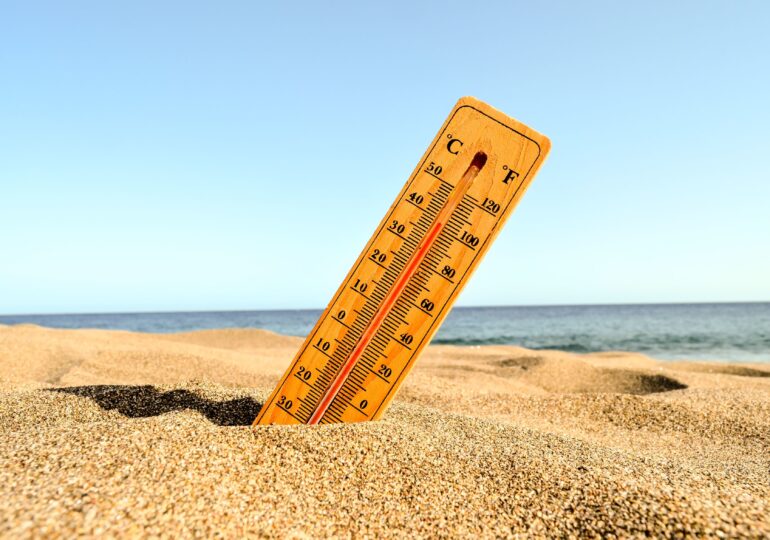
The entire world is getting hotter as carbon pollution from burning fossil fuels traps more heat, but Europe is warming twice as fast as other continents.
The consequences are becoming increasingly severe, with tens of thousands of deaths caused by heatwaves recorded so far this summer, writes The Guardian.
Why is Europe so affected by global warming?
The land requires less heat than the vast and deep oceans to warm up, so all continents are warming faster than the seas.
Europe, however, is particularly vulnerable for four reasons: changes in weather patterns, proximity to the Arctic, reduced snow cover, and decreased atmospheric pollution.
As a result, Europe is now 2.5°C warmer than before the massive burning of fossil fuels, almost double the global average increase of 1.4°C. Temperatures in Europe have risen by 0.56°C per decade since the mid-1990s, compared to 0.42°C in North America, 0.36°C in Africa, and 0.27°C in South America.
How have Europe's weather patterns changed?
Changes in atmospheric circulation above Europe have led to more frequent and intense summer heatwaves. Among them is the most severe heatwave ever recorded, in June 2026, when a huge area of hot air remained trapped under a stationary "heat dome."
Scientists are still investigating the role of global warming in producing changes in atmospheric circulation, but the link seems increasingly likely.
Dr. Samantha Burgess, from the EU's Copernicus Climate Change Service, stated: "We observe statistically significant changes in surface pressure patterns and other indicators of atmospheric circulation when we analyze trends over the past 40 years or more, and at this timescale, they are more likely to be associated with climate change than natural variability."
This association could be the result of changes in the jet stream, a high-altitude strong wind that has a major influence on Europe's weather and is in turn affected by rising temperatures.
Why is the Arctic important?
The Arctic is the fastest-warming region on the planet, even though it does not have extensive land areas. This is because the white polar ice cap, which normally reflects most of the sunlight back into space, is melting rapidly.
As a result, the darker ocean exposed by melting ice absorbs much more heat, leading to the melting of even more ice, forming a vicious circle. Since a significant part of Europe is relatively close to the Arctic, temperatures are rising more quickly.
What is happening to the snow cover?
In the past, most of Europe experienced snowfall during winter. Like Arctic sea ice, snow reflected sunlight and helped maintain a cooler continent. However, the climate crisis is reducing snow-covered areas.
In March 2025, the snow-covered area of Europe was about 1.3 million km², 31% below the 1991–2020 period average. The lost area is roughly equivalent to the combined territory of France, Italy, Germany, Switzerland, and Austria. It was the third lowest snow cover level since records began in 1983.
How does reducing atmospheric pollution affect temperatures?
Atmospheric pollution kills millions of people globally each year, so the fact that Europe has managed to reduce levels of toxic pollutants in recent decades is undoubtedly a good thing. However, cleaner air also reveals the impact of the increasing concentration of carbon dioxide in the atmosphere.
Pollutant particles can reflect sunlight, either directly or by stimulating cloud formation, meaning that some of the heat does not reach the ground. Fewer particles mean less reflection and more heat retained by greenhouse gases. The decrease in pollution could even be linked to the increase in blocking weather patterns.
How important are the four factors?
The short answer is that scientists do not yet know, but they aim to have an estimate next year.
Burgess stated: "What we can say is that the importance of each factor should vary depending on the season, with proximity to the Arctic being important in autumn and winter, while changes in atmospheric circulation since the late 1970s have greater statistical significance in summer."
The decrease in atmospheric pollution is most pronounced in winter, due to the reduction in coal use for heating homes, and snow cover is also a specific winter issue. Europe's warming during winter has been most pronounced in the north in recent decades, while summer warming has been strongest in the southeast.
What are the consequences?
Rapid warming leads to more deaths and increasingly intense wildfires, droughts, storms, heavy rains, and floods are also amplified by the excess heat in the climate system. All of these deeply affect lives and livelihoods across the continent and will continue to worsen until emissions reach net zero.
Urgent rapid reductions in CO₂ pollution and the implementation of measures to protect the population are necessary.
UN climate chief Simon Stiell stated at the end of July: "The terrible costs of this climate crisis – both human and economic – are now at national emergency levels. What needs to be done is clear: to ditch coal, oil, and gas faster, to expand the use of renewable energy, and to protect people."