


Romania continues to be the country with the lowest consumer prices in the European Union, but this does not automatically mean that Romanians live cheaper. Across Europe, the same basket of goods and services can cost nearly four times more, depending on the country where it is purchased.
An analysis conducted by Euronews based on the most recent statistics published by Eurostat shows that price differences between countries are huge, but they must be viewed together with salary levels and purchasing power.
Eurostat compares the cost of over 2,000 goods and services and establishes a price level index, where the European Union average is 100. An index above this value means that a country is more expensive than the EU average, while one below 100 indicates lower prices.
Romania, the cheapest in the European Union
In the ranking of European Union member states, Luxembourg is the most expensive country, while Romania ranks last with the lowest prices.
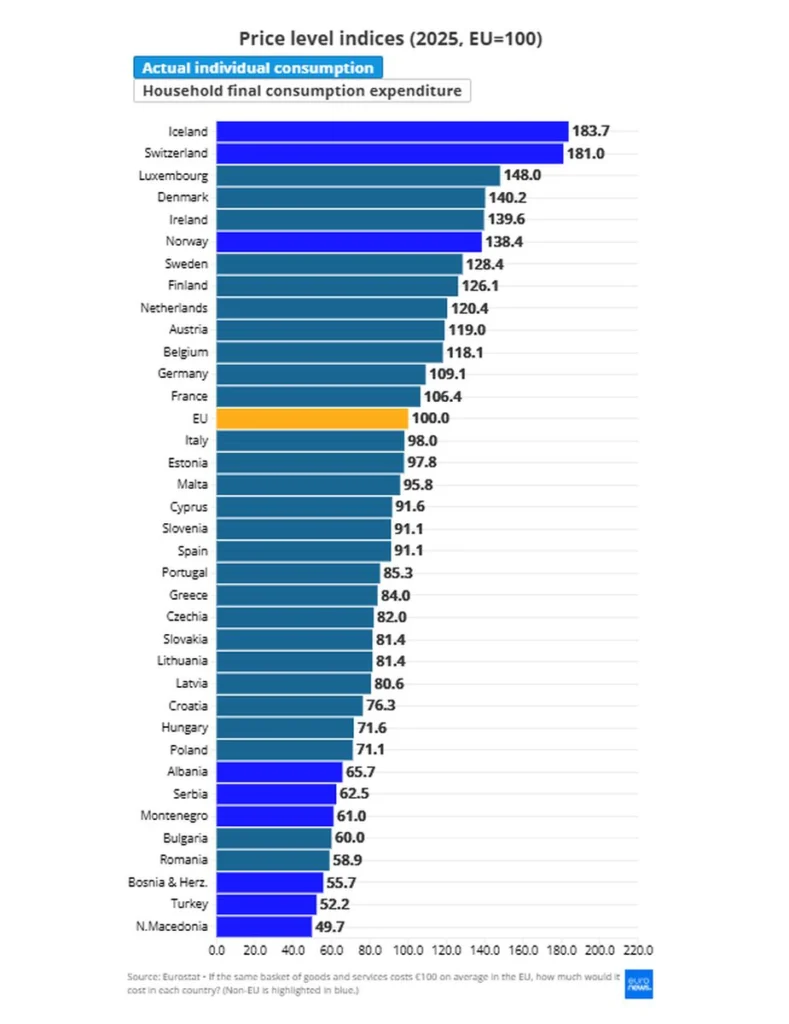
According to Eurostat data, a basket of goods and services that costs an average of 100 euros in the European Union can be purchased in Romania for only 58.9 euros.
In other words, consumer prices in Luxembourg are about two and a half times higher than those in Romania.
If the analysis includes EU candidate countries and members of the European Free Trade Association (EFTA), Iceland becomes the most expensive country in Europe, while North Macedonia becomes the cheapest. In this case, the difference between extremes reaches almost four times.
Overall, Western and Northern Europe remain the most expensive regions on the continent, while Central and Eastern Europe still have the lowest price levels.
However, the ranking exclusively compares price levels, not population incomes. In other words, the fact that Romania has the lowest prices in the European Union does not automatically mean it has the highest level of affordability for its residents.
Iceland and Switzerland top the list of the most expensive countries
Compared to the European Union average, Iceland is 83.7% more expensive, and Switzerland is 81% more expensive.
Following in the top are Denmark (40.2%), Ireland (39.6%), and Norway (38.4%), all with prices approximately 40% above the European average.
Sweden and Finland are also significantly more expensive than the EU average, by 28.4% and 26.1%, respectively.
On the other hand, of the four major economies of the European Union, Germany is the most expensive, with prices 9.1% above the European average, while Spain is 8.9% below the average. Thus, the same shopping basket costs approximately 18 euros more in Germany than in Spain.
France is slightly above the European average, and Italy slightly below it.
North Macedonia and Turkey are cheaper than Romania
At the bottom of the ranking is North Macedonia, where the same shopping basket costs only 49.7 euros.
Next are Turkey (52.2 euros), Bosnia and Herzegovina (55.7 euros), Romania (58.9 euros), and Bulgaria (60 euros). In all these countries, prices are at least 40% below the European Union average.
Other countries with low price levels include Montenegro, Serbia, Albania, Poland, and Hungary.
Prices don't tell everything. Salaries make the difference
Professor Robert Inklaar from the University of Groningen, the Netherlands, points out that price levels cannot be analyzed separately from income levels.
“These figures must always be read together with salaries. For the standard of living, it matters not if prices are high, but what a local salary can buy in that country – purchasing power, not just the price tag,” says Inklaar.
He gives the example of Switzerland, where prices are among the highest in Europe, but salaries are high enough for purchasing power to remain one of the highest on the continent.
Why do prices vary so much
According to Professor Inklaar, the main reason is the difference in productivity between economies.
“Where workers are more productive, they earn more, and these higher wages are directly reflected in the price of all goods and services produced and consumed locally – from a meal at a restaurant or a haircut to rents and medical services,” the specialist further explains.
The same mechanism also influences the prices of products in stores. Even if these can be marketed internationally, local costs – such as employee salaries, transportation, commercial space rents, or distribution – are reflected in the final price.
These are compounded by other factors such as transportation distances, national regulations, taxes, and VAT levels.
Professor Rainer Maurer, emeritus professor at the University of Pforzheim, Germany, emphasizes that there is a clear link between price levels and GDP per capita: richer states tend to be the most expensive.