
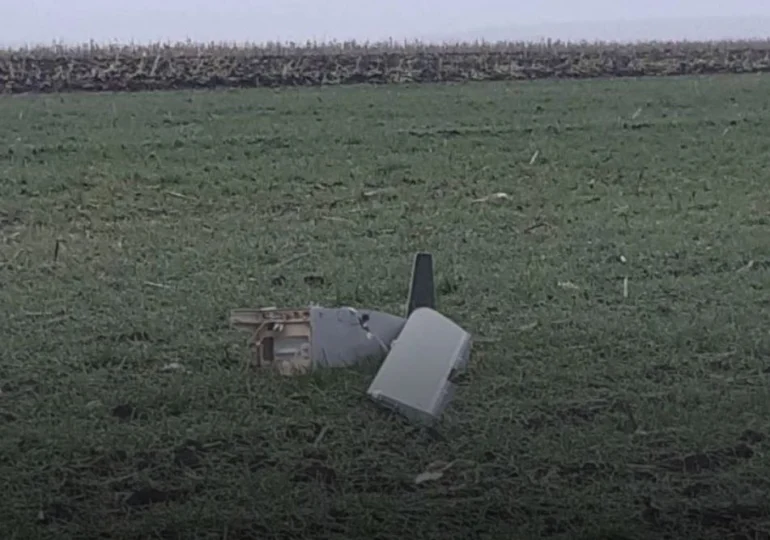
The Bulgarian press analyzes how it was possible for a drone to crash on the country’s territory and explode near a compressor station of the Trans-Balkan gas pipeline without being detected. Authorities in Sofia announced that the device came from Romania, and the Bulgarian press also writes about the hypothesis of the presence of a saboteur on our country’s territory.
On Saturday morning, shortly after 8:00 a.m., a drone entered Bulgarian airspace from Romania, near the old Kardam border crossing point in the Dobrich region, and disintegrated in a sunflower field, about 100 meters inside the country and in close proximity to a compressor station of the Trans-Balkan gas pipeline. No casualties were recorded, and no buildings were damaged.
Compared to the events taking place along the eastern flank of NATO, the incident was almost insignificant. An innocuous drone, whose appearance went unnoticed, represents the cheapest warning this country could ever receive, as stated in a commentary published by Novinite.
More important than the drone's nationality is the fact that no one detected it - neither the Bulgarian radars, nor the Romanian ones, and there was no alert from the NATO Combined Air Operations Center at Torrejon, which is precisely tasked with monitoring this airspace.
Prime Minister Radev acknowledged this, admitting at the same time that the acquisition of modern three-dimensional radars had stagnated "for years."
The Defense Minister, Admiral Emil Eftimov, went even further and admitted that even radars specialized in detecting drones might only spot such a target at a distance of four or five kilometers - which, in the case of a populated border area, leaves almost no time to take any action. It is not a surprise that suddenly emerged, but a gap that officials had been aware of for years but had not remedied.
The identity of the person who sent the device remains uncertain, but the cited publication considers that several hypotheses can be considered alongside the one circulated by television.
Official version: a Ukrainian lure
The initial assessment by the Ministry of Defense indicates that the wreckage most likely belongs to a Maya drone - a cheap decoy drone widely used by the Ukrainian armed forces. Kiev denied directing any device towards Bulgaria and offered to support the investigation.
This hypothesis leads to the most banal and, at the same time, the most technically credible explanation: a Maya drone deviated from its programmed trajectory due to Russian electronic warfare - the same jamming and spoofing techniques invoked by analysts when French fighter jets intercepted a lost Ukrainian Maya drone over the Baltic region earlier this year.
Even Eftimov indicated electronic interference as a probable cause. The hypothesis of a lost device is not only possible but represents the most plausible explanation, even though it lacks sensationalism.
However, this is not the only scenario, and two other scenarios deserve consideration, emphasized the Bulgarian publication.
Second hypothesis: it's the hand of the Russians
In the period leading up to the Kardam incident, several NATO governments publicly warned that Russia had captured intact Ukrainian drones and could use them for "false flag" provocations against Alliance member states, precisely to create the impression of a Ukrainian attack and to divide the allies.
The defense ministers of Poland and Lithuania officially stated this, and the Institute for the Study of War (ISW) describes this tactic as part of a deliberate Russian campaign aimed at preparing the ground for such incidents.
In other words, the fact that a provocation was being prepared somewhere along the eastern flank was already publicly known before such a device reached a field in Bulgaria.
Third hypothesis: an agent present in Romania
There is also a third, more discreet interpretation, and the preliminary evidence contradicts it, which deserves to be stated unequivocally, as mentioned by the source: that of a saboteur on Romanian territory.
The drone came from the north, from Romanian airspace, and the Romanian border police recorded its presence, detecting its sound before the explosion was heard on the Bulgarian side, near General Toshevo.
However, the radars of neither of the two countries tracked the device's trajectory because it was flying at low altitude and had small dimensions. This distinction - the fact that it was heard but not tracked - is the essence of the problem, and its interpretation requires caution to avoid hasty conclusions.
Some might argue, based on geographical data, that a drone crossing the carefully monitored areas from the Black Sea and the entire territory of Romania without being detected must have covered a short distance. From here, it is a small step to the darkest version of the theory: that the device did not cross half of NATO's territory but was launched from the immediate vicinity - from Romanian or even Bulgarian territory - by a saboteur or an individual paid to act in Russia's interest, as stated in the analysis cited.
In such a scenario, the incident would no longer be an accidental consequence of war but a deliberate action orchestrated on Alliance territory; that is why the idea is circulating and cannot simply be ignored.
However, it must be honestly analyzed in relation to the facts held. Acoustic detection from the Romanian side, the approach trajectory from the north, and the known pattern of Ukrainian drones entering NATO airspace following Russian jamming make the hypothesis of a long-distance drift flight more difficult to dismiss than the sabotage theory suggests.
In these conditions, an honest approach requires acknowledging that the remnants of the device - heavily charred, according to Radev - have not yet provided a definitive answer in either direction.
A lesson for Bulgaria
Regardless of whether the drone was a Ukrainian lure deviated from its trajectory, a Russian provocation using Ukrainian components, or a device discreetly placed near the border, the lesson for Bulgaria is the same: an object reached critical infrastructure and exploded before it was known in Sofia, Bucharest, or Torrejon that it was in the air.
Bulgarians should be grateful that the object reached a sunflower field as a lure and not as a Shahed drone with an incendiary device - the type of drone that Romania has already shot down three times near Bulgaria, according to Novinite.
The response mechanisms exist - the SAFE antidrone project, the NATO drone countermeasure experiment that Bulgaria is set to host in October, local companies already working on this technology - but things have progressed at the slow pace typical of situations that no one considers urgent.
The incident is the argument that imposes urgency, a lesson learned without paying a price in human lives. The scandal will not be related to the drone itself. The scandal will erupt if, in a year, the radar is still not installed, and we are forced to provide explanations for a new incident, concludes the Bulgarian publication.
T.D.