
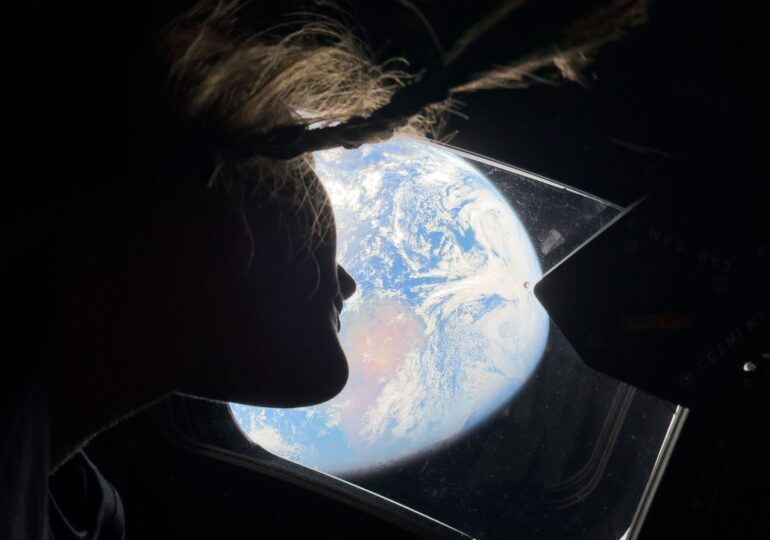
The four astronauts of the Artemis II mission reach today the climax of their flight: the flyby of the Moon, the first mission of this kind with a human crew since 1972.
After more than four days since the launch from Florida, the crew consisting of Christina Koch, Victor Glover, Reid Wiseman, and Canadian Jeremy Hansen, aboard the Orion capsule, approaches the Earth’s natural satellite. They practically enter the area where the Moon’s gravity becomes dominant – the so-called „sphere of influence,” according to AFP.
The astronauts will not land, but the mission remains historic. It is the first time a woman and an astronaut of color participate in a human flight around the Moon.
A First After the Apollo Era
The last human flights near the Moon took place in the Apollo program, between 1968 and 1972. Back then, the crews were exclusively composed of American men.
Moreover, no astronaut from other space programs has ventured so far from Earth until now - approximately 400 km being the limit of low Earth orbits where space stations operate.
The Moon, "a Basketball at the End of the Arm"
For about seven hours, starting at 18:45 GMT (21:45 in Romania), the Moon will be in the foreground in the Orion capsule's window.
Noah Petro, head of NASA's planetary geology laboratory, described the image as follows: the Moon will appear "like a basketball held at the end of the arm."
Other useful milestones (Romania time):
- Apollo 13 record surpass: April 6, 20:56
- Start of lunar observations: April 6, 21:45
- Communication loss (behind the Moon): April 7, 01:47
- Maximum approach to the Moon: April 7, 02:02
- Maximum distance from Earth: April 7, 02:05
Scientific Observations and Rare Images
The crew will document the Moon's surface through verbal descriptions, notes, and photographs taken with Nikon cameras on board.
The data could provide new information about the geology and history of the natural satellite.
NASA will broadcast the event live on platforms such as Netflix and on its YouTube channel, with a break of about 40 minutes when communications will be interrupted due to the Moon's position.
Kelsey Young, the mission's chief scientist, stated that "listening to this crew describe the lunar surface will give you chills."
Record Distance from Earth
The mission will surpass the record set by Apollo 13, with the crew reaching over 406,000 kilometers from Earth - the farthest distance ever traveled by humans.
The astronauts will also fly over the Moon's far side, inaccessible to observations from Earth.
The "Far Side" and a Giant Crater
The astronauts have been trained for over two years to identify and describe geological formations, including lunar soil nuances. The crew has already observed the Orientale basin, a gigantic crater known as the "Grand Canyon of the Moon," previously only seen in probe images.
Jeremy Hansen described the experience as "just like in training, but in three dimensions and it's simply incredible."
Solar Eclipse and "Earthrise"
During the flight, the astronauts will witness a solar eclipse and the spectacular "sunrise" and "sunset" moments of Earth seen from behind the Moon.
The images recall the famous "Earthrise" photograph taken in 1968 during the Apollo 8 mission.
Victor Glover described our planet as "an oasis, this magnificent place where we can live together."
If this mission and the next one go as planned, NASA intends to send astronauts back to the Moon in 2028.