
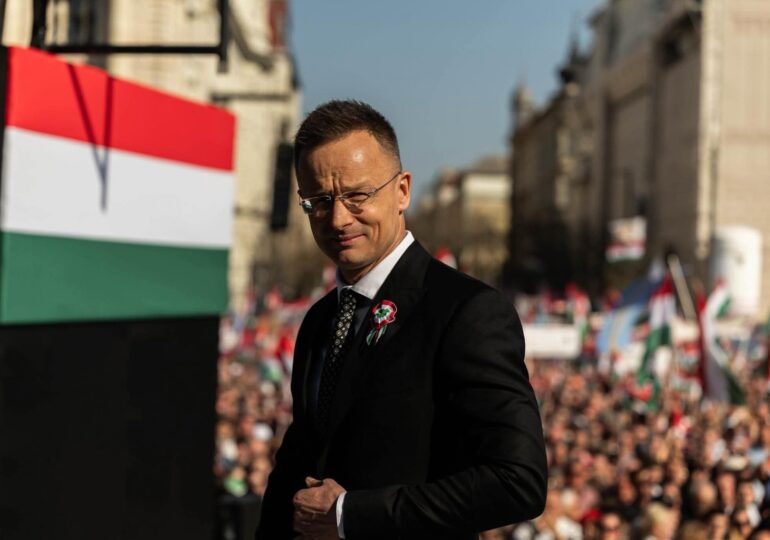
Hungarian Minister Péter Szijjártó has confirmed that he usually calls his Russian counterpart, Sergey Lavrov, during private EU meetings.
Szijjártó admitted that he constantly contacts Lavrov on foreign affairs issues, after the Budapest government initially dismissed these accusations as fake news, as reported by Euronews.
The Washington Post wrote over the weekend that Szijjártó is in contact with Lavrov during meetings in Brussels, communicating with him during breaks and informing him about the discussions taking place.
Szijjártó confirmed the phone discussions with Lavrov on Monday evening at a campaign event and argued that EU decisions on energy, the auto industry, and security directly impact Hungary's relations with partners outside the EU bloc.
Szijjártó says it's normal to call Moscow
"Yes, these issues need to be discussed with our partners outside the European Union. I don't just talk to the Russian Foreign Minister, but also to the American, Turkish, Israeli, Serbian, and others before and after European Council meetings," Szijjártó stated.
"What I say may sound harsh, but diplomacy means talking to the leaders of other countries," he added.
The Minister reiterated his position on Tuesday morning, posting a video on social media where he rejected accusations of violating any security protocols at Foreign Affairs Council meetings. He added that no classified information is discussed at the ministerial level.
"Every minister brings their phone into the room, except for me. The suggestion that there are security protocols falls into the category of nonsense," the Minister said.
The accusations are explosive as EU member states adhere to the principle of sincere cooperation, and the content of these meetings is considered confidential, as noted by the source.
On Monday, the European Commission requested Hungary to clarify the issue, labeling these revelations as "worrying."
Additionally, the European Union decided to limit the flow of confidential information to Hungary, and leaders are meeting in small groups – in a context where Polish Prime Minister Donald Tusk warned about long-standing suspicions that Viktor Orban's government could be sharing information with Russia.
Szijjarto denies, while Orban echoes
Initially, Szijjarto dismissed the accusations as "absurd conspiracy theories," stating that he was shocked that "one or more foreign intelligence services engaged in surveillance with the active cooperation of a Hungarian journalist," although the American newspaper did not mention any phone interception.
Hungarian Prime Minister Viktor Orban also reacted strongly on Monday, condemning the alleged interception of his minister's conversations. "Listening to the conversations of a government member is a serious attack against Hungary," Orban wrote on Facebook, adding that he asked the Hungarian Ministry of Justice to investigate the suspicions.
Donald Tusk is not surprised
Polish Prime Minister Donald Tusk responded to the revelations in The Washington Post, stating that "no one should be surprised." "I have suspected for a long time," he added. Tusk further mentioned on the X platform that this is one of the reasons why he speaks only when strictly necessary and says only what is strictly necessary.
The leader of the Hungarian opposition, Peter Magyar, emphasized that this could be a case of high treason, an accusation that could lead to a life sentence. "According to current information, Peter Szijjarto collaborates with the Russians and betrays Hungarian and European interests," he wrote on Facebook.
Hungary has a special relationship with Russia
These revelations come as political tensions escalate ahead of the parliamentary elections in Hungary. Prime Minister Viktor Orban's Fidesz party faces a tough challenge from the Opposition leader Péter Magyar's Tisza Party, leading in opinion polls.
Orban's government is among the few in Europe that maintains regular ties with the Kremlin. Additionally, Hungary continues to import large volumes of fossil fuels from Russia, despite EU pressures to reduce energy dependence on Moscow.
Szijjártó has visited Moscow 16 times since Russia launched a large-scale invasion of Ukraine in February 2022. His most recent trip was on March 4, when he met with Russian President Vladimir Putin at the Kremlin.
T.D.