
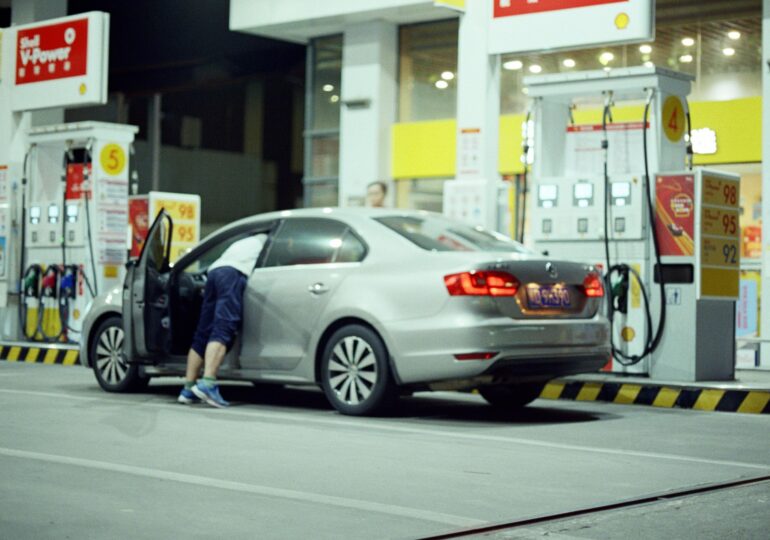
Fuel prices continue to rise rapidly in Romania, amid tensions in the Middle East. In less than 3 weeks, diesel has increased by more than 1 leu per liter.
Wednesday morning, March 18, at a Petrom station in Bucharest, regular gasoline was sold at 8.69 lei/l, while diesel reached 9.25 lei/l, after a new increase of 10 bani for gasoline and 15 bani for diesel, according to data analyzed by Economica.net and Capital.
Wave of consecutive price hikes
The increases come after a long series of almost daily hikes. In March alone, there have been around ten consecutive price hikes, following others from February, as shown by Economica.net.
Overall, since the beginning of the month, gasoline has increased by approximately 64 bani per liter, and diesel by over 1 leu/l, developments also confirmed by Profit.ro. In some premium OMV stations in the capital, diesel has even reached 9.39 lei/l, and gasoline 8.82 lei/l.
Impact of the war in the Middle East
Authorities and analysts attribute these increases to the international context, especially the conflict in the Middle East, which has significantly influenced oil markets.
"Prices have risen, that's very bad, but they have risen due to the international crisis," stated the President of the Competition Council, Bogdan Chirițoiu.
He emphasized that Romania is not an exception, and in some European countries, the price hikes have been even higher.
No evidence of agreements between companies
Despite the accelerated pace of increases, the Competition Council maintains that there is no evidence of anti-competitive practices in the local market.
"We have not identified agreements or coordinated behaviors among companies in Romania. We continuously monitor the market, and if there are any signs, we will intervene," stated Chirițoiu, as quoted by Capital.
The official explained that some companies operating in Romania have their own oil resources, which has allowed for a partial cushioning of the international shock.
However, authorities warn of another risk: significant price differences compared to other countries could lead to massive fuel exports and a shortage in the domestic market.
"The only risk of running out of products is if we have lower prices than neighboring countries," warned the head of the Competition Council.