
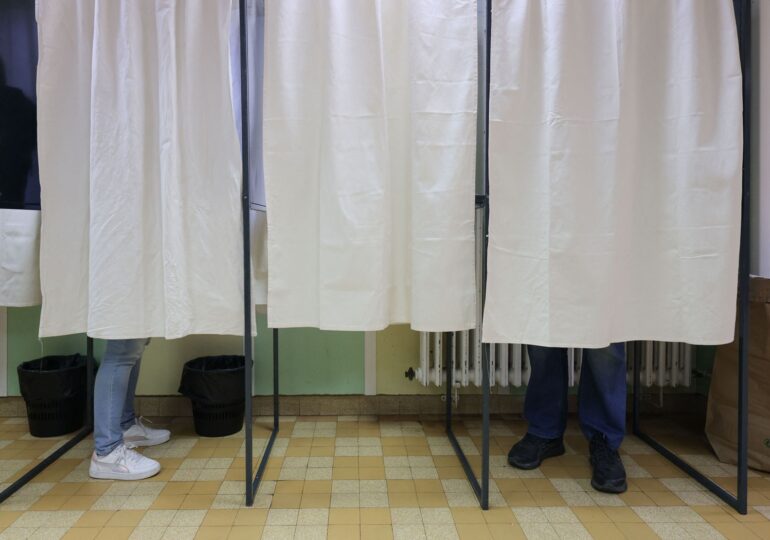
As the results of the first round of the municipal elections in France began to arrive on Sunday evening, RN, Marine Le Pen’s anti-immigration party, retained the largest city it administers: Perpignan. Louis Aliot was re-elected in the first round as mayor of the city, which has a population of 121,000 inhabitants and is located near the border with Spain.
RN (Rassemblement National) now hopes to conquer another city, for example, the coastal city in the south of the country, Toulon, which will enter the second round. But any success in Toulon will depend on whether other parties will unite to block RN, writes The Guardian.
Jean-Luc Mélenchon's radical left party, La France Insoumise (LFI), is also trying to strengthen its position locally before Mélenchon likely attempts his chances for the fourth time at the French presidency next year.
The party, which is trying to increase its number of local councilors, has obtained strong results in northern France, in Lille and Roubaix, where they will now advance to the second round. Manuel Bompard, the national coordinator of LFI, stated that the party is willing to create an "anti-fascist front" together with other left-wing parties to prevent RN from making electoral gains.
Low voter turnout
Following a record low voter turnout in the last local elections in 2020, during the coronavirus pandemic, analysts closely examined Sunday's electoral race to assess a possible disengagement of voters.
According to estimates from several polling institutes, the voter turnout rate was low - between 56% and 58.5%, compared to 63.55% in similar elections in 2014.
"With the exception of 2020, we have reached a historic low during the Fifth Republic (the political system valid since 1958)," said François Kraus from the polling institute IFOP for Agence France-Presse.
"Public apathy is on the rise," added Adélaïde Zulfikarpasic from the polling institute Ipsos BVA, stating that this "is not good news for French democracy."
Battle for Paris, Marseille, and Lyon enters second round
Historically, the major cities of France have been governed either by center-left formations, including socialists, or by Les Républicains (center-right). Green-led coalitions won significant cities in the last municipal elections in 2020, including Lyon, but are under pressure to maintain their influence.
In the northern port of Le Havre, Edouard Philippe, the former prime minister who intends to run for president from the center-right next year, obtained a strong score in the first round and will now advance to the second round. Philippe had suggested that if he does not win the city he has been leading since 2014, his candidacy for the presidential elections will be in question. In a speech on Sunday evening, Philippe said he is grateful and is there to "listen" to the voters "neighborhood by neighborhood."
Major cities such as Paris, Marseille, and Lyon will enter a decisive round of voting next Sunday.
Many mayoral candidates have distanced themselves from political parties, reflecting voters' exasperation with politics and the deadlock in parliament. A large number of mayors, especially from villages, ran as independents.
Crucial test for the 2027 presidential elections
The municipal elections in France are considered a crucial test of the political climate ahead of next year's presidential elections, although the vote for mayors and councilors in 35,000 villages, towns, and municipalities across France focuses on local issues, including security, housing, and waste collection, and is very different from national elections.
However, the two-round ballot, held on two consecutive Sundays - especially the vote in major cities - will be closely scrutinized to see what it can reveal about the strategies of parties and alliances in the increasingly fragmented political landscape of France, ahead of the 2027 presidential race.
Emmanuel Macron's two terms end next year, and there is uncertainty about who will run for the presidency of the second largest economy in the EU. Two years after Macron called for early elections in 2024, the parliament remains divided, without an absolute majority, split between the left, the far right, and centrists.