
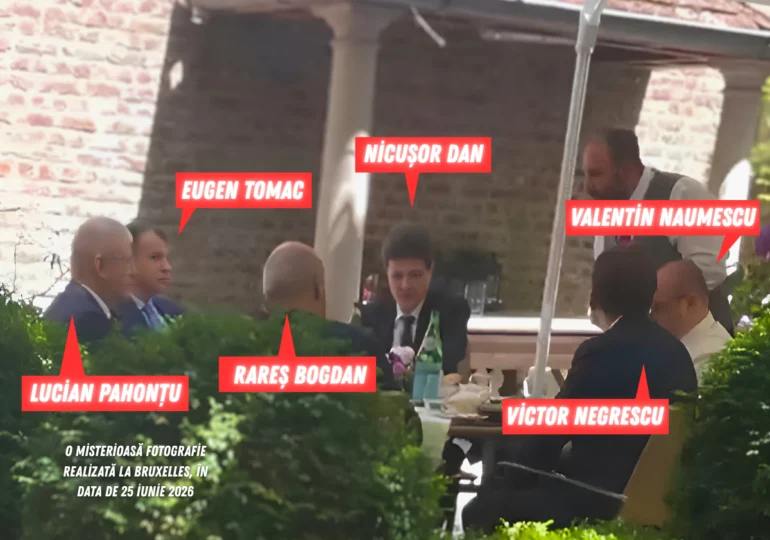
Let’s go back in time to June 25, 2026. At that time, TV station Digi 24 publishes a paparazzi-style photo, in contrast with the channel’s editorial policy up to that moment, where at a table in a restaurant in Brussels were Nicușor Dan, the President of Romania, General Lucian Pahonțu, the head of the SPP, Rareș Bogdan, a PNL member, Eugen Tomac, the President’s counselor, Victor Negrescu, a PSD member of the European Parliament, and Valentin Naumescu, a state counselor at the Cotroceni Palace.
The event takes place three days after the moment when Adrian Veștea (PNL), designated by the president for the position of prime minister against the will of the liberal leadership, is rejected by Parliament. A major defeat for Nicușor Dan.
The image went viral and sparked a wide debate among the public, coming in the context of the interest generated by the political tension surrounding the formation of a new government.
General Lucian Pahonțu, the head of the SPP for over 20 years, a security and protection service for dignitaries which, over time, through the information gathered about those he protects, has become an influential and informal secret service, did not fit at all in that particular image.
If the rest of the diners were politicians and presidential advisers, Pahonțu's place should have been in the president's security detail, not at the table with him.
In fact, the image represents the officer's biggest professional failure. The President was exposed. If he had done his job properly, that photo would not have existed. Its creation, in itself, represents a security breach in terms of protecting the head of state, precisely Pahonțu's main mission. If instead of a camera there was a weapon, and instead of the photographer there was an extremist or a terrorist, a tragedy could have occurred.
The most powerful general
That's the moment when General Pahonțu comes into the public eye and the attention of journalists, who, amid a deep crisis of intelligence services in Romania, discover that for the past 20 years, an officer with a dark past has been in charge of protecting dignitaries, involved in the bloody repression of the demonstrations on December 21, 1989.
The image also conveys the fact that the general has a significant political influence, actively participating in discussions about the crisis caused by the no-confidence motion.
It should also be noted that the respective image is a "surveillance" one, meaning it was taken by professionals in the field of intelligence for a secret service, either domestic or foreign.
Both General Pahonțu and President Nicușor Dan were being surveilled and protected by SPP employees. A security detail was deployed around them. Those who took the photograph bypassed this security detail without being noticed or were allowed to enter by someone from the inside to fulfill their "mission."
Whichever way that episode is viewed, it appears to be a confrontation in the secret and dark corners of power in Romania.
Normally, when the head of a security and protection service records such a failure, they should submit their resignation or discreetly be relieved of their duties by their superior, in this case, the President of Romania. But nothing happened.
A president in the quagmire
Now, following the revelation made by Recorder, through the publication of the article "The Hidden Biography of General Pahonțu", Nicușor Dan had, once again, the obligation, if he is a leader who respects democratic rules, to remove General Pahonțu, but he did not. Furthermore, he gratuitously defended him.
This represents a significant political and informational vulnerability for the presidential institution, one that endangers Romania's stability.
It is difficult to say whether, when he decided to run for president, Mayor Nicușor Dan knew what he was getting into. His actions and statements suggest otherwise.
Instead of resolving the intelligence agencies crisis, triggered by the strong blow dealt by Russia through its influence networks in Bucharest, which pushed Călin Georgescu to the gates of the Cotroceni Palace, Nicușor Dan got caught up in the whirlwind of confrontation, and now finds himself in a quagmire from which he doesn't know how to escape, while the mud pulls him down.
The lack of experience in party life, as well as a chronic distrust of people, displayed by Nicușor Dan, have turned him into a sure victim of power circles within Romania's intelligence system.
Thus, the president has failed to create an alliance to support him, becoming dependent on underground arrangements that have been easily thwarted by opposing factions.
Without solutions
Since December 1989, with the rise to power of Ion Iliescu, a politician manufactured by the Kremlin, Romania has been divided into two major fault lines: one liberal, Western, pro-NATO and pro-European, and the other nationalist, playing a double game, illiberal and strongly controlled by Moscow.
Those following post-December history can pinpoint the key moments when the two camps clash, who the characters are, and their affiliations with the Kremlin from 1990 until now.
Romania joined NATO and the European Union only because, after the collapse of the Soviet Union in August 1991, chaos reigned in Moscow for a decade and a half, and the Kremlin was weak. The two major camps in Romania joined forces to find a formula to ensure the country's security and integrity.
Once these objectives were somehow achieved, the struggle intensified once again, and with the consolidation of Vladimir Putin's power and the onset, starting in 2008, of the attack on European democracies, the battle between the two camps became increasingly fierce, culminating in the Kremlin's attempt to take political control of Romania in November 2024.
Although many hoped that the presidential elections in May 2025 would mark the beginning of healing after the strong blow dealt by Russia through its networks of reservists, extremists, active intelligence agents, and influencers, the situation worsened, with Romania in a continuous political crisis, surviving only through the support of major European powers.
There are no indications that Nicușor Dan is a traitor or a malicious person, but with each passing day, it becomes increasingly clear that he is overwhelmed by the grave situation Romania is facing and lacks solutions to the problems at hand.