
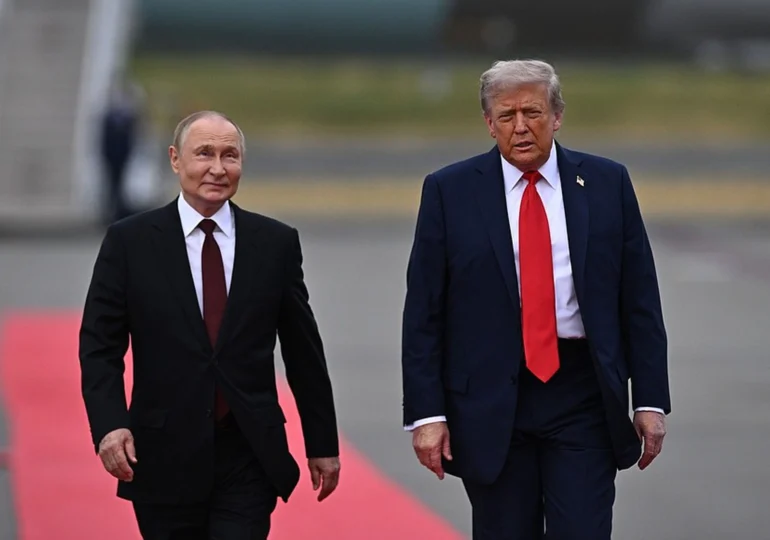
The United States and Russia are pressuring Europe to rethink the continent’s security system in an attempt to end the war in Ukraine. From bringing Moscow back to the negotiating table with NATO to concluding a new European security treaty, several scenarios are possible. However, the most likely one is precisely the one the Kremlin rejects: that nothing changes.
Vladimir Putin has long demanded a reorganization of Europe’s defense system, insisting that NATO withdraw its forces and that Russia have a strong say in decisions regarding the continent’s security. These demands predate the large-scale invasion of Ukraine.
Now, Donald Trump, eager to achieve a peace agreement, seems to be aligning with some of the Kremlin leader’s positions. “Security guarantees for Ukraine cannot be finalized separately from the post-war European security architecture. The two must be considered together,” wrote Jared Kushner, Trump’s envoy for peace negotiations, on Sunday.
Politico spoke with 12 current and former European officials, NATO experts, and diplomats to identify possible options for reorganizing the continent’s security.
From these discussions emerge three red lines for Europeans:
- No negotiation on Europe’s security without European participation;
- No unilateral decision regarding Ukraine’s accession to NATO;
- No new security agreement before the war ends.
“We have a security order in Europe; we have no need to change it,” said Norwegian Defense Minister Tore Sandvik.
Politico presents five scenarios and evaluates, on a scale from 1 to 5, the likelihood of their realization. Some of them could be implemented simultaneously.
1. An organization where Russia already has a seat at the table
The Organization for Security and Cooperation in Europe (OSCE), headquartered in Vienna, is one of the few European security structures that Russia is still part of. Romania, Ukraine, and the United States are also members. The organization already has mechanisms designed to reduce the risk of military confrontations. For example, the Vienna Document requires notification at least 42 days in advance of certain military activities involving a minimum of 9,000 soldiers.
In the event of a peace agreement, the OSCE could monitor compliance with the ceasefire in Ukraine, host negotiations on specific aspects of the agreement, and help reduce the risk of new confrontations, explains Ulrich Kühn, an arms control expert.
Over 40 countries, gathered this month in Dublin, have already expressed support for discussions on new mechanisms to reduce military risks in Europe, should a peace agreement be reached. The main disadvantage is that the OSCE has 57 participating states, and decisions are generally made by consensus, which can considerably hinder the organization’s activity.
However, OSCE leadership is open to taking on a larger role. “We must fully utilize this unique platform to maintain dialogue, restore transparency, reduce risks, and manage tensions,” said the organization’s Secretary General, Feridun Sinirlioğlu.
- Chances of realization: 3 out of 5.
2. Resuming official dialogue between NATO and Russia
An option supported by Jared Kushner is the reactivation of the NATO-Russia Council, a body established in 2002 for consultations, risk reduction, and cooperation in areas of common interest. In the past, this format allowed agreements on submarine crew rescue and counterterrorism.
It is important to note that through this council, Russia did not have veto power over NATO decisions or the defense policies of allied states.
The last meeting took place a month before the large-scale invasion of Ukraine. Since then, NATO Secretary General Mark Rutte has declared that this format is “dead.” The Alliance still maintains a communication line with the Chief of the Russian General Staff, Valery Gerasimov. However, it is rarely used, mainly because Russia refuses dialogue, according to NATO sources.
Even when discussions occur, they resemble more “parallel monologues,” says a NATO diplomat.
Reactivating the NATO-Russia Council after the war ends could help prevent escalation of conflicts. Diplomats warn, however, that such a decision must be carefully weighed because it risks legitimizing Moscow once again.
- Chances of realization: 2 out of 5.
3. A new security treaty for all of Europe
This is the most radical option and likely the one that would face the strongest opposition from Ukraine’s allies. A new treaty could complement or even replace current security structures.
There are arguments in favor of updating some agreements. Europe has changed considerably in recent years: Finland and Sweden have joined NATO, Ukraine aspires to become a member of the European Union, and artificial intelligence brings new military risks. The problem is how much decision-making power Russia would receive over the security of other European states.
“There is absolutely no basis for questioning existing alliances. We will not discuss such matters,” said German Foreign Minister Johann Wadephul.
Even more controversial is Moscow’s proposal to conclude separate agreements with each NATO member state in the form of non-aggression pacts. For the Alliance, this option is completely unacceptable, explains a NATO diplomat, because it would allow Russia to create divisions among allies.
A narrower option, advanced by the United States, is to grant security guarantees to Ukraine similar to those provided by Article 5 of the NATO Treaty, which enshrines the principle of collective defense.
However, Moscow also rejects this option, as stated by Russian Deputy Foreign Minister Sergey Ryabkov.
For his part, Ukrainian President Volodymyr Zelensky wants to know what exactly such guarantees would mean. “Which countries will support Ukraine if it is attacked again? What exactly will our partners do in response? What troops will be deployed in advance on our territory? How much will all this cost? And will it really work?” Zelensky asked on Monday at the NATO Parliamentary Assembly.
- Chances of realization: 1 out of 5.
4. A new relationship between the European Union and Russia
Before the illegal annexation of Crimea in 2014, the European Union and Russia had their own official cooperation mechanism. It allowed organizing ministerial meetings on security, justice, research, and economy and led to agreements on visa facilitation and border cooperation.
The format was frozen in 2014, but a similar mechanism could be created after the war.
The European Union has important levers in its relationship with Moscow, from economic sanctions and trade to visa policy and border management. Such a format would be acceptable to Europeans only if it complemented the current security system without modifying it, explains a European diplomat.
However, there is also the risk that normalizing economic relations would bring Europe back to energy dependence on Russia, which it has tried to exit since the invasion of Ukraine. Expert Ulrich Kühn warns that a rushed resumption of Russian gas imports would again make Europe vulnerable. The priority must be restoring trust and adopting security measures.
The European Commission also emphasizes that discussions on the future of the continent’s security can only take place after a ceasefire in Ukraine is achieved and with the participation of NATO allies and EU member states.
- Chances of realization: 2 out of 5.
5. Everything remains as it is
Despite pressures from Washington and Moscow, maintaining the current European security system is considered the most likely option. NATO and the European Union would remain the main pillars of Europe’s military and economic security, without Russia receiving a role in the decision-making processes of the two organizations.
Sven Biscop, director of the Europe program at the Egmont Institute, believes that Russia will remain, geopolitically, a neighbor of Europe, not a partner with whom it makes joint decisions about its own security. “It is not a good scenario (...) it will be very unstable,” says the expert, who nonetheless considers this a very probable outcome given Russia’s unrealistic demands.
A NATO diplomat puts the issue even more bluntly, recalling that Russia has ignored peace agreements made in the last 30 years. “If you want to rebuild a dialogue, both parties must agree on its terms, not just one. Otherwise, you’re talking to yourself.”
- Chances of realization: 4 out of 5.
G.P.