
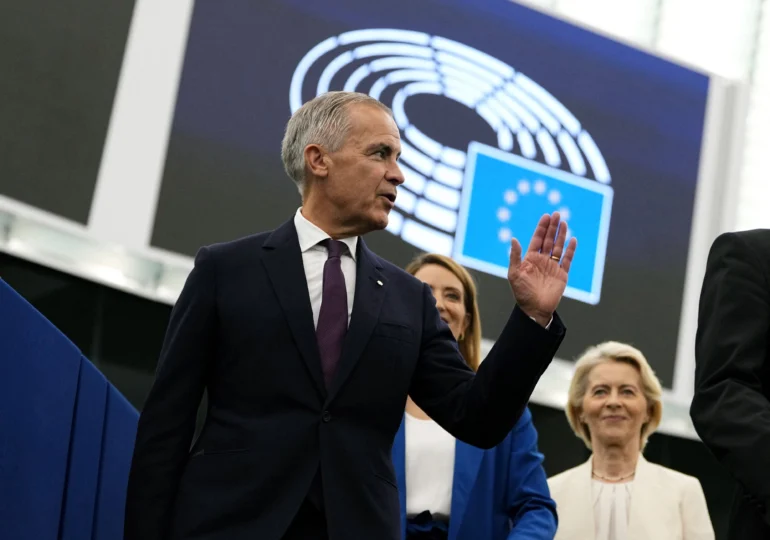
Ursula von der Leyen’s proposal to grant „associate member” status to Canada has surprised European capitals and caused confusion in Brussels. The idea had not been previously discussed with the member states, and currently, no one knows exactly what this status would entail.
The President of the European Commission launched the proposal on Wednesday in her State of the Union address, directly addressing Canadian Prime Minister Mark Carney, who was present in the European Parliament. „I would like to work with you to pave the way for Canada to become the first associate member of the EU,” von der Leyen said. The announcement was met with applause from Members of the European Parliament, and Carney embraced the Commission chief.
However, behind the carefully orchestrated moment, numerous questions have arisen. Four European diplomats told Politico that their governments had not been informed about the initiative.
Canada also does not seem ready to unreservedly adopt the formula proposed by von der Leyen. "We have not reached that point yet," said Jonathan Wilkinson, the future Canadian ambassador to the EU, when asked about the possibility of such a status. "We are actually focused on getting results," he added.
Thus, the Commission chief publicly proposed a status that does not currently exist in the EU structure, has no legal definition, and has not been approved by the member states.
European capitals were not informed
The idea of closer ties between Canada and the European Union is not new. Ottawa seeks to reduce its dependence on the United States, the destination for approximately 70% of Canadian exports, amid tariffs imposed by the Trump administration and threats by the American president to turn Canada into the "51st state".
Mark Carney recently stated that his country is not seeking EU membership but rather to build a "unique alliance" with the European bloc.
However, the formula chosen by von der Leyen took European capitals by surprise. One diplomat described the preparation of the announcement as "dangerous" and "unwise" and noted that the idea had not even been discussed at a recent meeting between the Commission chief and EU ambassadors.
Another diplomat stated that the advance version of the speech sent to his government did not include the expression "associate member".
"No one really knows what it means," said another European diplomat involved in discussions with Ottawa.
Von der Leyen was not required to present the content of the speech to the governments before delivering it. However, any agreement that would offer Canada a special status would require the approval of the member states.
The proposal also raised the question of whether the United Kingdom could request a similar arrangement. European officials, however, maintain that the formula would be intended for countries that, for geographical reasons, cannot join the EU.
A status that does not exist in EU treaties
The European treaties make a clear distinction between member states and partner countries. The EU has close relations with numerous states outside the bloc, but only the 27 members participate in the central political institutions and in the adoption of European legislation.
Creating a new form of membership would require amending the treaties, said René Repasi, a German MEP from the Socialists and Democrats group.
Confusion also exists within the Commission. A European official working in the enlargement field stated that his team had not been involved in any discussions about the proposal and knew nothing about it.
Nicola Procaccini, co-chair of the ECR conservative group, said that "nobody was aware" of this special status and that it is not clear what it would entail. In his opinion, if such a formula is created, the UK should be the first to benefit from it.
Several MEPs and European officials believe that at this stage, the announcement could be more of a political statement in which von der Leyen is trying to present the expansion of cooperation between the EU and Canada as a unified project.
After the meeting with Mark Carney, the office of European Parliament President Roberta Metsola stated that the discussions focused on areas with potential for closer cooperation, such as essential raw materials and defense. However, the statement did not mention the "associate member" status.
Canada tempers its expectations
The Canadian government welcomed Brussels' intention to deepen bilateral relations and expressed its desire to move from the current commercial relationship to a "much stronger and more ambitious alliance."
However, Ottawa avoided discussing a form of membership. Carney himself supported the idea of a "unique" partnership with Brussels without using the "associate member" term.
A possible model could be the EU's relationship with Norway, Iceland, and Liechtenstein, states that participate in the single market through the European Economic Area but do not vote on EU legislation. Switzerland, in turn, has access to parts of the single market through a series of bilateral agreements.
According to a European official, the future arrangement with Ottawa could create a new category of partners with extended cooperation in trade, defense, artificial intelligence, energy, research, and advanced technologies. However, Canada would not receive political rights or automatic access to free movement.
If the model is established, it could later be offered to countries such as Australia, New Zealand, Japan, or Singapore.
Obstacles ahead of a new agreement
It remains unclear how the new status would differ concretely from the partnerships that the EU already has with its allies. Ten member states have not even ratified the EU-Canada Comprehensive Economic and Trade Agreement (CETA) signed nearly a decade ago and applied largely on a provisional basis. A more ambitious agreement would require political support from all European governments.
Germany cautiously received the proposal. The spokesperson for the Berlin government, Stefan Kornelius, stated that his country is open to discussions on new partnership models with Canada.
Regarding the designation of "associate member," the German official added, "I think we should think more carefully about this aspect."
G.P.