

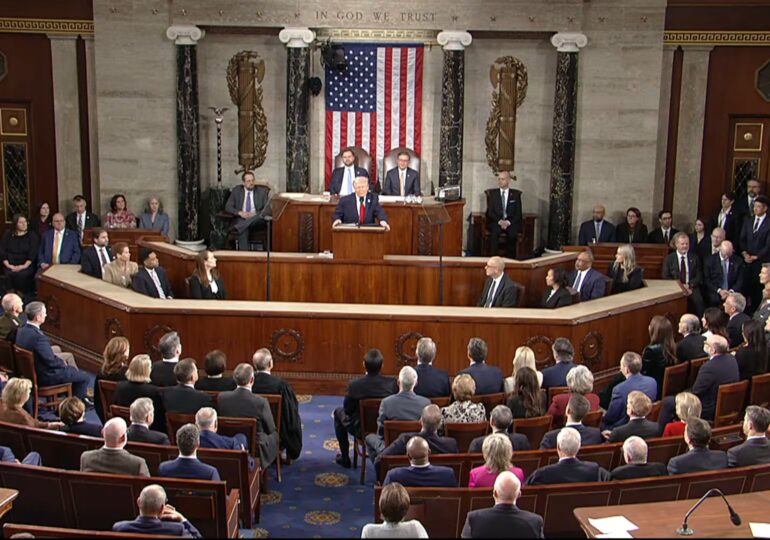
The State of the Nation address delivered by Donald Trump was, formally, a presidential assessment. In reality, it resembled more of a large-scale national rally, at a time when the White House is facing fragile popularity and the prospect of decisive legislative elections.
BBC notes that the intervention was „a patriotic appeal” to supporters, while Politico interprets it as the explicit beginning of the struggle for control of Congress. The central message – „Our country is winning again” – was more of an electoral plea than an invitation to national reconciliation.
"Our nation is back"
Trump began his intervention in a familiar tone: declarative optimism and political self-validation.
"Our nation is back," he said, adding that the United States is "the hottest country in the world." Later, in a passage that encapsulated the entire intervention, he stated: "Our country is winning again."
BBC points out that these statements were not accompanied by a change in tone or direction, although only about four in ten Americans say in polls that they approve of the way Trump is carrying out his mandate. Instead of addressing concerns about the cost of living, Trump reiterated that "we are doing very well," attributing economic difficulties to previous Democratic administrations.
The speech was not calibrated to convince skeptics, but to reaffirm the beliefs of supporters.
Less novelty, more reaffirmation
Politico highlights an essential detail: although the speech was one of the longest in history, it brought few concrete initiatives or changes in direction.
The President mentioned already familiar ideas – retirement savings accounts for the working class, direct payments to help cover health insurance premiums, the requirement to prove citizenship for voting, and the prohibition of granting commercial permits to migrants without documents.
Essentially, it was a moment of doctrinal reaffirmation. Politico notes that Trump "avoided self-harm," but missed the opportunity to address undecided or moderate voters, at a time when he could have tried to broaden his electoral base.
Protectionism, the red line
On the economic front, the speech reinforced the White House's protectionist stance. Trump promised not to give up tariffs, even after the Supreme Court decision that invalidated some of them.
"We will continue to defend American workers through strong tariffs. We will not back down," he said.
For BBC, this passage shows that the President did not intend to send compromise signals. Politico interprets the reactions in the room – including visible silences among some Republicans – as an indication of the tension between protectionist rhetoric and potential economic costs.
Three of the Supreme Court judges who voted against the tariffs were present in the front row, without showing any visible reaction.
Immigration, the mobilization test
If the economy produced mixed reactions, immigration was the theme that electrified the room. "The only thing standing between Americans and a completely open border is President Donald J Trump and our great Republican patriots in Congress," he declared.
BBC notes that passages about "illegal immigrants" generated some of the strongest applause from Republicans and hostile reactions from Democrats.
When Trump asked those in the room to stand up if they support protecting American citizens, the speech turned into a public delineation exercise. Those who remained seated were rebuked: "You should be ashamed."
It was a moment when the differences between the two camps were bluntly exposed.
Patriotism as a tool
The speech was interspersed with carefully constructed ceremonial moments: the US men's hockey team and its gold medals, a 100-year-old veteran from World War II, a decorated Coast Guard rescuer for his interventions.
BBC observes that these sequences energized a long speech and reinforced the theme of patriotism and American achievements. Politico suggests that they provided powerful visuals for television and emotionally strengthened the political message.
In a speech where political confrontation was constant, the symbols acted as an identity bond for the electoral base.
A campaign speech
Both BBC and Politico suggest that Trump's intervention was calibrated for an already convinced audience. It was not an attempt to build bridges but to clarify the fronts.
In a visibly divided room between enthusiastic applause and ostentatious silences, the image conveyed was that of a polarized America – a polarization that the speech sought to exploit.
In just over eight months, Americans will decide the composition of both chambers of Congress. For Trump, the stakes are the control of the legislative agenda.
His State of the Nation speech was not just an assessment. It was a gamble: that mobilizing the hardcore base and reaffirming identity themes can be enough to turn a presidential assessment speech into an electoral advantage.